Ranjan Kr. Giri , Sunil H. Chaki , Ankurkumar J. Khimani , Milind P. Deshpande
{"title":"从形态学、结构和光响应的角度探索浸涂CuInS2薄膜的光电电位","authors":"Ranjan Kr. Giri , Sunil H. Chaki , Ankurkumar J. Khimani , Milind P. Deshpande","doi":"10.1016/j.surfin.2025.106098","DOIUrl":null,"url":null,"abstract":"<div><div>In this present study, the dip coating technique is adopted to deposit copper indium disulfide (CuInS<sub>2</sub>) thin films onto a glass substrate. The scanning electron microscopy (SEM) shows that the film thickness is (1.18 ± 0.06) µm. The transmission electron microscopy (TEM) confirms the crystalline character of the CIS (CuInS<sub>2</sub>) thin films having fringe spacing consistent with the CIS major crystallographic (112) plane lattice spacing. The atomic force microscopy (AFM) reveals the presence of surface roughness-related hills and valleys. The X-ray diffraction (XRD) data show that the film has a tetragonal unit cell structure and is in the CIS phase. The elemental stoichiometry is validated by energy-dispersive X-ray spectroscopy (EDS) analysis. From the results of the ultraviolet-visible-near infrared spectroscopy (UV–Vis–NIR), an optical bandgap (direct) of 1.62 eV is found. Three different monochromatic incident photon wavelengths (480 nm, 560 nm, and 670 nm) are used to investigate the photoresponse of the CIS photodetector. When exposed to 670 nm (red) light with 5 mW·cm<sup>-2</sup> intensity and 100 mV bias voltage, the peak responsivity and detectivity for CIS thin films are determined to be 2.14 mA·W<sup>-1</sup> and 1.54 × 10<sup>9</sup> Jones, respectively. It validates that the dip-coated CIS thin film has the potential for usage in optoelectronic devices <span><span>1</span></span>,<span><span>2</span></span>.</div></div>","PeriodicalId":22081,"journal":{"name":"Surfaces and Interfaces","volume":"61 ","pages":"Article 106098"},"PeriodicalIF":6.3000,"publicationDate":"2025-03-15","publicationTypes":"Journal Article","fieldsOfStudy":null,"isOpenAccess":false,"openAccessPdf":"","citationCount":"0","resultStr":"{\"title\":\"Exploring the optoelectronic potential of dip coated CuInS2 thin films via morphological, structural, and photoresponse insights\",\"authors\":\"Ranjan Kr. Giri , Sunil H. Chaki , Ankurkumar J. Khimani , Milind P. Deshpande\",\"doi\":\"10.1016/j.surfin.2025.106098\",\"DOIUrl\":null,\"url\":null,\"abstract\":\"<div><div>In this present study, the dip coating technique is adopted to deposit copper indium disulfide (CuInS<sub>2</sub>) thin films onto a glass substrate. The scanning electron microscopy (SEM) shows that the film thickness is (1.18 ± 0.06) µm. The transmission electron microscopy (TEM) confirms the crystalline character of the CIS (CuInS<sub>2</sub>) thin films having fringe spacing consistent with the CIS major crystallographic (112) plane lattice spacing. The atomic force microscopy (AFM) reveals the presence of surface roughness-related hills and valleys. The X-ray diffraction (XRD) data show that the film has a tetragonal unit cell structure and is in the CIS phase. The elemental stoichiometry is validated by energy-dispersive X-ray spectroscopy (EDS) analysis. From the results of the ultraviolet-visible-near infrared spectroscopy (UV–Vis–NIR), an optical bandgap (direct) of 1.62 eV is found. Three different monochromatic incident photon wavelengths (480 nm, 560 nm, and 670 nm) are used to investigate the photoresponse of the CIS photodetector. When exposed to 670 nm (red) light with 5 mW·cm<sup>-2</sup> intensity and 100 mV bias voltage, the peak responsivity and detectivity for CIS thin films are determined to be 2.14 mA·W<sup>-1</sup> and 1.54 × 10<sup>9</sup> Jones, respectively. It validates that the dip-coated CIS thin film has the potential for usage in optoelectronic devices <span><span>1</span></span>,<span><span>2</span></span>.</div></div>\",\"PeriodicalId\":22081,\"journal\":{\"name\":\"Surfaces and Interfaces\",\"volume\":\"61 \",\"pages\":\"Article 106098\"},\"PeriodicalIF\":6.3000,\"publicationDate\":\"2025-03-15\",\"publicationTypes\":\"Journal Article\",\"fieldsOfStudy\":null,\"isOpenAccess\":false,\"openAccessPdf\":\"\",\"citationCount\":\"0\",\"resultStr\":null,\"platform\":\"Semanticscholar\",\"paperid\":null,\"PeriodicalName\":\"Surfaces and Interfaces\",\"FirstCategoryId\":\"88\",\"ListUrlMain\":\"https://www.sciencedirect.com/science/article/pii/S246802302500358X\",\"RegionNum\":2,\"RegionCategory\":\"材料科学\",\"ArticlePicture\":[],\"TitleCN\":null,\"AbstractTextCN\":null,\"PMCID\":null,\"EPubDate\":\"2025/2/28 0:00:00\",\"PubModel\":\"Epub\",\"JCR\":\"Q2\",\"JCRName\":\"CHEMISTRY, PHYSICAL\",\"Score\":null,\"Total\":0}","platform":"Semanticscholar","paperid":null,"PeriodicalName":"Surfaces and Interfaces","FirstCategoryId":"88","ListUrlMain":"https://www.sciencedirect.com/science/article/pii/S246802302500358X","RegionNum":2,"RegionCategory":"材料科学","ArticlePicture":[],"TitleCN":null,"AbstractTextCN":null,"PMCID":null,"EPubDate":"2025/2/28 0:00:00","PubModel":"Epub","JCR":"Q2","JCRName":"CHEMISTRY, PHYSICAL","Score":null,"Total":0}
Exploring the optoelectronic potential of dip coated CuInS2 thin films via morphological, structural, and photoresponse insights
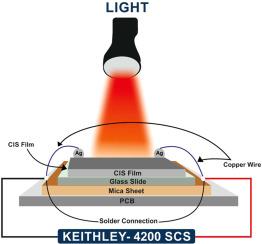
In this present study, the dip coating technique is adopted to deposit copper indium disulfide (CuInS2) thin films onto a glass substrate. The scanning electron microscopy (SEM) shows that the film thickness is (1.18 ± 0.06) µm. The transmission electron microscopy (TEM) confirms the crystalline character of the CIS (CuInS2) thin films having fringe spacing consistent with the CIS major crystallographic (112) plane lattice spacing. The atomic force microscopy (AFM) reveals the presence of surface roughness-related hills and valleys. The X-ray diffraction (XRD) data show that the film has a tetragonal unit cell structure and is in the CIS phase. The elemental stoichiometry is validated by energy-dispersive X-ray spectroscopy (EDS) analysis. From the results of the ultraviolet-visible-near infrared spectroscopy (UV–Vis–NIR), an optical bandgap (direct) of 1.62 eV is found. Three different monochromatic incident photon wavelengths (480 nm, 560 nm, and 670 nm) are used to investigate the photoresponse of the CIS photodetector. When exposed to 670 nm (red) light with 5 mW·cm-2 intensity and 100 mV bias voltage, the peak responsivity and detectivity for CIS thin films are determined to be 2.14 mA·W-1 and 1.54 × 10⁹ Jones, respectively. It validates that the dip-coated CIS thin film has the potential for usage in optoelectronic devices 1,2.
期刊介绍:
The aim of the journal is to provide a respectful outlet for ''sound science'' papers in all research areas on surfaces and interfaces. We define sound science papers as papers that describe new and well-executed research, but that do not necessarily provide brand new insights or are merely a description of research results.
Surfaces and Interfaces publishes research papers in all fields of surface science which may not always find the right home on first submission to our Elsevier sister journals (Applied Surface, Surface and Coatings Technology, Thin Solid Films)




 京公网安备 11010802042870号
京ICP备2023020795号-1
京公网安备 11010802042870号
京ICP备2023020795号-1

 分享
分享
 求助内容:
求助内容: 应助结果提醒方式:
 扫码关注我们
