Niels A D Guchelaar, Ron H J Mathijssen, Maaike de Boer, Marlies L van Bekkum, Joan B Heijns, Birgit E P J Vriens, Mandy M van Rosmalen, Lonneke W Kessels, Lisanne Hamming, Karin J Beelen, Peter Nieboer, Susan M van den Berg, Esther Oomen-de Hoop, Rhodé M Bijlsma, Monique E M M Bos
{"title":"Trifluridine-tipiracil治疗雌激素受体阳性、her2阴性转移性乳腺癌(BOOG 2019-01 TIBET试验):单组、多中心、2期试验","authors":"Niels A D Guchelaar, Ron H J Mathijssen, Maaike de Boer, Marlies L van Bekkum, Joan B Heijns, Birgit E P J Vriens, Mandy M van Rosmalen, Lonneke W Kessels, Lisanne Hamming, Karin J Beelen, Peter Nieboer, Susan M van den Berg, Esther Oomen-de Hoop, Rhodé M Bijlsma, Monique E M M Bos","doi":"10.1016/j.eclinm.2024.103065","DOIUrl":null,"url":null,"abstract":"<p><strong>Background: </strong>Effective later-line chemotherapy treatment options are scarce for patients with metastatic breast cancer (MBC). Trifluridine-tipiracil has shown survival benefit in heavily pre-treated patients with metastatic colorectal and in gastric cancer refractory to a fluoropyrimidine. This study aimed to investigate the efficacy of trifluridine-tipiracil in a Western population of previously treated patients with oestrogen receptor (ER+), HER2- MBC to facilitate further optimization of this treatment strategy.</p><p><strong>Methods: </strong>Adult patients at least 18 years old diagnosed with hormone receptor positive, HER2- receptor negative MBC with a performance status of 0 or 1 who have been treated with capecitabine in the metastatic setting and up to two other lines of chemotherapy, including a taxane, were enrolled in this single-arm, multicentre, phase 2 study in the Netherlands. The participants received trifluridine-tipiracil 35 mg/m<sup>2</sup> orally twice a day on days 1-5 and days 8-12 during a 28-day cycle until disease progression, unacceptable toxicity, or withdrawal of consent. The primary endpoint was the disease control rate (DCR) at 8 weeks, defined as the percentage of patients that had stable disease, partial response or complete response according to RECIST 1.1, in all patients that received at least one dose of trifluridine-tipiracil and met the key eligibility criteria defined <i>a priori</i>. Secondary endpoints included progression-free survival (PFS), overall survival (OS), safety, and quality of life and were performed in all patients that received at least one dose of trifluridine-tipiracil. The primary endpoint was considered met, justifying further research of this treatment regimen, if the lower boundary of the 80% confidence interval (CI) exceeded 30%. The study was registered within ClinicalTrials.gov (NCT04489173) and is closed for inclusion.</p><p><strong>Findings: </strong>Fifty female patients were enrolled from September 2020 to July 2023, with a median of 3 (IQR, 2-3) previous endocrine therapy lines and 2 (IQR, 2-3) chemotherapy lines for MBC. The DCR rate at 8 weeks was 64.0% (<i>n</i> = 32, 95% CI: 50.1-75.9%; 80% CI: 55.0-72.1%), thereby meeting the primary endpoint of this study. At data cutoff (January 8, 2024), the median follow-up time was 18.2 months (IQR, 13.1-25.1 months). The median PFS was 5.4 months (95% CI: 2.0-7.2 months) and the median OS 14.0 months (95% CI: 8.8-17.8 months). The safety profile of trifluridine-tipiracil aligned with expected toxicities and included leukopenia (n = 36, 69%), neutropenia (n = 43, 83%), and fatigue (n = 43, 83%). The most common grade 3-4 AEs were primarily haematological disorders and included neutropenia (n = 38, 73%), leukopenia (n = 15, 29%) and anaemia (n = 6, 12%). The most common SAEs (any grade) with a possible relationship with trifluridine-tipiracil included anaemia (n = 2) and vomiting (n = 2). No treatment-related deaths occurred. Quality of life scores remained stable throughout the treatment.</p><p><strong>Interpretation: </strong>Trifluridine-tipiracil demonstrated promising efficacy in heavily pre-treated patients with MBC, despite prior exposure to a fluoropyrimidine. Clinically, this suggests that trifluridine-tipiracil holds potential as a viable oral later-line treatment option with a manageable toxicity profile while maintaining quality of life. Preparations for a phase 3 trial are underway.</p><p><strong>Funding: </strong>Servier, France.</p>","PeriodicalId":11393,"journal":{"name":"EClinicalMedicine","volume":"80 ","pages":"103065"},"PeriodicalIF":10.0000,"publicationDate":"2025-01-27","publicationTypes":"Journal Article","fieldsOfStudy":null,"isOpenAccess":false,"openAccessPdf":"https://www.ncbi.nlm.nih.gov/pmc/articles/PMC11867194/pdf/","citationCount":"0","resultStr":"{\"title\":\"Trifluridine-tipiracil in previously treated patients with oestrogen receptor-positive, HER2-negative metastatic breast cancer (BOOG 2019-01 TIBET trial): a single-arm, multicentre, phase 2 trial.\",\"authors\":\"Niels A D Guchelaar, Ron H J Mathijssen, Maaike de Boer, Marlies L van Bekkum, Joan B Heijns, Birgit E P J Vriens, Mandy M van Rosmalen, Lonneke W Kessels, Lisanne Hamming, Karin J Beelen, Peter Nieboer, Susan M van den Berg, Esther Oomen-de Hoop, Rhodé M Bijlsma, Monique E M M Bos\",\"doi\":\"10.1016/j.eclinm.2024.103065\",\"DOIUrl\":null,\"url\":null,\"abstract\":\"<p><strong>Background: </strong>Effective later-line chemotherapy treatment options are scarce for patients with metastatic breast cancer (MBC). Trifluridine-tipiracil has shown survival benefit in heavily pre-treated patients with metastatic colorectal and in gastric cancer refractory to a fluoropyrimidine. This study aimed to investigate the efficacy of trifluridine-tipiracil in a Western population of previously treated patients with oestrogen receptor (ER+), HER2- MBC to facilitate further optimization of this treatment strategy.</p><p><strong>Methods: </strong>Adult patients at least 18 years old diagnosed with hormone receptor positive, HER2- receptor negative MBC with a performance status of 0 or 1 who have been treated with capecitabine in the metastatic setting and up to two other lines of chemotherapy, including a taxane, were enrolled in this single-arm, multicentre, phase 2 study in the Netherlands. The participants received trifluridine-tipiracil 35 mg/m<sup>2</sup> orally twice a day on days 1-5 and days 8-12 during a 28-day cycle until disease progression, unacceptable toxicity, or withdrawal of consent. The primary endpoint was the disease control rate (DCR) at 8 weeks, defined as the percentage of patients that had stable disease, partial response or complete response according to RECIST 1.1, in all patients that received at least one dose of trifluridine-tipiracil and met the key eligibility criteria defined <i>a priori</i>. Secondary endpoints included progression-free survival (PFS), overall survival (OS), safety, and quality of life and were performed in all patients that received at least one dose of trifluridine-tipiracil. The primary endpoint was considered met, justifying further research of this treatment regimen, if the lower boundary of the 80% confidence interval (CI) exceeded 30%. The study was registered within ClinicalTrials.gov (NCT04489173) and is closed for inclusion.</p><p><strong>Findings: </strong>Fifty female patients were enrolled from September 2020 to July 2023, with a median of 3 (IQR, 2-3) previous endocrine therapy lines and 2 (IQR, 2-3) chemotherapy lines for MBC. The DCR rate at 8 weeks was 64.0% (<i>n</i> = 32, 95% CI: 50.1-75.9%; 80% CI: 55.0-72.1%), thereby meeting the primary endpoint of this study. At data cutoff (January 8, 2024), the median follow-up time was 18.2 months (IQR, 13.1-25.1 months). The median PFS was 5.4 months (95% CI: 2.0-7.2 months) and the median OS 14.0 months (95% CI: 8.8-17.8 months). The safety profile of trifluridine-tipiracil aligned with expected toxicities and included leukopenia (n = 36, 69%), neutropenia (n = 43, 83%), and fatigue (n = 43, 83%). The most common grade 3-4 AEs were primarily haematological disorders and included neutropenia (n = 38, 73%), leukopenia (n = 15, 29%) and anaemia (n = 6, 12%). The most common SAEs (any grade) with a possible relationship with trifluridine-tipiracil included anaemia (n = 2) and vomiting (n = 2). No treatment-related deaths occurred. Quality of life scores remained stable throughout the treatment.</p><p><strong>Interpretation: </strong>Trifluridine-tipiracil demonstrated promising efficacy in heavily pre-treated patients with MBC, despite prior exposure to a fluoropyrimidine. Clinically, this suggests that trifluridine-tipiracil holds potential as a viable oral later-line treatment option with a manageable toxicity profile while maintaining quality of life. Preparations for a phase 3 trial are underway.</p><p><strong>Funding: </strong>Servier, France.</p>\",\"PeriodicalId\":11393,\"journal\":{\"name\":\"EClinicalMedicine\",\"volume\":\"80 \",\"pages\":\"103065\"},\"PeriodicalIF\":10.0000,\"publicationDate\":\"2025-01-27\",\"publicationTypes\":\"Journal Article\",\"fieldsOfStudy\":null,\"isOpenAccess\":false,\"openAccessPdf\":\"https://www.ncbi.nlm.nih.gov/pmc/articles/PMC11867194/pdf/\",\"citationCount\":\"0\",\"resultStr\":null,\"platform\":\"Semanticscholar\",\"paperid\":null,\"PeriodicalName\":\"EClinicalMedicine\",\"FirstCategoryId\":\"3\",\"ListUrlMain\":\"https://doi.org/10.1016/j.eclinm.2024.103065\",\"RegionNum\":1,\"RegionCategory\":\"医学\",\"ArticlePicture\":[],\"TitleCN\":null,\"AbstractTextCN\":null,\"PMCID\":null,\"EPubDate\":\"2025/2/1 0:00:00\",\"PubModel\":\"eCollection\",\"JCR\":\"Q1\",\"JCRName\":\"MEDICINE, GENERAL & INTERNAL\",\"Score\":null,\"Total\":0}","platform":"Semanticscholar","paperid":null,"PeriodicalName":"EClinicalMedicine","FirstCategoryId":"3","ListUrlMain":"https://doi.org/10.1016/j.eclinm.2024.103065","RegionNum":1,"RegionCategory":"医学","ArticlePicture":[],"TitleCN":null,"AbstractTextCN":null,"PMCID":null,"EPubDate":"2025/2/1 0:00:00","PubModel":"eCollection","JCR":"Q1","JCRName":"MEDICINE, GENERAL & INTERNAL","Score":null,"Total":0}
Trifluridine-tipiracil in previously treated patients with oestrogen receptor-positive, HER2-negative metastatic breast cancer (BOOG 2019-01 TIBET trial): a single-arm, multicentre, phase 2 trial.
Background: Effective later-line chemotherapy treatment options are scarce for patients with metastatic breast cancer (MBC). Trifluridine-tipiracil has shown survival benefit in heavily pre-treated patients with metastatic colorectal and in gastric cancer refractory to a fluoropyrimidine. This study aimed to investigate the efficacy of trifluridine-tipiracil in a Western population of previously treated patients with oestrogen receptor (ER+), HER2- MBC to facilitate further optimization of this treatment strategy.
Methods: Adult patients at least 18 years old diagnosed with hormone receptor positive, HER2- receptor negative MBC with a performance status of 0 or 1 who have been treated with capecitabine in the metastatic setting and up to two other lines of chemotherapy, including a taxane, were enrolled in this single-arm, multicentre, phase 2 study in the Netherlands. The participants received trifluridine-tipiracil 35 mg/m2 orally twice a day on days 1-5 and days 8-12 during a 28-day cycle until disease progression, unacceptable toxicity, or withdrawal of consent. The primary endpoint was the disease control rate (DCR) at 8 weeks, defined as the percentage of patients that had stable disease, partial response or complete response according to RECIST 1.1, in all patients that received at least one dose of trifluridine-tipiracil and met the key eligibility criteria defined a priori. Secondary endpoints included progression-free survival (PFS), overall survival (OS), safety, and quality of life and were performed in all patients that received at least one dose of trifluridine-tipiracil. The primary endpoint was considered met, justifying further research of this treatment regimen, if the lower boundary of the 80% confidence interval (CI) exceeded 30%. The study was registered within ClinicalTrials.gov (NCT04489173) and is closed for inclusion.
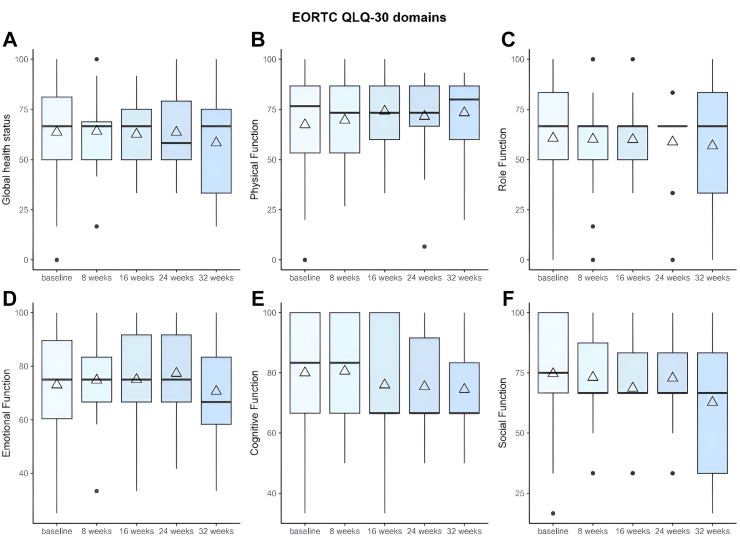
Findings: Fifty female patients were enrolled from September 2020 to July 2023, with a median of 3 (IQR, 2-3) previous endocrine therapy lines and 2 (IQR, 2-3) chemotherapy lines for MBC. The DCR rate at 8 weeks was 64.0% (n = 32, 95% CI: 50.1-75.9%; 80% CI: 55.0-72.1%), thereby meeting the primary endpoint of this study. At data cutoff (January 8, 2024), the median follow-up time was 18.2 months (IQR, 13.1-25.1 months). The median PFS was 5.4 months (95% CI: 2.0-7.2 months) and the median OS 14.0 months (95% CI: 8.8-17.8 months). The safety profile of trifluridine-tipiracil aligned with expected toxicities and included leukopenia (n = 36, 69%), neutropenia (n = 43, 83%), and fatigue (n = 43, 83%). The most common grade 3-4 AEs were primarily haematological disorders and included neutropenia (n = 38, 73%), leukopenia (n = 15, 29%) and anaemia (n = 6, 12%). The most common SAEs (any grade) with a possible relationship with trifluridine-tipiracil included anaemia (n = 2) and vomiting (n = 2). No treatment-related deaths occurred. Quality of life scores remained stable throughout the treatment.
Interpretation: Trifluridine-tipiracil demonstrated promising efficacy in heavily pre-treated patients with MBC, despite prior exposure to a fluoropyrimidine. Clinically, this suggests that trifluridine-tipiracil holds potential as a viable oral later-line treatment option with a manageable toxicity profile while maintaining quality of life. Preparations for a phase 3 trial are underway.
期刊介绍:
eClinicalMedicine is a gold open-access clinical journal designed to support frontline health professionals in addressing the complex and rapid health transitions affecting societies globally. The journal aims to assist practitioners in overcoming healthcare challenges across diverse communities, spanning diagnosis, treatment, prevention, and health promotion. Integrating disciplines from various specialties and life stages, it seeks to enhance health systems as fundamental institutions within societies. With a forward-thinking approach, eClinicalMedicine aims to redefine the future of healthcare.






 京公网安备 11010802042870号
京ICP备2023020795号-1
京公网安备 11010802042870号
京ICP备2023020795号-1

 分享
分享
 求助内容:
求助内容: 应助结果提醒方式:
 扫码关注我们
