{"title":"中国犬布鲁氏菌流行病学综述与荟萃分析-犬布鲁氏菌病流行病学分析","authors":"Mei-Mei Xiang, Hong-Yun Jiang, Qiu-Chi Jiang, Yi-Fan Zhang, Jia-Yu Yu, Lian-Min Li, Qi Wang, Ting Li, Wen-Tao Xiang, Chong-Bin Chen, Zheng-Yang Xie, Xue Leng, Qian-Zhen Zhang, Fei Liu, Jian-Ming Li","doi":"10.3389/fvets.2024.1515405","DOIUrl":null,"url":null,"abstract":"<p><strong>Introduction: </strong>Brucellosis is a zoonotic disease that affects both dogs and humans. With the increase in dog ownership, the risk of transmission has risen for both adults and children.</p><p><strong>Methods: </strong>This study used meta-analysis to comprehensively analyze the prevalence of canine brucellosis in China and to identify the relevant factors affecting its transmission.</p><p><strong>Result: </strong>We conducted a meta-analysis of 38 studies published between January 1983 and March 2024, sourced from six databases. The results showed a higher prevalence of canine brucellosis in northern and northwestern regions of China, with Xinjiang having the highest prevalence (19.77%) and Hunan the lowest (0.23%). Significant differences were found in positivity rates across different diagnostic methods (<i>P</i> < 0.05), with ELISA yielding the highest positivity rate (11.6%) and PCR and SAT the lowest (3.3%). The positivity rate of stray dogs (22.6%) was significantly higher than that of other dog sources (<i>P</i> < 0.05). Furthermore, environmental factors, such as temperature and altitude, were identified as influencing the incidence of brucellosis.</p><p><strong>Discussion: </strong>In conclusion, canine brucellosis is prevalent across China, with detection methods, dog sources, and environmental factors contributing to the varying incidence rates. We recommend regular brucellosis testing for pet dogs, improved kennel hygiene, and reduced contact with potentially infected animals.</p><p><strong>Systematic review registration: </strong>https://www.frontiersin.org/journals/veterinary-science.</p>","PeriodicalId":12772,"journal":{"name":"Frontiers in Veterinary Science","volume":"11 ","pages":"1515405"},"PeriodicalIF":3.1000,"publicationDate":"2025-02-13","publicationTypes":"Journal Article","fieldsOfStudy":null,"isOpenAccess":false,"openAccessPdf":"https://www.ncbi.nlm.nih.gov/pmc/articles/PMC11866426/pdf/","citationCount":"0","resultStr":"{\"title\":\"Prevalence of <i>Brucella</i> in dogs in China: a systematic review and meta-analysis-Epidemiological analysis of canine brucellosis.\",\"authors\":\"Mei-Mei Xiang, Hong-Yun Jiang, Qiu-Chi Jiang, Yi-Fan Zhang, Jia-Yu Yu, Lian-Min Li, Qi Wang, Ting Li, Wen-Tao Xiang, Chong-Bin Chen, Zheng-Yang Xie, Xue Leng, Qian-Zhen Zhang, Fei Liu, Jian-Ming Li\",\"doi\":\"10.3389/fvets.2024.1515405\",\"DOIUrl\":null,\"url\":null,\"abstract\":\"<p><strong>Introduction: </strong>Brucellosis is a zoonotic disease that affects both dogs and humans. With the increase in dog ownership, the risk of transmission has risen for both adults and children.</p><p><strong>Methods: </strong>This study used meta-analysis to comprehensively analyze the prevalence of canine brucellosis in China and to identify the relevant factors affecting its transmission.</p><p><strong>Result: </strong>We conducted a meta-analysis of 38 studies published between January 1983 and March 2024, sourced from six databases. The results showed a higher prevalence of canine brucellosis in northern and northwestern regions of China, with Xinjiang having the highest prevalence (19.77%) and Hunan the lowest (0.23%). Significant differences were found in positivity rates across different diagnostic methods (<i>P</i> < 0.05), with ELISA yielding the highest positivity rate (11.6%) and PCR and SAT the lowest (3.3%). The positivity rate of stray dogs (22.6%) was significantly higher than that of other dog sources (<i>P</i> < 0.05). Furthermore, environmental factors, such as temperature and altitude, were identified as influencing the incidence of brucellosis.</p><p><strong>Discussion: </strong>In conclusion, canine brucellosis is prevalent across China, with detection methods, dog sources, and environmental factors contributing to the varying incidence rates. We recommend regular brucellosis testing for pet dogs, improved kennel hygiene, and reduced contact with potentially infected animals.</p><p><strong>Systematic review registration: </strong>https://www.frontiersin.org/journals/veterinary-science.</p>\",\"PeriodicalId\":12772,\"journal\":{\"name\":\"Frontiers in Veterinary Science\",\"volume\":\"11 \",\"pages\":\"1515405\"},\"PeriodicalIF\":3.1000,\"publicationDate\":\"2025-02-13\",\"publicationTypes\":\"Journal Article\",\"fieldsOfStudy\":null,\"isOpenAccess\":false,\"openAccessPdf\":\"https://www.ncbi.nlm.nih.gov/pmc/articles/PMC11866426/pdf/\",\"citationCount\":\"0\",\"resultStr\":null,\"platform\":\"Semanticscholar\",\"paperid\":null,\"PeriodicalName\":\"Frontiers in Veterinary Science\",\"FirstCategoryId\":\"97\",\"ListUrlMain\":\"https://doi.org/10.3389/fvets.2024.1515405\",\"RegionNum\":2,\"RegionCategory\":\"农林科学\",\"ArticlePicture\":[],\"TitleCN\":null,\"AbstractTextCN\":null,\"PMCID\":null,\"EPubDate\":\"2024/1/1 0:00:00\",\"PubModel\":\"eCollection\",\"JCR\":\"Q1\",\"JCRName\":\"VETERINARY SCIENCES\",\"Score\":null,\"Total\":0}","platform":"Semanticscholar","paperid":null,"PeriodicalName":"Frontiers in Veterinary Science","FirstCategoryId":"97","ListUrlMain":"https://doi.org/10.3389/fvets.2024.1515405","RegionNum":2,"RegionCategory":"农林科学","ArticlePicture":[],"TitleCN":null,"AbstractTextCN":null,"PMCID":null,"EPubDate":"2024/1/1 0:00:00","PubModel":"eCollection","JCR":"Q1","JCRName":"VETERINARY SCIENCES","Score":null,"Total":0}
Prevalence of Brucella in dogs in China: a systematic review and meta-analysis-Epidemiological analysis of canine brucellosis.
Introduction: Brucellosis is a zoonotic disease that affects both dogs and humans. With the increase in dog ownership, the risk of transmission has risen for both adults and children.
Methods: This study used meta-analysis to comprehensively analyze the prevalence of canine brucellosis in China and to identify the relevant factors affecting its transmission.
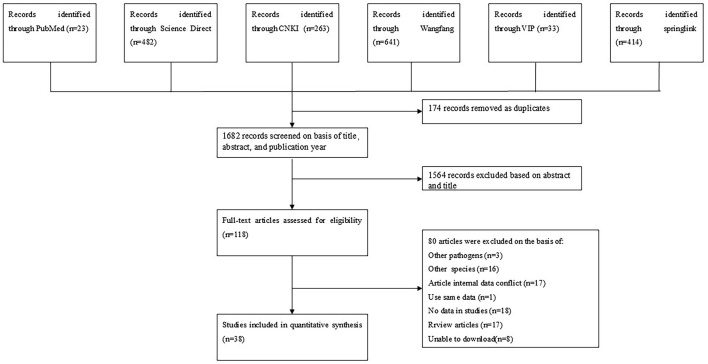
Result: We conducted a meta-analysis of 38 studies published between January 1983 and March 2024, sourced from six databases. The results showed a higher prevalence of canine brucellosis in northern and northwestern regions of China, with Xinjiang having the highest prevalence (19.77%) and Hunan the lowest (0.23%). Significant differences were found in positivity rates across different diagnostic methods (P < 0.05), with ELISA yielding the highest positivity rate (11.6%) and PCR and SAT the lowest (3.3%). The positivity rate of stray dogs (22.6%) was significantly higher than that of other dog sources (P < 0.05). Furthermore, environmental factors, such as temperature and altitude, were identified as influencing the incidence of brucellosis.
Discussion: In conclusion, canine brucellosis is prevalent across China, with detection methods, dog sources, and environmental factors contributing to the varying incidence rates. We recommend regular brucellosis testing for pet dogs, improved kennel hygiene, and reduced contact with potentially infected animals.
期刊介绍:
Frontiers in Veterinary Science is a global, peer-reviewed, Open Access journal that bridges animal and human health, brings a comparative approach to medical and surgical challenges, and advances innovative biotechnology and therapy.
Veterinary research today is interdisciplinary, collaborative, and socially relevant, transforming how we understand and investigate animal health and disease. Fundamental research in emerging infectious diseases, predictive genomics, stem cell therapy, and translational modelling is grounded within the integrative social context of public and environmental health, wildlife conservation, novel biomarkers, societal well-being, and cutting-edge clinical practice and specialization. Frontiers in Veterinary Science brings a 21st-century approach—networked, collaborative, and Open Access—to communicate this progress and innovation to both the specialist and to the wider audience of readers in the field.
Frontiers in Veterinary Science publishes articles on outstanding discoveries across a wide spectrum of translational, foundational, and clinical research. The journal''s mission is to bring all relevant veterinary sciences together on a single platform with the goal of improving animal and human health.







 京公网安备 11010802042870号
京ICP备2023020795号-1
京公网安备 11010802042870号
京ICP备2023020795号-1

 分享
分享
 求助内容:
求助内容: 应助结果提醒方式:
 扫码关注我们
