Jiaojiao Zhang, Blessed Kondowe, Hui Zhang, Xinming Xie, Qiang Song, Bo Guo, Jin Shang
{"title":"基于缺氧相关 lncRNAs 分析的肺腺癌预后指标的鉴定","authors":"Jiaojiao Zhang, Blessed Kondowe, Hui Zhang, Xinming Xie, Qiang Song, Bo Guo, Jin Shang","doi":"10.4314/mmj.v36i3.3","DOIUrl":null,"url":null,"abstract":"<p><strong>Introduction: </strong>There were no systematic studies about hypoxia-related long noncoding RNAs (lncRNAs) signatures to predict the survival of patients with lung adenocarcinoma (LUAD). Setting up matching hypoxia-related lncRNA signatures was necessary.</p><p><strong>Objective: </strong>This study aimed to establish hypoxia-related lncRNAs signatures and to seek new biomarkers to predict the prognosis of the patients with lung adenocarcinoma.</p><p><strong>Methodology: </strong>The Cancer Genome Atlas (TCGA) database provided the expression profiles of lncRNAs that includes 535 lung adenocarcinoma samples. The coexpression network of lncRNAs and hypoxia-related different expression genes (DEGs) was utilized to select hypoxia-related lncRNAs. The lncRNAs were further screened using univariate Cox regression. In addition, Lasso regression and multivariate Cox regression were used to develop a hypoxia-related lncRNAs signature. A risk score based on the signature was established, and Cox regression was used to test if it was an independent prognostic factor.</p><p><strong>Results: </strong>Nine prognostic hypoxia-related lncRNAs (LINC01150, AC010980.2, AL606489.1, AL034397.3, LINC00460, LINC02081, FAM83AAS1, AL365181.2, and AC026355.1) were identified to be significantly different, which made up a hypoxia-related lncRNAs signature. The high-risk group had shorter OS compared with the low-risk group (P = 3.329e - 09, log-rank test). A risk score based on the signature was a significantly independent factor for the patients with LUAD (HR = 1.449, 95% CI = 1.312 - 1.602, P < 0.001).</p><p><strong>Conclusion: </strong>The nine hypoxia-related lncRNAs and their signature might be molecular biomarkers and therapeutic targets for the patients with LUAD.</p>","PeriodicalId":18185,"journal":{"name":"Malawi Medical Journal","volume":"36 3","pages":"170-178"},"PeriodicalIF":0.9000,"publicationDate":"2024-10-16","publicationTypes":"Journal Article","fieldsOfStudy":null,"isOpenAccess":false,"openAccessPdf":"https://www.ncbi.nlm.nih.gov/pmc/articles/PMC11862855/pdf/","citationCount":"0","resultStr":"{\"title\":\"Identification of prognostic indicator based on hypoxia-related lncRNAs analysis in lung adenocarcinoma.\",\"authors\":\"Jiaojiao Zhang, Blessed Kondowe, Hui Zhang, Xinming Xie, Qiang Song, Bo Guo, Jin Shang\",\"doi\":\"10.4314/mmj.v36i3.3\",\"DOIUrl\":null,\"url\":null,\"abstract\":\"<p><strong>Introduction: </strong>There were no systematic studies about hypoxia-related long noncoding RNAs (lncRNAs) signatures to predict the survival of patients with lung adenocarcinoma (LUAD). Setting up matching hypoxia-related lncRNA signatures was necessary.</p><p><strong>Objective: </strong>This study aimed to establish hypoxia-related lncRNAs signatures and to seek new biomarkers to predict the prognosis of the patients with lung adenocarcinoma.</p><p><strong>Methodology: </strong>The Cancer Genome Atlas (TCGA) database provided the expression profiles of lncRNAs that includes 535 lung adenocarcinoma samples. The coexpression network of lncRNAs and hypoxia-related different expression genes (DEGs) was utilized to select hypoxia-related lncRNAs. The lncRNAs were further screened using univariate Cox regression. In addition, Lasso regression and multivariate Cox regression were used to develop a hypoxia-related lncRNAs signature. A risk score based on the signature was established, and Cox regression was used to test if it was an independent prognostic factor.</p><p><strong>Results: </strong>Nine prognostic hypoxia-related lncRNAs (LINC01150, AC010980.2, AL606489.1, AL034397.3, LINC00460, LINC02081, FAM83AAS1, AL365181.2, and AC026355.1) were identified to be significantly different, which made up a hypoxia-related lncRNAs signature. The high-risk group had shorter OS compared with the low-risk group (P = 3.329e - 09, log-rank test). A risk score based on the signature was a significantly independent factor for the patients with LUAD (HR = 1.449, 95% CI = 1.312 - 1.602, P < 0.001).</p><p><strong>Conclusion: </strong>The nine hypoxia-related lncRNAs and their signature might be molecular biomarkers and therapeutic targets for the patients with LUAD.</p>\",\"PeriodicalId\":18185,\"journal\":{\"name\":\"Malawi Medical Journal\",\"volume\":\"36 3\",\"pages\":\"170-178\"},\"PeriodicalIF\":0.9000,\"publicationDate\":\"2024-10-16\",\"publicationTypes\":\"Journal Article\",\"fieldsOfStudy\":null,\"isOpenAccess\":false,\"openAccessPdf\":\"https://www.ncbi.nlm.nih.gov/pmc/articles/PMC11862855/pdf/\",\"citationCount\":\"0\",\"resultStr\":null,\"platform\":\"Semanticscholar\",\"paperid\":null,\"PeriodicalName\":\"Malawi Medical Journal\",\"FirstCategoryId\":\"3\",\"ListUrlMain\":\"https://doi.org/10.4314/mmj.v36i3.3\",\"RegionNum\":4,\"RegionCategory\":\"医学\",\"ArticlePicture\":[],\"TitleCN\":null,\"AbstractTextCN\":null,\"PMCID\":null,\"EPubDate\":\"2024/9/1 0:00:00\",\"PubModel\":\"eCollection\",\"JCR\":\"Q4\",\"JCRName\":\"PUBLIC, ENVIRONMENTAL & OCCUPATIONAL HEALTH\",\"Score\":null,\"Total\":0}","platform":"Semanticscholar","paperid":null,"PeriodicalName":"Malawi Medical Journal","FirstCategoryId":"3","ListUrlMain":"https://doi.org/10.4314/mmj.v36i3.3","RegionNum":4,"RegionCategory":"医学","ArticlePicture":[],"TitleCN":null,"AbstractTextCN":null,"PMCID":null,"EPubDate":"2024/9/1 0:00:00","PubModel":"eCollection","JCR":"Q4","JCRName":"PUBLIC, ENVIRONMENTAL & OCCUPATIONAL HEALTH","Score":null,"Total":0}
引用次数: 0
摘要
目前还没有关于缺氧相关的长链非编码rna (lncRNAs)信号预测肺腺癌(LUAD)患者生存的系统研究。建立匹配的低氧相关lncRNA签名是必要的。目的:本研究旨在建立缺氧相关的lncRNAs特征,寻求新的生物标志物来预测肺腺癌患者的预后。方法:癌症基因组图谱(TCGA)数据库提供了包括535例肺腺癌样本的lncrna表达谱。利用lncrna与缺氧相关不同表达基因(DEGs)的共表达网络选择缺氧相关lncrna。使用单变量Cox回归进一步筛选lncrna。此外,使用Lasso回归和多变量Cox回归来建立低氧相关的lncrna特征。建立基于特征的风险评分,并使用Cox回归来检验其是否是独立的预后因素。结果:9个预后低氧相关lncrna (LINC01150、AC010980.2、AL606489.1、AL034397.3、LINC00460、LINC02081、FAM83AAS1、AL365181.2、AC026355.1)存在显著差异,构成低氧相关lncrna特征。高危组OS较低危组短(P = 3.329e - 09, log-rank检验)。基于该特征的风险评分是LUAD患者的显著独立因素(HR = 1.449, 95% CI = 1.312 - 1.602, P < 0.001)。结论:9个低氧相关lncrna及其特征可能是LUAD患者的分子生物标志物和治疗靶点。
Identification of prognostic indicator based on hypoxia-related lncRNAs analysis in lung adenocarcinoma.
Introduction: There were no systematic studies about hypoxia-related long noncoding RNAs (lncRNAs) signatures to predict the survival of patients with lung adenocarcinoma (LUAD). Setting up matching hypoxia-related lncRNA signatures was necessary.
Objective: This study aimed to establish hypoxia-related lncRNAs signatures and to seek new biomarkers to predict the prognosis of the patients with lung adenocarcinoma.
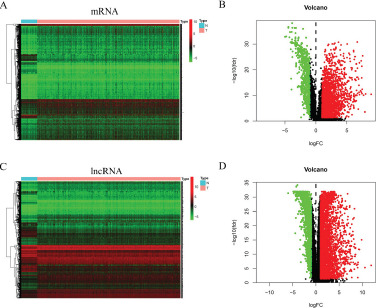
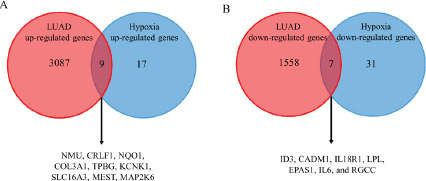
Methodology: The Cancer Genome Atlas (TCGA) database provided the expression profiles of lncRNAs that includes 535 lung adenocarcinoma samples. The coexpression network of lncRNAs and hypoxia-related different expression genes (DEGs) was utilized to select hypoxia-related lncRNAs. The lncRNAs were further screened using univariate Cox regression. In addition, Lasso regression and multivariate Cox regression were used to develop a hypoxia-related lncRNAs signature. A risk score based on the signature was established, and Cox regression was used to test if it was an independent prognostic factor.
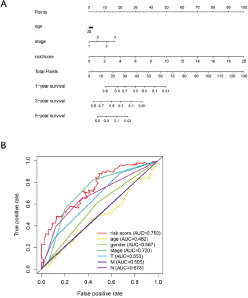
Results: Nine prognostic hypoxia-related lncRNAs (LINC01150, AC010980.2, AL606489.1, AL034397.3, LINC00460, LINC02081, FAM83AAS1, AL365181.2, and AC026355.1) were identified to be significantly different, which made up a hypoxia-related lncRNAs signature. The high-risk group had shorter OS compared with the low-risk group (P = 3.329e - 09, log-rank test). A risk score based on the signature was a significantly independent factor for the patients with LUAD (HR = 1.449, 95% CI = 1.312 - 1.602, P < 0.001).
Conclusion: The nine hypoxia-related lncRNAs and their signature might be molecular biomarkers and therapeutic targets for the patients with LUAD.
期刊介绍:
Driven and guided by the priorities articulated in the Malawi National Health Research Agenda, the Malawi Medical Journal publishes original research, short reports, case reports, viewpoints, insightful editorials and commentaries that are of high quality, informative and applicable to the Malawian and sub-Saharan Africa regions. Our particular interest is to publish evidence-based research that impacts and informs national health policies and medical practice in Malawi and the broader region.
Topics covered in the journal include, but are not limited to:
- Communicable diseases (HIV and AIDS, Malaria, TB, etc.)
- Non-communicable diseases (Cardiovascular diseases, cancer, diabetes, etc.)
- Sexual and Reproductive Health (Adolescent health, education, pregnancy and abortion, STDs and HIV and AIDS, etc.)
- Mental health
- Environmental health
- Nutrition
- Health systems and health policy (Leadership, ethics, and governance)
- Community systems strengthening research
- Injury, trauma, and surgical disorders




 京公网安备 11010802042870号
京ICP备2023020795号-1
京公网安备 11010802042870号
京ICP备2023020795号-1

 分享
分享
 求助内容:
求助内容: 应助结果提醒方式:
 扫码关注我们
