Deep learning-based weed detection for precision herbicide application in turf
BACKGROUND
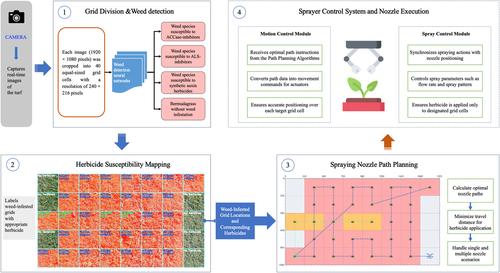
Precision weed mapping in turf according to its susceptibility to selective herbicides allows the smart sprayer to spot-spray the most pertinent herbicides onto the susceptible weeds. The objective of this study was to evaluate the feasibility of implementing herbicide susceptibility-based weed mapping using deep convolutional neural networks (DCNNs) to facilitate targeted and efficient herbicide applications. Additionally, applying path-planning algorithms to weed mapping data to guide the spraying nozzle ensures minimal travel paths for herbicide application.
RESULTS
DenseNet achieved high precision, recall, overall accuracy, and F1 score values for all categories of herbicides and no herbicides, with F1 scores ranging from 0.996 to 0.999 in the validation dataset and from 0.992 to 0.997 in the testing dataset. The average accuracies attained by DenseNet, GoogLeNet and ResNet were 0.9985, 0.9953 and 0.9980, respectively. By considering both accuracy and computational efficiency, the ResNet model was identified as the most effective among the models compared to weed detection. The performance of the Christofides, Greedy and 2-opt algorithms in optimizing path planning for single or dual spraying nozzles was compared and analyzed. The Greedy algorithm proved the most efficient in optimizing the nozzle's trajectory.
期刊介绍:
Pest Management Science is the international journal of research and development in crop protection and pest control. Since its launch in 1970, the journal has become the premier forum for papers on the discovery, application, and impact on the environment of products and strategies designed for pest management.
Published for SCI by John Wiley & Sons Ltd.





 京公网安备 11010802042870号
京ICP备2023020795号-1
京公网安备 11010802042870号
京ICP备2023020795号-1

 分享
分享
 求助内容:
求助内容: 应助结果提醒方式:
 扫码关注我们
