Shuya Li, Udani K. Wijethunga, Chun Chu, Saerona Kim, Weiwei Zheng, Benjamin D. Sherman, Chang Geun Yoo, Seunghyun Lee, Gyu Leem
{"title":"在木质素模型化合物中,钌聚吡啶涂层纳米tio2光诱导氢原子转移催化选择性C-C键裂解","authors":"Shuya Li, Udani K. Wijethunga, Chun Chu, Saerona Kim, Weiwei Zheng, Benjamin D. Sherman, Chang Geun Yoo, Seunghyun Lee, Gyu Leem","doi":"10.1021/acscatal.4c04934","DOIUrl":null,"url":null,"abstract":"Ruthenium(II) polypyridine complexes have been widely studied for applications in dye-sensitized solar cells and artificial photosynthesis. Here, this work reports studies of intermolecular charge transfer from metal-to-ligand charge transfer (MLCT) excitation of Ru(II)-based chromophores onto TiO<sub>2</sub> nanoparticles to a hydrogen atom transfer (HAT) mediator and photocatalytic activation of HAT for cleavage of the C–C bond in the aryl ether linkages at room temperature. Initial studies demonstrated intermolecular energy/electron transfer among the photoexcited photocatalyst, bis(2,2′-bipyridine)(4,4′-dicarboxy-2,2′-bipyridine)Ru(II) (<b>RuC</b>) coated TiO<sub>2</sub> nanoparticles (RuC/TiO<sub>2</sub> NPs), the <i>N</i>-hydroxy-phthalimide (NHPI) HAT mediator, and the diol substrate 1-(3,4-dimethoxyphenyl)-2-(2-methoxyphenoxy)propane-1,3-diol (<b>LMC-ol</b>). Photophysical studies of RuC/TiO<sub>2</sub> NPs in the presence of NHPI/2,6-lutidine and <b>LMC-ol</b> exhibited a highly effective quenching for photoexcited RuC*/TiO<sub>2</sub> with K<sub>SV</sub> = 7.21 × 10<sup>3</sup> M<sup>–1</sup> compared to the lower quenching constant (K<sub>SV</sub> ∼ 0.11 × 10<sup>3</sup> M<sup>–1</sup>) observed for RuC*/TiO<sub>2</sub> with only <b>LMC-ol</b> in acetonitrile solution. Under ambient temperature and aerobic conditions, the oxidative cleavage products of 3,4-dimethoxybenzaldehyde and 2-(2-methoxyphenoxy)-acetaldehyde from <b>LMC-ol</b> were obtained with the oxidized ketone product. This result indicates that the solar driven HAT-mediated process allows catalysis of the oxidative cleavage of C–C bonds in the aryl ether linkages via a one-pot cleavage reaction at room temperature. This photocatalytic system presents a possible approach to support lignin depolymerization targeting value-added aromatic chemicals and developing polymer degradation.","PeriodicalId":9,"journal":{"name":"ACS Catalysis ","volume":"8 1","pages":""},"PeriodicalIF":13.1000,"publicationDate":"2025-03-01","publicationTypes":"Journal Article","fieldsOfStudy":null,"isOpenAccess":false,"openAccessPdf":"","citationCount":"0","resultStr":"{\"title\":\"Photoinduced Hydrogen Atom Transfer Catalysis with Ruthenium Polypyridyl Coated-TiO2 Nanoparticles for Selective C–C Bond Cleavage in a Lignin Model Compound\",\"authors\":\"Shuya Li, Udani K. Wijethunga, Chun Chu, Saerona Kim, Weiwei Zheng, Benjamin D. Sherman, Chang Geun Yoo, Seunghyun Lee, Gyu Leem\",\"doi\":\"10.1021/acscatal.4c04934\",\"DOIUrl\":null,\"url\":null,\"abstract\":\"Ruthenium(II) polypyridine complexes have been widely studied for applications in dye-sensitized solar cells and artificial photosynthesis. Here, this work reports studies of intermolecular charge transfer from metal-to-ligand charge transfer (MLCT) excitation of Ru(II)-based chromophores onto TiO<sub>2</sub> nanoparticles to a hydrogen atom transfer (HAT) mediator and photocatalytic activation of HAT for cleavage of the C–C bond in the aryl ether linkages at room temperature. Initial studies demonstrated intermolecular energy/electron transfer among the photoexcited photocatalyst, bis(2,2′-bipyridine)(4,4′-dicarboxy-2,2′-bipyridine)Ru(II) (<b>RuC</b>) coated TiO<sub>2</sub> nanoparticles (RuC/TiO<sub>2</sub> NPs), the <i>N</i>-hydroxy-phthalimide (NHPI) HAT mediator, and the diol substrate 1-(3,4-dimethoxyphenyl)-2-(2-methoxyphenoxy)propane-1,3-diol (<b>LMC-ol</b>). Photophysical studies of RuC/TiO<sub>2</sub> NPs in the presence of NHPI/2,6-lutidine and <b>LMC-ol</b> exhibited a highly effective quenching for photoexcited RuC*/TiO<sub>2</sub> with K<sub>SV</sub> = 7.21 × 10<sup>3</sup> M<sup>–1</sup> compared to the lower quenching constant (K<sub>SV</sub> ∼ 0.11 × 10<sup>3</sup> M<sup>–1</sup>) observed for RuC*/TiO<sub>2</sub> with only <b>LMC-ol</b> in acetonitrile solution. Under ambient temperature and aerobic conditions, the oxidative cleavage products of 3,4-dimethoxybenzaldehyde and 2-(2-methoxyphenoxy)-acetaldehyde from <b>LMC-ol</b> were obtained with the oxidized ketone product. This result indicates that the solar driven HAT-mediated process allows catalysis of the oxidative cleavage of C–C bonds in the aryl ether linkages via a one-pot cleavage reaction at room temperature. This photocatalytic system presents a possible approach to support lignin depolymerization targeting value-added aromatic chemicals and developing polymer degradation.\",\"PeriodicalId\":9,\"journal\":{\"name\":\"ACS Catalysis \",\"volume\":\"8 1\",\"pages\":\"\"},\"PeriodicalIF\":13.1000,\"publicationDate\":\"2025-03-01\",\"publicationTypes\":\"Journal Article\",\"fieldsOfStudy\":null,\"isOpenAccess\":false,\"openAccessPdf\":\"\",\"citationCount\":\"0\",\"resultStr\":null,\"platform\":\"Semanticscholar\",\"paperid\":null,\"PeriodicalName\":\"ACS Catalysis \",\"FirstCategoryId\":\"92\",\"ListUrlMain\":\"https://doi.org/10.1021/acscatal.4c04934\",\"RegionNum\":1,\"RegionCategory\":\"化学\",\"ArticlePicture\":[],\"TitleCN\":null,\"AbstractTextCN\":null,\"PMCID\":null,\"EPubDate\":\"\",\"PubModel\":\"\",\"JCR\":\"Q1\",\"JCRName\":\"CHEMISTRY, PHYSICAL\",\"Score\":null,\"Total\":0}","platform":"Semanticscholar","paperid":null,"PeriodicalName":"ACS Catalysis ","FirstCategoryId":"92","ListUrlMain":"https://doi.org/10.1021/acscatal.4c04934","RegionNum":1,"RegionCategory":"化学","ArticlePicture":[],"TitleCN":null,"AbstractTextCN":null,"PMCID":null,"EPubDate":"","PubModel":"","JCR":"Q1","JCRName":"CHEMISTRY, PHYSICAL","Score":null,"Total":0}
Photoinduced Hydrogen Atom Transfer Catalysis with Ruthenium Polypyridyl Coated-TiO2 Nanoparticles for Selective C–C Bond Cleavage in a Lignin Model Compound
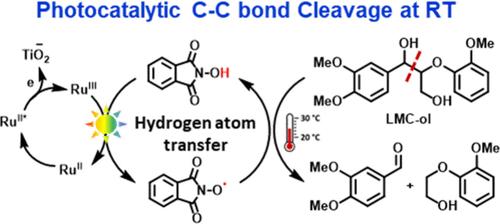
Ruthenium(II) polypyridine complexes have been widely studied for applications in dye-sensitized solar cells and artificial photosynthesis. Here, this work reports studies of intermolecular charge transfer from metal-to-ligand charge transfer (MLCT) excitation of Ru(II)-based chromophores onto TiO2 nanoparticles to a hydrogen atom transfer (HAT) mediator and photocatalytic activation of HAT for cleavage of the C–C bond in the aryl ether linkages at room temperature. Initial studies demonstrated intermolecular energy/electron transfer among the photoexcited photocatalyst, bis(2,2′-bipyridine)(4,4′-dicarboxy-2,2′-bipyridine)Ru(II) (RuC) coated TiO2 nanoparticles (RuC/TiO2 NPs), the N-hydroxy-phthalimide (NHPI) HAT mediator, and the diol substrate 1-(3,4-dimethoxyphenyl)-2-(2-methoxyphenoxy)propane-1,3-diol (LMC-ol). Photophysical studies of RuC/TiO2 NPs in the presence of NHPI/2,6-lutidine and LMC-ol exhibited a highly effective quenching for photoexcited RuC*/TiO2 with KSV = 7.21 × 10³ M–1 compared to the lower quenching constant (KSV ∼ 0.11 × 10³ M–1) observed for RuC*/TiO2 with only LMC-ol in acetonitrile solution. Under ambient temperature and aerobic conditions, the oxidative cleavage products of 3,4-dimethoxybenzaldehyde and 2-(2-methoxyphenoxy)-acetaldehyde from LMC-ol were obtained with the oxidized ketone product. This result indicates that the solar driven HAT-mediated process allows catalysis of the oxidative cleavage of C–C bonds in the aryl ether linkages via a one-pot cleavage reaction at room temperature. This photocatalytic system presents a possible approach to support lignin depolymerization targeting value-added aromatic chemicals and developing polymer degradation.
期刊介绍:
ACS Catalysis is an esteemed journal that publishes original research in the fields of heterogeneous catalysis, molecular catalysis, and biocatalysis. It offers broad coverage across diverse areas such as life sciences, organometallics and synthesis, photochemistry and electrochemistry, drug discovery and synthesis, materials science, environmental protection, polymer discovery and synthesis, and energy and fuels.
The scope of the journal is to showcase innovative work in various aspects of catalysis. This includes new reactions and novel synthetic approaches utilizing known catalysts, the discovery or modification of new catalysts, elucidation of catalytic mechanisms through cutting-edge investigations, practical enhancements of existing processes, as well as conceptual advances in the field. Contributions to ACS Catalysis can encompass both experimental and theoretical research focused on catalytic molecules, macromolecules, and materials that exhibit catalytic turnover.




 京公网安备 11010802042870号
京ICP备2023020795号-1
京公网安备 11010802042870号
京ICP备2023020795号-1

 分享
分享
 求助内容:
求助内容: 应助结果提醒方式:
 扫码关注我们
