{"title":"电化学乙腈加氢的表面晶格限氧氢转移","authors":"Hao Zhang, Linghao Yu, Yancai Yao, Biao Zhou, Jundi Cheng, Xupeng Liu, Ziyue Chen, Hao Zhang, Long Zhao, Lizhi Zhang","doi":"10.1021/acscatal.4c07928","DOIUrl":null,"url":null,"abstract":"Electrochemical synthesis of ethylamine from acetonitrile with H<sub>2</sub>O is a promising alternative to the traditional H<sub>2</sub>-based process but is challenged by the sluggish hydrogenation process with the inefficient supply of active hydrogen species (H*). Herein, we report an accelerated hydrogen transfer strategy to facilitate on-site electrochemical hydrogenation of acetonitrile for ethylamine synthesis. This strategy was realized by a monolithic electrode composed of oxygen vacancies (OVs)-rich titanium dioxide nanoarrays grown on Ti foam in combination with Ni single atoms (Ni<sub>1</sub>/OVs-TiO<sub>2</sub> NA), which enabled the efficient electrochemical water dissociation into H* along with the optimized electronic structure of surface lattice oxygens by leveraging adjacent OVs, effectively weakening the binding strength of O–H bonds for the subsequent fast transfer of confined H* mediated by surface lattice oxygens. With further incorporation of Ni single atoms as H* trapping centers for the hydrogenation step, the as-prepared Ni<sub>1</sub>/OVs-TiO<sub>2</sub> NA delivered an impressive electrocatalytic performance of acetonitrile hydrogenation with an ethylamine yield rate of 6.93 mmol h<sup>–1</sup> mg<sub>Ni</sub><sup>–1</sup> and a Faraday efficiency of 94%, 8.8-fold higher than that of OVs-free counterpart (0.78 mmol h<sup>–1</sup> mg<sub>Ni</sub><sup>–1</sup>, 39%). This work clarifies the promotion effect of surface lattice oxygen on hydrogen-transfer-related electrochemical hydrogenation reactions and offers a water-based ethylamine synthesis strategy.","PeriodicalId":9,"journal":{"name":"ACS Catalysis ","volume":"52 1","pages":""},"PeriodicalIF":13.1000,"publicationDate":"2025-03-01","publicationTypes":"Journal Article","fieldsOfStudy":null,"isOpenAccess":false,"openAccessPdf":"","citationCount":"0","resultStr":"{\"title\":\"Surface Lattice Oxygen Confined Hydrogen Transfer for Electrochemical Acetonitrile Hydrogenation\",\"authors\":\"Hao Zhang, Linghao Yu, Yancai Yao, Biao Zhou, Jundi Cheng, Xupeng Liu, Ziyue Chen, Hao Zhang, Long Zhao, Lizhi Zhang\",\"doi\":\"10.1021/acscatal.4c07928\",\"DOIUrl\":null,\"url\":null,\"abstract\":\"Electrochemical synthesis of ethylamine from acetonitrile with H<sub>2</sub>O is a promising alternative to the traditional H<sub>2</sub>-based process but is challenged by the sluggish hydrogenation process with the inefficient supply of active hydrogen species (H*). Herein, we report an accelerated hydrogen transfer strategy to facilitate on-site electrochemical hydrogenation of acetonitrile for ethylamine synthesis. This strategy was realized by a monolithic electrode composed of oxygen vacancies (OVs)-rich titanium dioxide nanoarrays grown on Ti foam in combination with Ni single atoms (Ni<sub>1</sub>/OVs-TiO<sub>2</sub> NA), which enabled the efficient electrochemical water dissociation into H* along with the optimized electronic structure of surface lattice oxygens by leveraging adjacent OVs, effectively weakening the binding strength of O–H bonds for the subsequent fast transfer of confined H* mediated by surface lattice oxygens. With further incorporation of Ni single atoms as H* trapping centers for the hydrogenation step, the as-prepared Ni<sub>1</sub>/OVs-TiO<sub>2</sub> NA delivered an impressive electrocatalytic performance of acetonitrile hydrogenation with an ethylamine yield rate of 6.93 mmol h<sup>–1</sup> mg<sub>Ni</sub><sup>–1</sup> and a Faraday efficiency of 94%, 8.8-fold higher than that of OVs-free counterpart (0.78 mmol h<sup>–1</sup> mg<sub>Ni</sub><sup>–1</sup>, 39%). This work clarifies the promotion effect of surface lattice oxygen on hydrogen-transfer-related electrochemical hydrogenation reactions and offers a water-based ethylamine synthesis strategy.\",\"PeriodicalId\":9,\"journal\":{\"name\":\"ACS Catalysis \",\"volume\":\"52 1\",\"pages\":\"\"},\"PeriodicalIF\":13.1000,\"publicationDate\":\"2025-03-01\",\"publicationTypes\":\"Journal Article\",\"fieldsOfStudy\":null,\"isOpenAccess\":false,\"openAccessPdf\":\"\",\"citationCount\":\"0\",\"resultStr\":null,\"platform\":\"Semanticscholar\",\"paperid\":null,\"PeriodicalName\":\"ACS Catalysis \",\"FirstCategoryId\":\"92\",\"ListUrlMain\":\"https://doi.org/10.1021/acscatal.4c07928\",\"RegionNum\":1,\"RegionCategory\":\"化学\",\"ArticlePicture\":[],\"TitleCN\":null,\"AbstractTextCN\":null,\"PMCID\":null,\"EPubDate\":\"\",\"PubModel\":\"\",\"JCR\":\"Q1\",\"JCRName\":\"CHEMISTRY, PHYSICAL\",\"Score\":null,\"Total\":0}","platform":"Semanticscholar","paperid":null,"PeriodicalName":"ACS Catalysis ","FirstCategoryId":"92","ListUrlMain":"https://doi.org/10.1021/acscatal.4c07928","RegionNum":1,"RegionCategory":"化学","ArticlePicture":[],"TitleCN":null,"AbstractTextCN":null,"PMCID":null,"EPubDate":"","PubModel":"","JCR":"Q1","JCRName":"CHEMISTRY, PHYSICAL","Score":null,"Total":0}
引用次数: 0
摘要
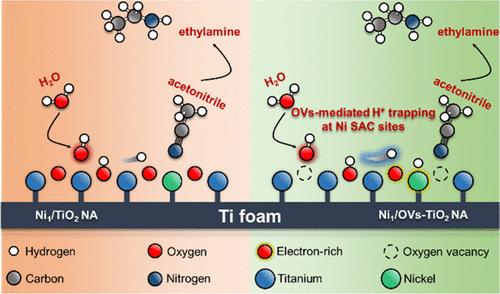
以乙腈为原料,用水电化学合成乙胺是一种很有前途的替代方法,但由于氢化过程缓慢,活性氢(H*)的供应效率低下而受到挑战。在此,我们报告了一种加速氢转移策略,以促进乙腈的现场电化学加氢合成乙胺。该策略是通过在钛泡沫上生长的富含氧空位(OVs)的二氧化钛纳米阵列与Ni单原子(Ni1/OVs- tio2 NA)组成的单片电极来实现的,该电极利用相邻的OVs,使电化学水解离成H*,并优化了表面晶格氧的电子结构。有效地削弱了O-H键的结合强度,从而导致随后由表面晶格氧介导的受限H*的快速转移。在加氢步骤中进一步加入Ni单原子作为H*捕获中心,制备的Ni1/OVs-TiO2 NA具有良好的乙腈加氢电催化性能,乙胺产率为6.93 mmol H - 1 mgNi-1,法拉第效率为94%,比无ovs的Ni1/OVs-TiO2 NA (0.78 mmol H - 1 mgNi-1, 39%)高8.8倍。本研究阐明了表面点阵氧对氢转移相关的电化学加氢反应的促进作用,提供了一种水基乙胺合成策略。
Surface Lattice Oxygen Confined Hydrogen Transfer for Electrochemical Acetonitrile Hydrogenation
Electrochemical synthesis of ethylamine from acetonitrile with H2O is a promising alternative to the traditional H2-based process but is challenged by the sluggish hydrogenation process with the inefficient supply of active hydrogen species (H*). Herein, we report an accelerated hydrogen transfer strategy to facilitate on-site electrochemical hydrogenation of acetonitrile for ethylamine synthesis. This strategy was realized by a monolithic electrode composed of oxygen vacancies (OVs)-rich titanium dioxide nanoarrays grown on Ti foam in combination with Ni single atoms (Ni1/OVs-TiO2 NA), which enabled the efficient electrochemical water dissociation into H* along with the optimized electronic structure of surface lattice oxygens by leveraging adjacent OVs, effectively weakening the binding strength of O–H bonds for the subsequent fast transfer of confined H* mediated by surface lattice oxygens. With further incorporation of Ni single atoms as H* trapping centers for the hydrogenation step, the as-prepared Ni1/OVs-TiO2 NA delivered an impressive electrocatalytic performance of acetonitrile hydrogenation with an ethylamine yield rate of 6.93 mmol h–1 mgNi–1 and a Faraday efficiency of 94%, 8.8-fold higher than that of OVs-free counterpart (0.78 mmol h–1 mgNi–1, 39%). This work clarifies the promotion effect of surface lattice oxygen on hydrogen-transfer-related electrochemical hydrogenation reactions and offers a water-based ethylamine synthesis strategy.
期刊介绍:
ACS Catalysis is an esteemed journal that publishes original research in the fields of heterogeneous catalysis, molecular catalysis, and biocatalysis. It offers broad coverage across diverse areas such as life sciences, organometallics and synthesis, photochemistry and electrochemistry, drug discovery and synthesis, materials science, environmental protection, polymer discovery and synthesis, and energy and fuels.
The scope of the journal is to showcase innovative work in various aspects of catalysis. This includes new reactions and novel synthetic approaches utilizing known catalysts, the discovery or modification of new catalysts, elucidation of catalytic mechanisms through cutting-edge investigations, practical enhancements of existing processes, as well as conceptual advances in the field. Contributions to ACS Catalysis can encompass both experimental and theoretical research focused on catalytic molecules, macromolecules, and materials that exhibit catalytic turnover.




 京公网安备 11010802042870号
京ICP备2023020795号-1
京公网安备 11010802042870号
京ICP备2023020795号-1

 分享
分享
 求助内容:
求助内容: 应助结果提醒方式:
 扫码关注我们
