Suman Dana, Neeraj Kumar Pandit, Philipp Boos, Tristan von Münchow, Sven Erik Peters, Sven Trienes, Laura Haberstock, Regine Herbst-Irmer, Dietmar Stalke, Lutz Ackermann
{"title":"κ2-N, o-恶唑啉预配体对映选择性钴电催化C-H活化的参数化","authors":"Suman Dana, Neeraj Kumar Pandit, Philipp Boos, Tristan von Münchow, Sven Erik Peters, Sven Trienes, Laura Haberstock, Regine Herbst-Irmer, Dietmar Stalke, Lutz Ackermann","doi":"10.1021/acscatal.5c00250","DOIUrl":null,"url":null,"abstract":"Enantioselective electrocatalyzed C–H activations have emerged as a transformative platform for the assembly of value-added chiral organic molecules. Despite the recent progress, the construction of multiple C(sp<sup>3</sup>)-stereogenic centers via a C(sp<sup>3</sup>)–C(sp<sup>3</sup>) bond formation has thus far proven to be elusive. In contrast, we herein report an annulative C–H activation strategy, generating chiral Fsp<sup>3</sup>-rich molecules with high levels of diastereo- and enantioselectivity. κ<sup>2</sup>-<i>N</i>,<i>O</i>-oxazoline preligands were effectively employed in enantioselective cobalt(III)-catalyzed C–H activation reactions. Using DFT-derived descriptors and regression statistical modeling, we performed a parametrization study on the modularity of chiral κ<sup>2</sup>-<i>N</i>,<i>O</i>-oxazoline preligands. The study resulted in a model describing ligands’ selectivity characterized by key steric, electronic, and interaction behaviors.","PeriodicalId":9,"journal":{"name":"ACS Catalysis ","volume":"34 1","pages":""},"PeriodicalIF":13.1000,"publicationDate":"2025-02-28","publicationTypes":"Journal Article","fieldsOfStudy":null,"isOpenAccess":false,"openAccessPdf":"","citationCount":"0","resultStr":"{\"title\":\"Parametrization of κ2-N,O-Oxazoline Preligands for Enantioselective Cobaltaelectro-Catalyzed C–H Activations\",\"authors\":\"Suman Dana, Neeraj Kumar Pandit, Philipp Boos, Tristan von Münchow, Sven Erik Peters, Sven Trienes, Laura Haberstock, Regine Herbst-Irmer, Dietmar Stalke, Lutz Ackermann\",\"doi\":\"10.1021/acscatal.5c00250\",\"DOIUrl\":null,\"url\":null,\"abstract\":\"Enantioselective electrocatalyzed C–H activations have emerged as a transformative platform for the assembly of value-added chiral organic molecules. Despite the recent progress, the construction of multiple C(sp<sup>3</sup>)-stereogenic centers via a C(sp<sup>3</sup>)–C(sp<sup>3</sup>) bond formation has thus far proven to be elusive. In contrast, we herein report an annulative C–H activation strategy, generating chiral Fsp<sup>3</sup>-rich molecules with high levels of diastereo- and enantioselectivity. κ<sup>2</sup>-<i>N</i>,<i>O</i>-oxazoline preligands were effectively employed in enantioselective cobalt(III)-catalyzed C–H activation reactions. Using DFT-derived descriptors and regression statistical modeling, we performed a parametrization study on the modularity of chiral κ<sup>2</sup>-<i>N</i>,<i>O</i>-oxazoline preligands. The study resulted in a model describing ligands’ selectivity characterized by key steric, electronic, and interaction behaviors.\",\"PeriodicalId\":9,\"journal\":{\"name\":\"ACS Catalysis \",\"volume\":\"34 1\",\"pages\":\"\"},\"PeriodicalIF\":13.1000,\"publicationDate\":\"2025-02-28\",\"publicationTypes\":\"Journal Article\",\"fieldsOfStudy\":null,\"isOpenAccess\":false,\"openAccessPdf\":\"\",\"citationCount\":\"0\",\"resultStr\":null,\"platform\":\"Semanticscholar\",\"paperid\":null,\"PeriodicalName\":\"ACS Catalysis \",\"FirstCategoryId\":\"92\",\"ListUrlMain\":\"https://doi.org/10.1021/acscatal.5c00250\",\"RegionNum\":1,\"RegionCategory\":\"化学\",\"ArticlePicture\":[],\"TitleCN\":null,\"AbstractTextCN\":null,\"PMCID\":null,\"EPubDate\":\"\",\"PubModel\":\"\",\"JCR\":\"Q1\",\"JCRName\":\"CHEMISTRY, PHYSICAL\",\"Score\":null,\"Total\":0}","platform":"Semanticscholar","paperid":null,"PeriodicalName":"ACS Catalysis ","FirstCategoryId":"92","ListUrlMain":"https://doi.org/10.1021/acscatal.5c00250","RegionNum":1,"RegionCategory":"化学","ArticlePicture":[],"TitleCN":null,"AbstractTextCN":null,"PMCID":null,"EPubDate":"","PubModel":"","JCR":"Q1","JCRName":"CHEMISTRY, PHYSICAL","Score":null,"Total":0}
引用次数: 0
摘要
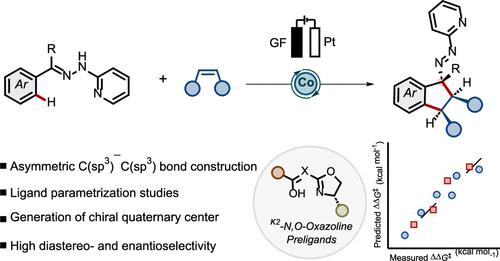
对映选择性电催化C-H活化已成为一个转化平台组装增值手性有机分子。尽管最近取得了进展,但通过C(sp3) -C (sp3)键形成多个C(sp3)-立体中心的构建迄今为止被证明是难以捉摸的。相反,我们在此报告了一种环状碳氢活化策略,产生具有高水平非映对和对映选择性的手性富fsp3分子。κ2-N, o -恶唑啉预配体有效地应用于对映选择性钴(III)催化的C-H活化反应。利用dft衍生的描述符和回归统计模型,对手性κ2-N, o -恶唑啉预配体的模块化进行了参数化研究。该研究建立了一个描述配体选择性的模型,该模型以键位、电子和相互作用行为为特征。
Parametrization of κ2-N,O-Oxazoline Preligands for Enantioselective Cobaltaelectro-Catalyzed C–H Activations
Enantioselective electrocatalyzed C–H activations have emerged as a transformative platform for the assembly of value-added chiral organic molecules. Despite the recent progress, the construction of multiple C(sp3)-stereogenic centers via a C(sp3)–C(sp3) bond formation has thus far proven to be elusive. In contrast, we herein report an annulative C–H activation strategy, generating chiral Fsp3-rich molecules with high levels of diastereo- and enantioselectivity. κ2-N,O-oxazoline preligands were effectively employed in enantioselective cobalt(III)-catalyzed C–H activation reactions. Using DFT-derived descriptors and regression statistical modeling, we performed a parametrization study on the modularity of chiral κ2-N,O-oxazoline preligands. The study resulted in a model describing ligands’ selectivity characterized by key steric, electronic, and interaction behaviors.
期刊介绍:
ACS Catalysis is an esteemed journal that publishes original research in the fields of heterogeneous catalysis, molecular catalysis, and biocatalysis. It offers broad coverage across diverse areas such as life sciences, organometallics and synthesis, photochemistry and electrochemistry, drug discovery and synthesis, materials science, environmental protection, polymer discovery and synthesis, and energy and fuels.
The scope of the journal is to showcase innovative work in various aspects of catalysis. This includes new reactions and novel synthetic approaches utilizing known catalysts, the discovery or modification of new catalysts, elucidation of catalytic mechanisms through cutting-edge investigations, practical enhancements of existing processes, as well as conceptual advances in the field. Contributions to ACS Catalysis can encompass both experimental and theoretical research focused on catalytic molecules, macromolecules, and materials that exhibit catalytic turnover.




 京公网安备 11010802042870号
京ICP备2023020795号-1
京公网安备 11010802042870号
京ICP备2023020795号-1

 分享
分享
 求助内容:
求助内容: 应助结果提醒方式:
 扫码关注我们
