Woo Hyuk Jung , Sang Yup Lee , Yedam Lee , Dong June Ahn
{"title":"冷冻驱动的离子电荷不平衡导致脂质膜的孔形成和渗透损伤","authors":"Woo Hyuk Jung , Sang Yup Lee , Yedam Lee , Dong June Ahn","doi":"10.1016/j.compbiomed.2025.109960","DOIUrl":null,"url":null,"abstract":"<div><div>In this work, we reveal the fundamental mechanism controlling osmotic injury of lipid membranes under low-temperature preservation using an in-vitro membrane system under freezing temperature and the molecular dynamic simulations. The freezing-driven ionic charge imbalance is the major factor affecting the membrane conformation and causing the osmotic injury. Under freezing temperature, the ionic charge imbalance, originating from the preferential incorporation of anions into the growing ice crystals, results in membrane poration with the directional penetration of ion molecules. Subsequently, the osmotic efflux of water molecules through the pore causes cell dehydration, eventually leading to the lethal osmotic injury of lipid membranes during freezing. Moreover, we find a stark difference in tolerance to freezing and the times required for pore formation in membranes with different lipid compositions. Membranes enriched with cholesterol and anionic lipids exhibit increased resistance to freezing-induced osmotic injury, as the addition of cholesterol and anionic lipids in membranes delays the pore formation under freezing temperature. These findings advance in depth the molecular-level understanding of freezing injury on lipid membranes and provide an opportunity to develop an alternative strategy to protect diverse cells during preservation at subzero temperatures by regulating the composition of lipid membranes.</div></div>","PeriodicalId":10578,"journal":{"name":"Computers in biology and medicine","volume":"189 ","pages":"Article 109960"},"PeriodicalIF":6.3000,"publicationDate":"2025-05-01","publicationTypes":"Journal Article","fieldsOfStudy":null,"isOpenAccess":false,"openAccessPdf":"","citationCount":"0","resultStr":"{\"title\":\"Freezing-driven ionic charge imbalance leads to pore formation and osmotic injury of lipid membranes\",\"authors\":\"Woo Hyuk Jung , Sang Yup Lee , Yedam Lee , Dong June Ahn\",\"doi\":\"10.1016/j.compbiomed.2025.109960\",\"DOIUrl\":null,\"url\":null,\"abstract\":\"<div><div>In this work, we reveal the fundamental mechanism controlling osmotic injury of lipid membranes under low-temperature preservation using an in-vitro membrane system under freezing temperature and the molecular dynamic simulations. The freezing-driven ionic charge imbalance is the major factor affecting the membrane conformation and causing the osmotic injury. Under freezing temperature, the ionic charge imbalance, originating from the preferential incorporation of anions into the growing ice crystals, results in membrane poration with the directional penetration of ion molecules. Subsequently, the osmotic efflux of water molecules through the pore causes cell dehydration, eventually leading to the lethal osmotic injury of lipid membranes during freezing. Moreover, we find a stark difference in tolerance to freezing and the times required for pore formation in membranes with different lipid compositions. Membranes enriched with cholesterol and anionic lipids exhibit increased resistance to freezing-induced osmotic injury, as the addition of cholesterol and anionic lipids in membranes delays the pore formation under freezing temperature. These findings advance in depth the molecular-level understanding of freezing injury on lipid membranes and provide an opportunity to develop an alternative strategy to protect diverse cells during preservation at subzero temperatures by regulating the composition of lipid membranes.</div></div>\",\"PeriodicalId\":10578,\"journal\":{\"name\":\"Computers in biology and medicine\",\"volume\":\"189 \",\"pages\":\"Article 109960\"},\"PeriodicalIF\":6.3000,\"publicationDate\":\"2025-05-01\",\"publicationTypes\":\"Journal Article\",\"fieldsOfStudy\":null,\"isOpenAccess\":false,\"openAccessPdf\":\"\",\"citationCount\":\"0\",\"resultStr\":null,\"platform\":\"Semanticscholar\",\"paperid\":null,\"PeriodicalName\":\"Computers in biology and medicine\",\"FirstCategoryId\":\"5\",\"ListUrlMain\":\"https://www.sciencedirect.com/science/article/pii/S0010482525003117\",\"RegionNum\":2,\"RegionCategory\":\"医学\",\"ArticlePicture\":[],\"TitleCN\":null,\"AbstractTextCN\":null,\"PMCID\":null,\"EPubDate\":\"2025/3/2 0:00:00\",\"PubModel\":\"Epub\",\"JCR\":\"Q1\",\"JCRName\":\"BIOLOGY\",\"Score\":null,\"Total\":0}","platform":"Semanticscholar","paperid":null,"PeriodicalName":"Computers in biology and medicine","FirstCategoryId":"5","ListUrlMain":"https://www.sciencedirect.com/science/article/pii/S0010482525003117","RegionNum":2,"RegionCategory":"医学","ArticlePicture":[],"TitleCN":null,"AbstractTextCN":null,"PMCID":null,"EPubDate":"2025/3/2 0:00:00","PubModel":"Epub","JCR":"Q1","JCRName":"BIOLOGY","Score":null,"Total":0}
Freezing-driven ionic charge imbalance leads to pore formation and osmotic injury of lipid membranes
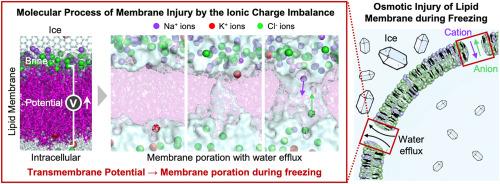
In this work, we reveal the fundamental mechanism controlling osmotic injury of lipid membranes under low-temperature preservation using an in-vitro membrane system under freezing temperature and the molecular dynamic simulations. The freezing-driven ionic charge imbalance is the major factor affecting the membrane conformation and causing the osmotic injury. Under freezing temperature, the ionic charge imbalance, originating from the preferential incorporation of anions into the growing ice crystals, results in membrane poration with the directional penetration of ion molecules. Subsequently, the osmotic efflux of water molecules through the pore causes cell dehydration, eventually leading to the lethal osmotic injury of lipid membranes during freezing. Moreover, we find a stark difference in tolerance to freezing and the times required for pore formation in membranes with different lipid compositions. Membranes enriched with cholesterol and anionic lipids exhibit increased resistance to freezing-induced osmotic injury, as the addition of cholesterol and anionic lipids in membranes delays the pore formation under freezing temperature. These findings advance in depth the molecular-level understanding of freezing injury on lipid membranes and provide an opportunity to develop an alternative strategy to protect diverse cells during preservation at subzero temperatures by regulating the composition of lipid membranes.
期刊介绍:
Computers in Biology and Medicine is an international forum for sharing groundbreaking advancements in the use of computers in bioscience and medicine. This journal serves as a medium for communicating essential research, instruction, ideas, and information regarding the rapidly evolving field of computer applications in these domains. By encouraging the exchange of knowledge, we aim to facilitate progress and innovation in the utilization of computers in biology and medicine.




 京公网安备 11010802042870号
京ICP备2023020795号-1
京公网安备 11010802042870号
京ICP备2023020795号-1

 分享
分享
 求助内容:
求助内容: 应助结果提醒方式:
 扫码关注我们
