Xiangrong Li , Li Shi , Zhizhi Song , Zuhui Geng , Yunhui Yan
{"title":"槲皮素包被纳米银及蛋白质复合物的抗菌活性及形成机制","authors":"Xiangrong Li , Li Shi , Zhizhi Song , Zuhui Geng , Yunhui Yan","doi":"10.1016/j.molstruc.2025.141878","DOIUrl":null,"url":null,"abstract":"<div><div>Positively charged quercetin-coated AgNPs (Que@AgNPs) were synthesized using quercetin as reducing agent and cetyltrimethyl ammonium bromide as stabilizer. The antibacterial activity of Que@AgNPs against <em>Escherichia coli</em> and <em>S. aureus</em> is significantly stronger than that of AgNPs without quercetin coating. It is found that the antibacterial activity of Que@AgNPs-lysozyme/γ-globulin complex is further enhanced, which is related to the concentration of Que@AgNPs and the coated lysozyme/γ-globulin. While, the antibacterial activity of Que@AgNPs-fibrinogen complex is lower than that of Que@AgNPs. The formation mechanism of Que@AgNPs-protein complex is further studied. The results show that the interaction between lysozyme/γ-globulin/fibrinogen and Que@AgNPs is a static quenching process. Hydrophobic interaction is important for lysozyme/γ-globulin, whereas in the case of fibrinogen, electrostatic force is mainly present. The presence of two different types of the binding sites for lysozyme and only one type of binding site for γ-globulin and fibrinogen on the surface of Que@AgNPs. The adsorption of lysozyme/γ-globulin/fibrinogen onto Que@AgNPs follows pseudo-second-order model, and chemisorption is the rate-limiting step. The experimental data fit well with Freundlich isotherm model. Que@AgNPs result in the loosening and unfolding of lysozyme/γ-globulin/fibrinogen backbone, and the content of α-helix (lysozyme, fibrinogen) or β-sheet (γ-globulin) of the secondary structure increases with increasing of Que@AgNPs concentrations.</div></div>","PeriodicalId":16414,"journal":{"name":"Journal of Molecular Structure","volume":"1334 ","pages":"Article 141878"},"PeriodicalIF":4.9000,"publicationDate":"2025-07-05","publicationTypes":"Journal Article","fieldsOfStudy":null,"isOpenAccess":false,"openAccessPdf":"","citationCount":"0","resultStr":"{\"title\":\"The antibacterial activity and formation mechanism of quercetin-coated silver nanoparticles and protein complex\",\"authors\":\"Xiangrong Li , Li Shi , Zhizhi Song , Zuhui Geng , Yunhui Yan\",\"doi\":\"10.1016/j.molstruc.2025.141878\",\"DOIUrl\":null,\"url\":null,\"abstract\":\"<div><div>Positively charged quercetin-coated AgNPs (Que@AgNPs) were synthesized using quercetin as reducing agent and cetyltrimethyl ammonium bromide as stabilizer. The antibacterial activity of Que@AgNPs against <em>Escherichia coli</em> and <em>S. aureus</em> is significantly stronger than that of AgNPs without quercetin coating. It is found that the antibacterial activity of Que@AgNPs-lysozyme/γ-globulin complex is further enhanced, which is related to the concentration of Que@AgNPs and the coated lysozyme/γ-globulin. While, the antibacterial activity of Que@AgNPs-fibrinogen complex is lower than that of Que@AgNPs. The formation mechanism of Que@AgNPs-protein complex is further studied. The results show that the interaction between lysozyme/γ-globulin/fibrinogen and Que@AgNPs is a static quenching process. Hydrophobic interaction is important for lysozyme/γ-globulin, whereas in the case of fibrinogen, electrostatic force is mainly present. The presence of two different types of the binding sites for lysozyme and only one type of binding site for γ-globulin and fibrinogen on the surface of Que@AgNPs. The adsorption of lysozyme/γ-globulin/fibrinogen onto Que@AgNPs follows pseudo-second-order model, and chemisorption is the rate-limiting step. The experimental data fit well with Freundlich isotherm model. Que@AgNPs result in the loosening and unfolding of lysozyme/γ-globulin/fibrinogen backbone, and the content of α-helix (lysozyme, fibrinogen) or β-sheet (γ-globulin) of the secondary structure increases with increasing of Que@AgNPs concentrations.</div></div>\",\"PeriodicalId\":16414,\"journal\":{\"name\":\"Journal of Molecular Structure\",\"volume\":\"1334 \",\"pages\":\"Article 141878\"},\"PeriodicalIF\":4.9000,\"publicationDate\":\"2025-07-05\",\"publicationTypes\":\"Journal Article\",\"fieldsOfStudy\":null,\"isOpenAccess\":false,\"openAccessPdf\":\"\",\"citationCount\":\"0\",\"resultStr\":null,\"platform\":\"Semanticscholar\",\"paperid\":null,\"PeriodicalName\":\"Journal of Molecular Structure\",\"FirstCategoryId\":\"92\",\"ListUrlMain\":\"https://www.sciencedirect.com/science/article/pii/S0022286025005642\",\"RegionNum\":2,\"RegionCategory\":\"化学\",\"ArticlePicture\":[],\"TitleCN\":null,\"AbstractTextCN\":null,\"PMCID\":null,\"EPubDate\":\"2025/2/26 0:00:00\",\"PubModel\":\"Epub\",\"JCR\":\"Q2\",\"JCRName\":\"CHEMISTRY, PHYSICAL\",\"Score\":null,\"Total\":0}","platform":"Semanticscholar","paperid":null,"PeriodicalName":"Journal of Molecular Structure","FirstCategoryId":"92","ListUrlMain":"https://www.sciencedirect.com/science/article/pii/S0022286025005642","RegionNum":2,"RegionCategory":"化学","ArticlePicture":[],"TitleCN":null,"AbstractTextCN":null,"PMCID":null,"EPubDate":"2025/2/26 0:00:00","PubModel":"Epub","JCR":"Q2","JCRName":"CHEMISTRY, PHYSICAL","Score":null,"Total":0}
The antibacterial activity and formation mechanism of quercetin-coated silver nanoparticles and protein complex
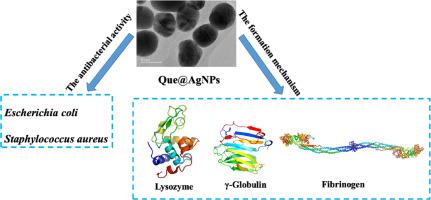
Positively charged quercetin-coated AgNPs (Que@AgNPs) were synthesized using quercetin as reducing agent and cetyltrimethyl ammonium bromide as stabilizer. The antibacterial activity of Que@AgNPs against Escherichia coli and S. aureus is significantly stronger than that of AgNPs without quercetin coating. It is found that the antibacterial activity of Que@AgNPs-lysozyme/γ-globulin complex is further enhanced, which is related to the concentration of Que@AgNPs and the coated lysozyme/γ-globulin. While, the antibacterial activity of Que@AgNPs-fibrinogen complex is lower than that of Que@AgNPs. The formation mechanism of Que@AgNPs-protein complex is further studied. The results show that the interaction between lysozyme/γ-globulin/fibrinogen and Que@AgNPs is a static quenching process. Hydrophobic interaction is important for lysozyme/γ-globulin, whereas in the case of fibrinogen, electrostatic force is mainly present. The presence of two different types of the binding sites for lysozyme and only one type of binding site for γ-globulin and fibrinogen on the surface of Que@AgNPs. The adsorption of lysozyme/γ-globulin/fibrinogen onto Que@AgNPs follows pseudo-second-order model, and chemisorption is the rate-limiting step. The experimental data fit well with Freundlich isotherm model. Que@AgNPs result in the loosening and unfolding of lysozyme/γ-globulin/fibrinogen backbone, and the content of α-helix (lysozyme, fibrinogen) or β-sheet (γ-globulin) of the secondary structure increases with increasing of Que@AgNPs concentrations.
期刊介绍:
The Journal of Molecular Structure is dedicated to the publication of full-length articles and review papers, providing important new structural information on all types of chemical species including:
• Stable and unstable molecules in all types of environments (vapour, molecular beam, liquid, solution, liquid crystal, solid state, matrix-isolated, surface-absorbed etc.)
• Chemical intermediates
• Molecules in excited states
• Biological molecules
• Polymers.
The methods used may include any combination of spectroscopic and non-spectroscopic techniques, for example:
• Infrared spectroscopy (mid, far, near)
• Raman spectroscopy and non-linear Raman methods (CARS, etc.)
• Electronic absorption spectroscopy
• Optical rotatory dispersion and circular dichroism
• Fluorescence and phosphorescence techniques
• Electron spectroscopies (PES, XPS), EXAFS, etc.
• Microwave spectroscopy
• Electron diffraction
• NMR and ESR spectroscopies
• Mössbauer spectroscopy
• X-ray crystallography
• Charge Density Analyses
• Computational Studies (supplementing experimental methods)
We encourage publications combining theoretical and experimental approaches. The structural insights gained by the studies should be correlated with the properties, activity and/ or reactivity of the molecule under investigation and the relevance of this molecule and its implications should be discussed.





 京公网安备 11010802042870号
京ICP备2023020795号-1
京公网安备 11010802042870号
京ICP备2023020795号-1

 分享
分享
 求助内容:
求助内容: 应助结果提醒方式:
 扫码关注我们
