{"title":"手术治疗的老年腰椎管狭窄患者的年龄差异:一项早期和晚期老年患者的回顾性比较研究。","authors":"Ken Takase, Soya Kawabata, Takehiro Michikawa, Yuki Akaike, Takao Tobe, Risa Tobe, Sota Nagai, Takaya Imai, Hiroki Takeda, Shinjiro Kaneko, Shigeki Yamada, Nobuyuki Fujita","doi":"10.1186/s12891-025-08456-8","DOIUrl":null,"url":null,"abstract":"<p><strong>Background: </strong>At present, the threshold defining older adults is 65 years, and this classification has been widely accepted globally. However, with the extension of both life expectancy and healthy life expectancy, there is a need to reconsider this age-based definition. This study compared the characteristics and surgical outcomes of older patients with lumbar spinal stenosis (LSS) between the early and late stages to clarify age diversity in this population.</p><p><strong>Methods: </strong>Data collected from consecutive patients aged ≥ 65 years who underwent LSS surgery were retrospectively reviewed. All participants completed the Zurich Claudication Questionnaire, Japanese Orthopaedic Association Back Pain Evaluation Questionnaire (JOABPEQ), and 25-Question Geriatric Locomotive Function Scale preoperatively as well as 6 and 12 months postoperatively. Frailty was evaluated using the 11-point modified frailty index. Polypharmacy was defined as the concomitant use of at least six drugs.</p><p><strong>Results: </strong>In total, 311 older patients with LSS were enrolled. Among them, 136 patients younger than 75 were categorized into the E group, and 175 patients aged 75 and older were categorized into the L group. Baseline characteristics, including frailty and polypharmacy, significantly differed between the groups. The frequency of effective case of surgical treatment on JOABPEQ was significantly lower for walking ability in the L group. At 1 year after surgery, the incidence of non-improvement in locomotive syndrome stages was higher in the L group than in the E group (relative risk = 1.38, 95% confidence interval [CI] = 1.08-1.78). In addition, when the L group was further divided into three subgroups based on age, the relative risk was 1.32 (95% CI = 0.99-1.76) for patients aged 75 to < 80, 1.42 (95% CI = 1.07-1.88) for those aged 80 to < 85 years, and 1.68 (95% CI = 1.16-2.45) for those aged ≥ 85.</p><p><strong>Conclusions: </strong>Significant differences were observed in baseline characteristics and postoperative improvement of walking ability and locomotive syndrome based on age among older patients with LSS. Our findings underscore the significant age diversity among older adults, highlighting the necessity of considering each patient in a more nuanced age-specific manner rather than adopting a one-size-fits-all approach.</p>","PeriodicalId":9189,"journal":{"name":"BMC Musculoskeletal Disorders","volume":"26 1","pages":"209"},"PeriodicalIF":2.4000,"publicationDate":"2025-02-28","publicationTypes":"Journal Article","fieldsOfStudy":null,"isOpenAccess":false,"openAccessPdf":"https://www.ncbi.nlm.nih.gov/pmc/articles/PMC11869556/pdf/","citationCount":"0","resultStr":"{\"title\":\"Age diversity among older surgically treated patients with lumbar spinal stenosis: a retrospective comparative study of early and late older adults.\",\"authors\":\"Ken Takase, Soya Kawabata, Takehiro Michikawa, Yuki Akaike, Takao Tobe, Risa Tobe, Sota Nagai, Takaya Imai, Hiroki Takeda, Shinjiro Kaneko, Shigeki Yamada, Nobuyuki Fujita\",\"doi\":\"10.1186/s12891-025-08456-8\",\"DOIUrl\":null,\"url\":null,\"abstract\":\"<p><strong>Background: </strong>At present, the threshold defining older adults is 65 years, and this classification has been widely accepted globally. However, with the extension of both life expectancy and healthy life expectancy, there is a need to reconsider this age-based definition. This study compared the characteristics and surgical outcomes of older patients with lumbar spinal stenosis (LSS) between the early and late stages to clarify age diversity in this population.</p><p><strong>Methods: </strong>Data collected from consecutive patients aged ≥ 65 years who underwent LSS surgery were retrospectively reviewed. All participants completed the Zurich Claudication Questionnaire, Japanese Orthopaedic Association Back Pain Evaluation Questionnaire (JOABPEQ), and 25-Question Geriatric Locomotive Function Scale preoperatively as well as 6 and 12 months postoperatively. Frailty was evaluated using the 11-point modified frailty index. Polypharmacy was defined as the concomitant use of at least six drugs.</p><p><strong>Results: </strong>In total, 311 older patients with LSS were enrolled. Among them, 136 patients younger than 75 were categorized into the E group, and 175 patients aged 75 and older were categorized into the L group. Baseline characteristics, including frailty and polypharmacy, significantly differed between the groups. The frequency of effective case of surgical treatment on JOABPEQ was significantly lower for walking ability in the L group. At 1 year after surgery, the incidence of non-improvement in locomotive syndrome stages was higher in the L group than in the E group (relative risk = 1.38, 95% confidence interval [CI] = 1.08-1.78). In addition, when the L group was further divided into three subgroups based on age, the relative risk was 1.32 (95% CI = 0.99-1.76) for patients aged 75 to < 80, 1.42 (95% CI = 1.07-1.88) for those aged 80 to < 85 years, and 1.68 (95% CI = 1.16-2.45) for those aged ≥ 85.</p><p><strong>Conclusions: </strong>Significant differences were observed in baseline characteristics and postoperative improvement of walking ability and locomotive syndrome based on age among older patients with LSS. Our findings underscore the significant age diversity among older adults, highlighting the necessity of considering each patient in a more nuanced age-specific manner rather than adopting a one-size-fits-all approach.</p>\",\"PeriodicalId\":9189,\"journal\":{\"name\":\"BMC Musculoskeletal Disorders\",\"volume\":\"26 1\",\"pages\":\"209\"},\"PeriodicalIF\":2.4000,\"publicationDate\":\"2025-02-28\",\"publicationTypes\":\"Journal Article\",\"fieldsOfStudy\":null,\"isOpenAccess\":false,\"openAccessPdf\":\"https://www.ncbi.nlm.nih.gov/pmc/articles/PMC11869556/pdf/\",\"citationCount\":\"0\",\"resultStr\":null,\"platform\":\"Semanticscholar\",\"paperid\":null,\"PeriodicalName\":\"BMC Musculoskeletal Disorders\",\"FirstCategoryId\":\"3\",\"ListUrlMain\":\"https://doi.org/10.1186/s12891-025-08456-8\",\"RegionNum\":3,\"RegionCategory\":\"医学\",\"ArticlePicture\":[],\"TitleCN\":null,\"AbstractTextCN\":null,\"PMCID\":null,\"EPubDate\":\"\",\"PubModel\":\"\",\"JCR\":\"Q2\",\"JCRName\":\"ORTHOPEDICS\",\"Score\":null,\"Total\":0}","platform":"Semanticscholar","paperid":null,"PeriodicalName":"BMC Musculoskeletal Disorders","FirstCategoryId":"3","ListUrlMain":"https://doi.org/10.1186/s12891-025-08456-8","RegionNum":3,"RegionCategory":"医学","ArticlePicture":[],"TitleCN":null,"AbstractTextCN":null,"PMCID":null,"EPubDate":"","PubModel":"","JCR":"Q2","JCRName":"ORTHOPEDICS","Score":null,"Total":0}
引用次数: 0
摘要
背景:目前,老年人的定义阈值为65岁,这一分类已被全球广泛接受。然而,随着预期寿命和健康预期寿命的延长,有必要重新考虑这一基于年龄的定义。本研究比较了早期和晚期老年腰椎管狭窄(LSS)患者的特征和手术结果,以阐明该人群的年龄多样性。方法:回顾性分析年龄≥65岁连续行LSS手术患者的资料。所有参与者术前及术后6个月和12个月完成苏黎世跛行问卷、日本骨科协会背痛评估问卷(JOABPEQ)和25题老年运动功能量表。使用11点修正的虚弱指数来评估虚弱程度。多重用药被定义为同时使用至少6种药物。结果:共纳入311例老年LSS患者。其中75岁以下136例为E组,75岁及以上175例为L组。基线特征,包括虚弱和多药,在两组之间有显著差异。L组JOABPEQ手术治疗对行走能力的影响明显低于L组。术后1年,L组机车综合征分期未改善的发生率高于E组(相对危险度= 1.38,95%可信区间[CI] = 1.08-1.78)。此外,当L组根据年龄进一步分为三个亚组时,75岁至75岁患者的相对危险度为1.32 (95% CI = 0.99-1.76)。结论:老年LSS患者的基线特征及术后行走能力和运动综合征的改善情况在基于年龄的LSS患者中存在显著差异。我们的研究结果强调了老年人中显著的年龄差异,强调了以更细致入微的年龄特异性方式考虑每位患者的必要性,而不是采用一刀切的方法。
Age diversity among older surgically treated patients with lumbar spinal stenosis: a retrospective comparative study of early and late older adults.
Background: At present, the threshold defining older adults is 65 years, and this classification has been widely accepted globally. However, with the extension of both life expectancy and healthy life expectancy, there is a need to reconsider this age-based definition. This study compared the characteristics and surgical outcomes of older patients with lumbar spinal stenosis (LSS) between the early and late stages to clarify age diversity in this population.
Methods: Data collected from consecutive patients aged ≥ 65 years who underwent LSS surgery were retrospectively reviewed. All participants completed the Zurich Claudication Questionnaire, Japanese Orthopaedic Association Back Pain Evaluation Questionnaire (JOABPEQ), and 25-Question Geriatric Locomotive Function Scale preoperatively as well as 6 and 12 months postoperatively. Frailty was evaluated using the 11-point modified frailty index. Polypharmacy was defined as the concomitant use of at least six drugs.
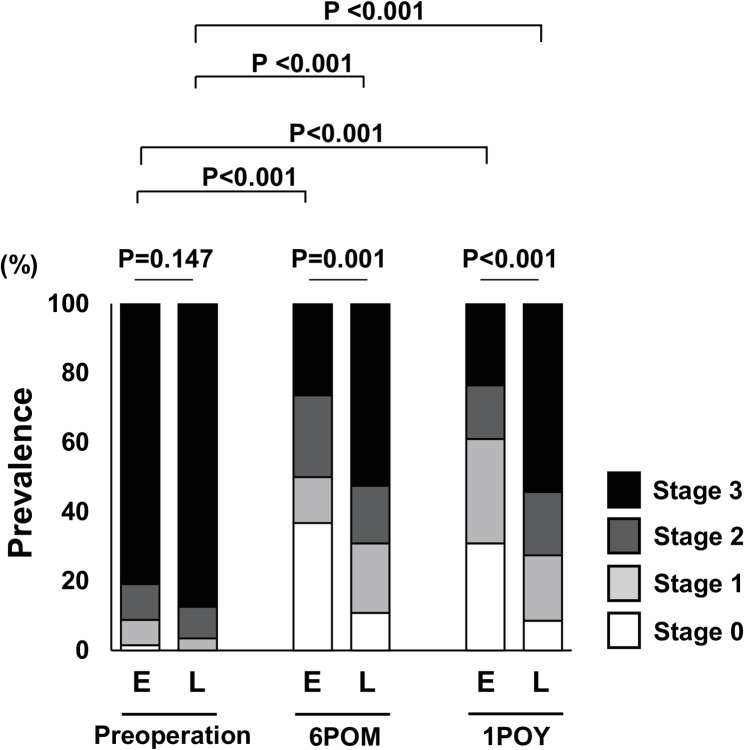
Results: In total, 311 older patients with LSS were enrolled. Among them, 136 patients younger than 75 were categorized into the E group, and 175 patients aged 75 and older were categorized into the L group. Baseline characteristics, including frailty and polypharmacy, significantly differed between the groups. The frequency of effective case of surgical treatment on JOABPEQ was significantly lower for walking ability in the L group. At 1 year after surgery, the incidence of non-improvement in locomotive syndrome stages was higher in the L group than in the E group (relative risk = 1.38, 95% confidence interval [CI] = 1.08-1.78). In addition, when the L group was further divided into three subgroups based on age, the relative risk was 1.32 (95% CI = 0.99-1.76) for patients aged 75 to < 80, 1.42 (95% CI = 1.07-1.88) for those aged 80 to < 85 years, and 1.68 (95% CI = 1.16-2.45) for those aged ≥ 85.
Conclusions: Significant differences were observed in baseline characteristics and postoperative improvement of walking ability and locomotive syndrome based on age among older patients with LSS. Our findings underscore the significant age diversity among older adults, highlighting the necessity of considering each patient in a more nuanced age-specific manner rather than adopting a one-size-fits-all approach.
期刊介绍:
BMC Musculoskeletal Disorders is an open access, peer-reviewed journal that considers articles on all aspects of the prevention, diagnosis and management of musculoskeletal disorders, as well as related molecular genetics, pathophysiology, and epidemiology.
The scope of the Journal covers research into rheumatic diseases where the primary focus relates specifically to a component(s) of the musculoskeletal system.




 京公网安备 11010802042870号
京ICP备2023020795号-1
京公网安备 11010802042870号
京ICP备2023020795号-1

 分享
分享
 求助内容:
求助内容: 应助结果提醒方式:
 扫码关注我们
