Shasha Xue, Li Li, Zhuolun Liu, Feng Lyu, Fan Wu, Panxiao Shi, Yongmin Zhang, Lina Zhang, Zhaoxin Qian
{"title":"使用可解释的机器学习预测成人感染性休克患者对固定剂量亚甲基蓝的反应性:一项回顾性研究。","authors":"Shasha Xue, Li Li, Zhuolun Liu, Feng Lyu, Fan Wu, Panxiao Shi, Yongmin Zhang, Lina Zhang, Zhaoxin Qian","doi":"10.1038/s41598-025-89934-w","DOIUrl":null,"url":null,"abstract":"<p><p>This study aimed to develop an interpretable machine learning model to predict methylene blue (MB) responsiveness in adult patients with refractory septic shock and to identify key factors influencing MB responsiveness using the SHapley Additive exPlanations (SHAP) approach. We retrospectively analyzed data from 416 adult patients with refractory septic shock who received MB treatment at Xiangya Hospital of Central South University between June 2018 and October 2022. MB responders were defined as patients who, within 6 hours after MB administration, exhibited either a reduction in average norepinephrine equivalence (NEE) of ≥ 10% or an increase in mean arterial pressure of ≥ 10 mmHg without an associated increase in NEE. The incidence of MB responders was 38.2%(n=159). Statistical and machine learning methods were used for feature selection, resulting in two datasets (ST and ML). Each dataset was randomly divided into a training set (75%) for model development and a testing set (25%) for internal validation. Prediction models were developed using logistic regression, support vector machine (SVM), random forest, light gradient boosting machine (LightGBM), and explainable boosting machine (EBM). The models were evaluated regarding discrimination, calibration, and clinical benefit. The SVM model trained on the ML dataset demonstrated the best predictive performance, with an area under the curve (AUC) of 0.74 (95% CI 0.62-0.84), 76% accuracy, 36% sensitivity, and 94% specificity. Although the model's sensitivity was low, its high specificity and the safety profile of MB underscore its clinical relevance. The model showed superior net benefit within a 24-85% threshold probability, as determined by decision curve analysis. The SHAP analysis identified the average NEE dose within 6 hours before MB initiation as the most important factor influencing MB responsiveness (P<0.01), with higher doses positively correlating with a greater likelihood of response. Lactate levels were identified as the second most important factor. The optimal model was externally validated in an independent cohort from the same institution, achieving an AUC of 0.75 and an accuracy of 74%.</p>","PeriodicalId":21811,"journal":{"name":"Scientific Reports","volume":"15 1","pages":"7254"},"PeriodicalIF":3.9000,"publicationDate":"2025-03-01","publicationTypes":"Journal Article","fieldsOfStudy":null,"isOpenAccess":false,"openAccessPdf":"https://www.ncbi.nlm.nih.gov/pmc/articles/PMC11871053/pdf/","citationCount":"0","resultStr":"{\"title\":\"Predicting responsiveness to fixed-dose methylene blue in adult patients with septic shock using interpretable machine learning: a retrospective study.\",\"authors\":\"Shasha Xue, Li Li, Zhuolun Liu, Feng Lyu, Fan Wu, Panxiao Shi, Yongmin Zhang, Lina Zhang, Zhaoxin Qian\",\"doi\":\"10.1038/s41598-025-89934-w\",\"DOIUrl\":null,\"url\":null,\"abstract\":\"<p><p>This study aimed to develop an interpretable machine learning model to predict methylene blue (MB) responsiveness in adult patients with refractory septic shock and to identify key factors influencing MB responsiveness using the SHapley Additive exPlanations (SHAP) approach. We retrospectively analyzed data from 416 adult patients with refractory septic shock who received MB treatment at Xiangya Hospital of Central South University between June 2018 and October 2022. MB responders were defined as patients who, within 6 hours after MB administration, exhibited either a reduction in average norepinephrine equivalence (NEE) of ≥ 10% or an increase in mean arterial pressure of ≥ 10 mmHg without an associated increase in NEE. The incidence of MB responders was 38.2%(n=159). Statistical and machine learning methods were used for feature selection, resulting in two datasets (ST and ML). Each dataset was randomly divided into a training set (75%) for model development and a testing set (25%) for internal validation. Prediction models were developed using logistic regression, support vector machine (SVM), random forest, light gradient boosting machine (LightGBM), and explainable boosting machine (EBM). The models were evaluated regarding discrimination, calibration, and clinical benefit. The SVM model trained on the ML dataset demonstrated the best predictive performance, with an area under the curve (AUC) of 0.74 (95% CI 0.62-0.84), 76% accuracy, 36% sensitivity, and 94% specificity. Although the model's sensitivity was low, its high specificity and the safety profile of MB underscore its clinical relevance. The model showed superior net benefit within a 24-85% threshold probability, as determined by decision curve analysis. The SHAP analysis identified the average NEE dose within 6 hours before MB initiation as the most important factor influencing MB responsiveness (P<0.01), with higher doses positively correlating with a greater likelihood of response. Lactate levels were identified as the second most important factor. The optimal model was externally validated in an independent cohort from the same institution, achieving an AUC of 0.75 and an accuracy of 74%.</p>\",\"PeriodicalId\":21811,\"journal\":{\"name\":\"Scientific Reports\",\"volume\":\"15 1\",\"pages\":\"7254\"},\"PeriodicalIF\":3.9000,\"publicationDate\":\"2025-03-01\",\"publicationTypes\":\"Journal Article\",\"fieldsOfStudy\":null,\"isOpenAccess\":false,\"openAccessPdf\":\"https://www.ncbi.nlm.nih.gov/pmc/articles/PMC11871053/pdf/\",\"citationCount\":\"0\",\"resultStr\":null,\"platform\":\"Semanticscholar\",\"paperid\":null,\"PeriodicalName\":\"Scientific Reports\",\"FirstCategoryId\":\"103\",\"ListUrlMain\":\"https://doi.org/10.1038/s41598-025-89934-w\",\"RegionNum\":2,\"RegionCategory\":\"综合性期刊\",\"ArticlePicture\":[],\"TitleCN\":null,\"AbstractTextCN\":null,\"PMCID\":null,\"EPubDate\":\"\",\"PubModel\":\"\",\"JCR\":\"Q1\",\"JCRName\":\"MULTIDISCIPLINARY SCIENCES\",\"Score\":null,\"Total\":0}","platform":"Semanticscholar","paperid":null,"PeriodicalName":"Scientific Reports","FirstCategoryId":"103","ListUrlMain":"https://doi.org/10.1038/s41598-025-89934-w","RegionNum":2,"RegionCategory":"综合性期刊","ArticlePicture":[],"TitleCN":null,"AbstractTextCN":null,"PMCID":null,"EPubDate":"","PubModel":"","JCR":"Q1","JCRName":"MULTIDISCIPLINARY SCIENCES","Score":null,"Total":0}
Predicting responsiveness to fixed-dose methylene blue in adult patients with septic shock using interpretable machine learning: a retrospective study.
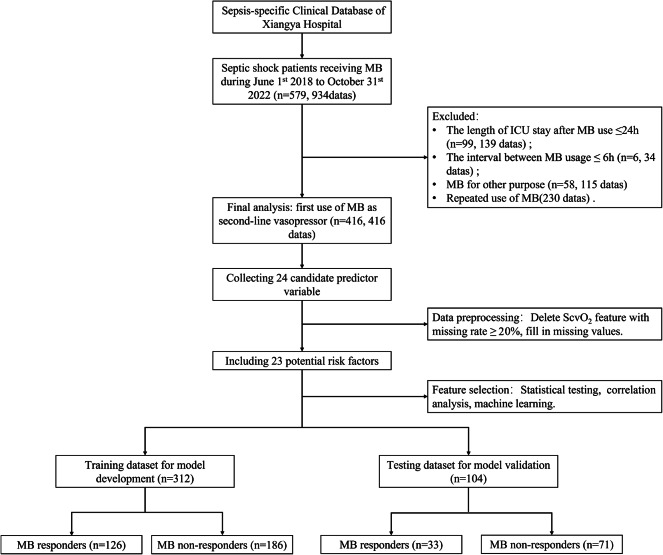
This study aimed to develop an interpretable machine learning model to predict methylene blue (MB) responsiveness in adult patients with refractory septic shock and to identify key factors influencing MB responsiveness using the SHapley Additive exPlanations (SHAP) approach. We retrospectively analyzed data from 416 adult patients with refractory septic shock who received MB treatment at Xiangya Hospital of Central South University between June 2018 and October 2022. MB responders were defined as patients who, within 6 hours after MB administration, exhibited either a reduction in average norepinephrine equivalence (NEE) of ≥ 10% or an increase in mean arterial pressure of ≥ 10 mmHg without an associated increase in NEE. The incidence of MB responders was 38.2%(n=159). Statistical and machine learning methods were used for feature selection, resulting in two datasets (ST and ML). Each dataset was randomly divided into a training set (75%) for model development and a testing set (25%) for internal validation. Prediction models were developed using logistic regression, support vector machine (SVM), random forest, light gradient boosting machine (LightGBM), and explainable boosting machine (EBM). The models were evaluated regarding discrimination, calibration, and clinical benefit. The SVM model trained on the ML dataset demonstrated the best predictive performance, with an area under the curve (AUC) of 0.74 (95% CI 0.62-0.84), 76% accuracy, 36% sensitivity, and 94% specificity. Although the model's sensitivity was low, its high specificity and the safety profile of MB underscore its clinical relevance. The model showed superior net benefit within a 24-85% threshold probability, as determined by decision curve analysis. The SHAP analysis identified the average NEE dose within 6 hours before MB initiation as the most important factor influencing MB responsiveness (P<0.01), with higher doses positively correlating with a greater likelihood of response. Lactate levels were identified as the second most important factor. The optimal model was externally validated in an independent cohort from the same institution, achieving an AUC of 0.75 and an accuracy of 74%.
期刊介绍:
We publish original research from all areas of the natural sciences, psychology, medicine and engineering. You can learn more about what we publish by browsing our specific scientific subject areas below or explore Scientific Reports by browsing all articles and collections.
Scientific Reports has a 2-year impact factor: 4.380 (2021), and is the 6th most-cited journal in the world, with more than 540,000 citations in 2020 (Clarivate Analytics, 2021).
•Engineering
Engineering covers all aspects of engineering, technology, and applied science. It plays a crucial role in the development of technologies to address some of the world''s biggest challenges, helping to save lives and improve the way we live.
•Physical sciences
Physical sciences are those academic disciplines that aim to uncover the underlying laws of nature — often written in the language of mathematics. It is a collective term for areas of study including astronomy, chemistry, materials science and physics.
•Earth and environmental sciences
Earth and environmental sciences cover all aspects of Earth and planetary science and broadly encompass solid Earth processes, surface and atmospheric dynamics, Earth system history, climate and climate change, marine and freshwater systems, and ecology. It also considers the interactions between humans and these systems.
•Biological sciences
Biological sciences encompass all the divisions of natural sciences examining various aspects of vital processes. The concept includes anatomy, physiology, cell biology, biochemistry and biophysics, and covers all organisms from microorganisms, animals to plants.
•Health sciences
The health sciences study health, disease and healthcare. This field of study aims to develop knowledge, interventions and technology for use in healthcare to improve the treatment of patients.






 京公网安备 11010802042870号
京ICP备2023020795号-1
京公网安备 11010802042870号
京ICP备2023020795号-1

 分享
分享
 求助内容:
求助内容: 应助结果提醒方式:
 扫码关注我们
