Vandna Chhabra, S Sreethu, Gurleen Kaur, Amritpal Singh, Manpreet Kaur, Manzer H Siddiqui, Rajeev Kumar Gupta
{"title":"不同土地配置和养分管理下小麦作物对涝渍条件的响应","authors":"Vandna Chhabra, S Sreethu, Gurleen Kaur, Amritpal Singh, Manpreet Kaur, Manzer H Siddiqui, Rajeev Kumar Gupta","doi":"10.1038/s41598-024-83752-2","DOIUrl":null,"url":null,"abstract":"<p><p>By 2050, the global population is expected to increase from 7.7 billion to 9.7 billion, and wheat will remain crucial for ensuring food security worldwide. It supplies food for more than 4.5 billion individuals in 94 countries and constitutes 40% of the primary diet for the global population. It also has 20% protein and 21% calories. An important concern for wheat cultivation is waterlogging stress, which may escalate in occurrence and intensity due to climate change. The raised bed planting pattern was created to reduce the negative impact of waterlogging stress on wheat productivity. The study was conducted during the rabi seasons of 2017-2018 and 2018-2019 to assess the impact of various nutrient management practices on the growth, yield, and yield characteristics of wheat using flat and raised bed planting methods at the crop research farm in Punjab. The study found that wheat cultivated using a raised bed system with recommended nitrogen, phosphorus, and potassium showed significantly improved plant height (105.28 cm), number of effective tillers per plant (25.08), spike length (11.67 cm), number of grains per spike (72.50), grain yield (6.97 t/ha), and straw yield (9.39 t/ha) compared to traditional planting techniques. Furthermore, these investigations need to be repeated at various locations with various agro-climatic circumstances.</p>","PeriodicalId":21811,"journal":{"name":"Scientific Reports","volume":"15 1","pages":"7168"},"PeriodicalIF":3.9000,"publicationDate":"2025-02-28","publicationTypes":"Journal Article","fieldsOfStudy":null,"isOpenAccess":false,"openAccessPdf":"https://www.ncbi.nlm.nih.gov/pmc/articles/PMC11871076/pdf/","citationCount":"0","resultStr":"{\"title\":\"Response of wheat crop to water-logged conditions under different land configurations and nutrient management.\",\"authors\":\"Vandna Chhabra, S Sreethu, Gurleen Kaur, Amritpal Singh, Manpreet Kaur, Manzer H Siddiqui, Rajeev Kumar Gupta\",\"doi\":\"10.1038/s41598-024-83752-2\",\"DOIUrl\":null,\"url\":null,\"abstract\":\"<p><p>By 2050, the global population is expected to increase from 7.7 billion to 9.7 billion, and wheat will remain crucial for ensuring food security worldwide. It supplies food for more than 4.5 billion individuals in 94 countries and constitutes 40% of the primary diet for the global population. It also has 20% protein and 21% calories. An important concern for wheat cultivation is waterlogging stress, which may escalate in occurrence and intensity due to climate change. The raised bed planting pattern was created to reduce the negative impact of waterlogging stress on wheat productivity. The study was conducted during the rabi seasons of 2017-2018 and 2018-2019 to assess the impact of various nutrient management practices on the growth, yield, and yield characteristics of wheat using flat and raised bed planting methods at the crop research farm in Punjab. The study found that wheat cultivated using a raised bed system with recommended nitrogen, phosphorus, and potassium showed significantly improved plant height (105.28 cm), number of effective tillers per plant (25.08), spike length (11.67 cm), number of grains per spike (72.50), grain yield (6.97 t/ha), and straw yield (9.39 t/ha) compared to traditional planting techniques. Furthermore, these investigations need to be repeated at various locations with various agro-climatic circumstances.</p>\",\"PeriodicalId\":21811,\"journal\":{\"name\":\"Scientific Reports\",\"volume\":\"15 1\",\"pages\":\"7168\"},\"PeriodicalIF\":3.9000,\"publicationDate\":\"2025-02-28\",\"publicationTypes\":\"Journal Article\",\"fieldsOfStudy\":null,\"isOpenAccess\":false,\"openAccessPdf\":\"https://www.ncbi.nlm.nih.gov/pmc/articles/PMC11871076/pdf/\",\"citationCount\":\"0\",\"resultStr\":null,\"platform\":\"Semanticscholar\",\"paperid\":null,\"PeriodicalName\":\"Scientific Reports\",\"FirstCategoryId\":\"103\",\"ListUrlMain\":\"https://doi.org/10.1038/s41598-024-83752-2\",\"RegionNum\":2,\"RegionCategory\":\"综合性期刊\",\"ArticlePicture\":[],\"TitleCN\":null,\"AbstractTextCN\":null,\"PMCID\":null,\"EPubDate\":\"\",\"PubModel\":\"\",\"JCR\":\"Q1\",\"JCRName\":\"MULTIDISCIPLINARY SCIENCES\",\"Score\":null,\"Total\":0}","platform":"Semanticscholar","paperid":null,"PeriodicalName":"Scientific Reports","FirstCategoryId":"103","ListUrlMain":"https://doi.org/10.1038/s41598-024-83752-2","RegionNum":2,"RegionCategory":"综合性期刊","ArticlePicture":[],"TitleCN":null,"AbstractTextCN":null,"PMCID":null,"EPubDate":"","PubModel":"","JCR":"Q1","JCRName":"MULTIDISCIPLINARY SCIENCES","Score":null,"Total":0}
Response of wheat crop to water-logged conditions under different land configurations and nutrient management.
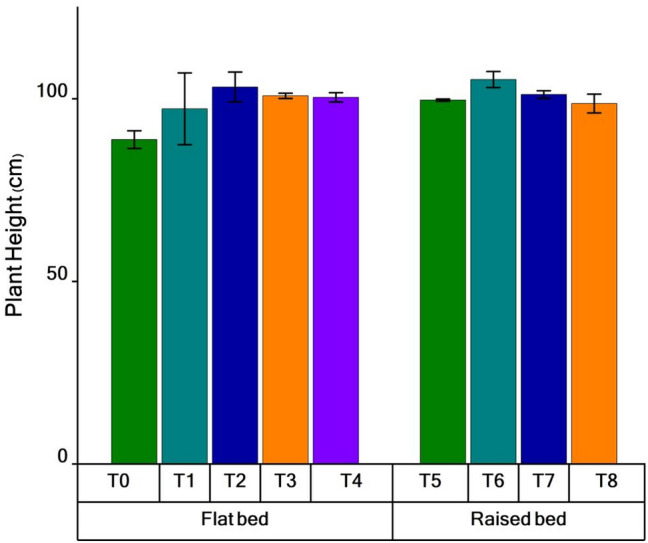
By 2050, the global population is expected to increase from 7.7 billion to 9.7 billion, and wheat will remain crucial for ensuring food security worldwide. It supplies food for more than 4.5 billion individuals in 94 countries and constitutes 40% of the primary diet for the global population. It also has 20% protein and 21% calories. An important concern for wheat cultivation is waterlogging stress, which may escalate in occurrence and intensity due to climate change. The raised bed planting pattern was created to reduce the negative impact of waterlogging stress on wheat productivity. The study was conducted during the rabi seasons of 2017-2018 and 2018-2019 to assess the impact of various nutrient management practices on the growth, yield, and yield characteristics of wheat using flat and raised bed planting methods at the crop research farm in Punjab. The study found that wheat cultivated using a raised bed system with recommended nitrogen, phosphorus, and potassium showed significantly improved plant height (105.28 cm), number of effective tillers per plant (25.08), spike length (11.67 cm), number of grains per spike (72.50), grain yield (6.97 t/ha), and straw yield (9.39 t/ha) compared to traditional planting techniques. Furthermore, these investigations need to be repeated at various locations with various agro-climatic circumstances.
期刊介绍:
We publish original research from all areas of the natural sciences, psychology, medicine and engineering. You can learn more about what we publish by browsing our specific scientific subject areas below or explore Scientific Reports by browsing all articles and collections.
Scientific Reports has a 2-year impact factor: 4.380 (2021), and is the 6th most-cited journal in the world, with more than 540,000 citations in 2020 (Clarivate Analytics, 2021).
•Engineering
Engineering covers all aspects of engineering, technology, and applied science. It plays a crucial role in the development of technologies to address some of the world''s biggest challenges, helping to save lives and improve the way we live.
•Physical sciences
Physical sciences are those academic disciplines that aim to uncover the underlying laws of nature — often written in the language of mathematics. It is a collective term for areas of study including astronomy, chemistry, materials science and physics.
•Earth and environmental sciences
Earth and environmental sciences cover all aspects of Earth and planetary science and broadly encompass solid Earth processes, surface and atmospheric dynamics, Earth system history, climate and climate change, marine and freshwater systems, and ecology. It also considers the interactions between humans and these systems.
•Biological sciences
Biological sciences encompass all the divisions of natural sciences examining various aspects of vital processes. The concept includes anatomy, physiology, cell biology, biochemistry and biophysics, and covers all organisms from microorganisms, animals to plants.
•Health sciences
The health sciences study health, disease and healthcare. This field of study aims to develop knowledge, interventions and technology for use in healthcare to improve the treatment of patients.





 京公网安备 11010802042870号
京ICP备2023020795号-1
京公网安备 11010802042870号
京ICP备2023020795号-1

 分享
分享
 求助内容:
求助内容: 应助结果提醒方式:
 扫码关注我们
