Dominik Stelzle, Ajay Rangaraj, Joseph N Jarvis, Nirina H Razakasoa, George Perrin, Daniel Low-Beer, Meg Doherty, Nathan Ford, Shona Dalal
{"title":"撒哈拉以南非洲艾滋病毒晚期患病率:对具有全国代表性的家庭调查的多国分析。","authors":"Dominik Stelzle, Ajay Rangaraj, Joseph N Jarvis, Nirina H Razakasoa, George Perrin, Daniel Low-Beer, Meg Doherty, Nathan Ford, Shona Dalal","doi":"10.1016/S2214-109X(24)00538-2","DOIUrl":null,"url":null,"abstract":"<p><strong>Background: </strong>Advanced HIV disease (AHD) is a critical stage in the progression of HIV infection and is associated with heightened susceptibility to opportunistic infections, malignancies, and other life-threatening complications. Estimates of the burden of AHD in sub-Saharan Africa are scarce but are needed for programme planning which includes the allocation of resources and the monitoring of outcomes. The aim of the study was to assess the prevalence of and the number of people living with HIV with AHD.</p><p><strong>Methods: </strong>In this nationally representative study, we analysed data from 13 Population-based HIV Impact Assessment (PHIA) household surveys conducted between 2016 and 2021 to determine the proportion of adults living with HIV who have AHD (defined as CD4 count <200 cells per mm<sup>3</sup>). We analysed the prevalence of AHD by various demographic and socioeconomic factors; we then estimated the number of individuals with AHD in sub-Saharan Africa by combining these proportions with the latest UNAIDS HIV estimates for the region by the treatment and care cascade. We also assessed policies related to the provision of the recommended package of care for the diagnosis and management of AHD.</p><p><strong>Findings: </strong>A total of 28 040 people living with HIV were included in this study from 13 PHIA surveys. 19 364 were females (weighted percentage 64·5%) and 8676 (35·5%) were males, and the median age of participants was 38 years (IQR 30-47). Pooled across the 13 countries, 9·8% (95% CI 9·3-10·3) had a CD4 cell count of less than 200 cells per mm<sup>3</sup>. AHD was more common among males than females (13·2% vs 8·0%) and differed across the treatment cascade: 15·4% among people living with HIV who did not know their HIV status, 20·9% among people who knew their status but were not on antiretroviral treatment (ART), 29·5% among people who were on ART but not virally suppressed, and 4·3% among people who were virally suppressed. Extrapolating these results to sub-Saharan Africa yielded an estimated 1·88 million people living with AHD (uncertainty interval [UI] 1·58-2·20); 920 000 (UI 770 000-1·07 million) females and 970 000 (UI 810 000-1·13 million) males.</p><p><strong>Interpretation: </strong>Despite advances in ART that have transformed HIV into a manageable chronic condition, a substantial number of people continue to develop AHD. These figures highlight the need for urgent and innovative programmatic improvements in monitoring, prevention, testing, and diagnosis of AHD in the context of well-established and maturing ART programmes.</p><p><strong>Funding: </strong>None.</p>","PeriodicalId":48783,"journal":{"name":"Lancet Global Health","volume":"13 3","pages":"e437-e446"},"PeriodicalIF":19.9000,"publicationDate":"2025-03-01","publicationTypes":"Journal Article","fieldsOfStudy":null,"isOpenAccess":false,"openAccessPdf":"https://www.ncbi.nlm.nih.gov/pmc/articles/PMC11868778/pdf/","citationCount":"0","resultStr":"{\"title\":\"Prevalence of advanced HIV disease in sub-Saharan Africa: a multi-country analysis of nationally representative household surveys.\",\"authors\":\"Dominik Stelzle, Ajay Rangaraj, Joseph N Jarvis, Nirina H Razakasoa, George Perrin, Daniel Low-Beer, Meg Doherty, Nathan Ford, Shona Dalal\",\"doi\":\"10.1016/S2214-109X(24)00538-2\",\"DOIUrl\":null,\"url\":null,\"abstract\":\"<p><strong>Background: </strong>Advanced HIV disease (AHD) is a critical stage in the progression of HIV infection and is associated with heightened susceptibility to opportunistic infections, malignancies, and other life-threatening complications. Estimates of the burden of AHD in sub-Saharan Africa are scarce but are needed for programme planning which includes the allocation of resources and the monitoring of outcomes. The aim of the study was to assess the prevalence of and the number of people living with HIV with AHD.</p><p><strong>Methods: </strong>In this nationally representative study, we analysed data from 13 Population-based HIV Impact Assessment (PHIA) household surveys conducted between 2016 and 2021 to determine the proportion of adults living with HIV who have AHD (defined as CD4 count <200 cells per mm<sup>3</sup>). We analysed the prevalence of AHD by various demographic and socioeconomic factors; we then estimated the number of individuals with AHD in sub-Saharan Africa by combining these proportions with the latest UNAIDS HIV estimates for the region by the treatment and care cascade. We also assessed policies related to the provision of the recommended package of care for the diagnosis and management of AHD.</p><p><strong>Findings: </strong>A total of 28 040 people living with HIV were included in this study from 13 PHIA surveys. 19 364 were females (weighted percentage 64·5%) and 8676 (35·5%) were males, and the median age of participants was 38 years (IQR 30-47). Pooled across the 13 countries, 9·8% (95% CI 9·3-10·3) had a CD4 cell count of less than 200 cells per mm<sup>3</sup>. AHD was more common among males than females (13·2% vs 8·0%) and differed across the treatment cascade: 15·4% among people living with HIV who did not know their HIV status, 20·9% among people who knew their status but were not on antiretroviral treatment (ART), 29·5% among people who were on ART but not virally suppressed, and 4·3% among people who were virally suppressed. Extrapolating these results to sub-Saharan Africa yielded an estimated 1·88 million people living with AHD (uncertainty interval [UI] 1·58-2·20); 920 000 (UI 770 000-1·07 million) females and 970 000 (UI 810 000-1·13 million) males.</p><p><strong>Interpretation: </strong>Despite advances in ART that have transformed HIV into a manageable chronic condition, a substantial number of people continue to develop AHD. These figures highlight the need for urgent and innovative programmatic improvements in monitoring, prevention, testing, and diagnosis of AHD in the context of well-established and maturing ART programmes.</p><p><strong>Funding: </strong>None.</p>\",\"PeriodicalId\":48783,\"journal\":{\"name\":\"Lancet Global Health\",\"volume\":\"13 3\",\"pages\":\"e437-e446\"},\"PeriodicalIF\":19.9000,\"publicationDate\":\"2025-03-01\",\"publicationTypes\":\"Journal Article\",\"fieldsOfStudy\":null,\"isOpenAccess\":false,\"openAccessPdf\":\"https://www.ncbi.nlm.nih.gov/pmc/articles/PMC11868778/pdf/\",\"citationCount\":\"0\",\"resultStr\":null,\"platform\":\"Semanticscholar\",\"paperid\":null,\"PeriodicalName\":\"Lancet Global Health\",\"FirstCategoryId\":\"3\",\"ListUrlMain\":\"https://doi.org/10.1016/S2214-109X(24)00538-2\",\"RegionNum\":1,\"RegionCategory\":\"医学\",\"ArticlePicture\":[],\"TitleCN\":null,\"AbstractTextCN\":null,\"PMCID\":null,\"EPubDate\":\"\",\"PubModel\":\"\",\"JCR\":\"Q1\",\"JCRName\":\"PUBLIC, ENVIRONMENTAL & OCCUPATIONAL HEALTH\",\"Score\":null,\"Total\":0}","platform":"Semanticscholar","paperid":null,"PeriodicalName":"Lancet Global Health","FirstCategoryId":"3","ListUrlMain":"https://doi.org/10.1016/S2214-109X(24)00538-2","RegionNum":1,"RegionCategory":"医学","ArticlePicture":[],"TitleCN":null,"AbstractTextCN":null,"PMCID":null,"EPubDate":"","PubModel":"","JCR":"Q1","JCRName":"PUBLIC, ENVIRONMENTAL & OCCUPATIONAL HEALTH","Score":null,"Total":0}
Prevalence of advanced HIV disease in sub-Saharan Africa: a multi-country analysis of nationally representative household surveys.
Background: Advanced HIV disease (AHD) is a critical stage in the progression of HIV infection and is associated with heightened susceptibility to opportunistic infections, malignancies, and other life-threatening complications. Estimates of the burden of AHD in sub-Saharan Africa are scarce but are needed for programme planning which includes the allocation of resources and the monitoring of outcomes. The aim of the study was to assess the prevalence of and the number of people living with HIV with AHD.
Methods: In this nationally representative study, we analysed data from 13 Population-based HIV Impact Assessment (PHIA) household surveys conducted between 2016 and 2021 to determine the proportion of adults living with HIV who have AHD (defined as CD4 count <200 cells per mm3). We analysed the prevalence of AHD by various demographic and socioeconomic factors; we then estimated the number of individuals with AHD in sub-Saharan Africa by combining these proportions with the latest UNAIDS HIV estimates for the region by the treatment and care cascade. We also assessed policies related to the provision of the recommended package of care for the diagnosis and management of AHD.
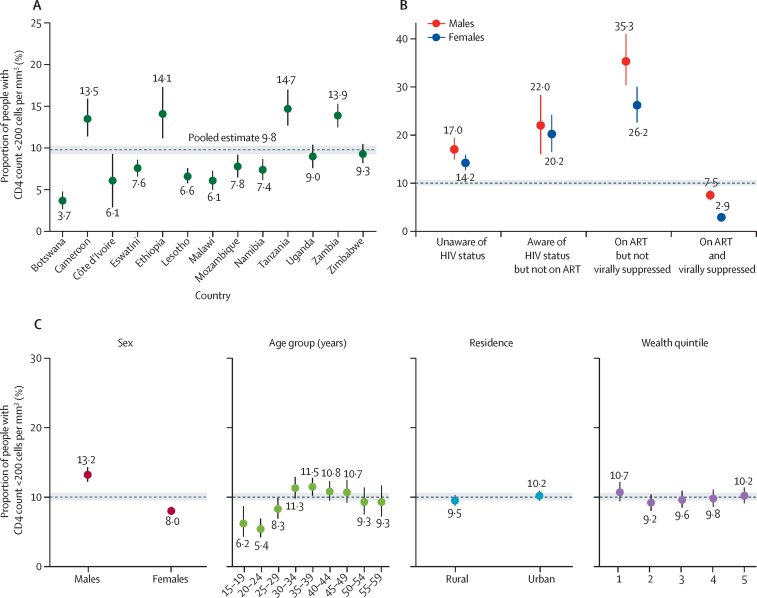
Findings: A total of 28 040 people living with HIV were included in this study from 13 PHIA surveys. 19 364 were females (weighted percentage 64·5%) and 8676 (35·5%) were males, and the median age of participants was 38 years (IQR 30-47). Pooled across the 13 countries, 9·8% (95% CI 9·3-10·3) had a CD4 cell count of less than 200 cells per mm3. AHD was more common among males than females (13·2% vs 8·0%) and differed across the treatment cascade: 15·4% among people living with HIV who did not know their HIV status, 20·9% among people who knew their status but were not on antiretroviral treatment (ART), 29·5% among people who were on ART but not virally suppressed, and 4·3% among people who were virally suppressed. Extrapolating these results to sub-Saharan Africa yielded an estimated 1·88 million people living with AHD (uncertainty interval [UI] 1·58-2·20); 920 000 (UI 770 000-1·07 million) females and 970 000 (UI 810 000-1·13 million) males.
Interpretation: Despite advances in ART that have transformed HIV into a manageable chronic condition, a substantial number of people continue to develop AHD. These figures highlight the need for urgent and innovative programmatic improvements in monitoring, prevention, testing, and diagnosis of AHD in the context of well-established and maturing ART programmes.
期刊介绍:
The Lancet Global Health is an online publication that releases monthly open access (subscription-free) issues.Each issue includes original research, commentary, and correspondence.In addition to this, the publication also provides regular blog posts.
The main focus of The Lancet Global Health is on disadvantaged populations, which can include both entire economic regions and marginalized groups within prosperous nations.The publication prefers to cover topics related to reproductive, maternal, neonatal, child, and adolescent health; infectious diseases (including neglected tropical diseases); non-communicable diseases; mental health; the global health workforce; health systems; surgery; and health policy.





 京公网安备 11010802042870号
京ICP备2023020795号-1
京公网安备 11010802042870号
京ICP备2023020795号-1

 分享
分享
 求助内容:
求助内容: 应助结果提醒方式:
 扫码关注我们
