Agathe Margulies, Nassim Sahki, Fabien Rech, Guillaume Vogin, Marie Blonski, Didier Peiffert, Luc Taillandier, Grégory Lesanne, Nicolas Demogeot
{"title":"成人胶质母细胞瘤分次立体定向再照射后的复发模式。","authors":"Agathe Margulies, Nassim Sahki, Fabien Rech, Guillaume Vogin, Marie Blonski, Didier Peiffert, Luc Taillandier, Grégory Lesanne, Nicolas Demogeot","doi":"10.1186/s13014-025-02611-0","DOIUrl":null,"url":null,"abstract":"<p><strong>Background: </strong>Glioblastomas all eventually relapse after initial treatment, and an option to treat these recurrences is fractionated stereotactic reirradiation (fSRT). The location of recurrences following reirradiation has not been studied for fSRT delivered by a dedicated stereotactic device. We aimed to analyze these locations to better elucidate safety margins, dose and fractionation regimens.</p><p><strong>Methods: </strong>We retrospectively analyzed the data of patients with glioblastoma recurrence that had been reirradiated by fSRT in October 2010-December 2020, in 25 Gy in 5 fractions delivered by a CyberKnife<sup>®</sup> at Institut de Cancérologie de Lorraine. We matched the images of the post-fSRT relapse with the stereotactic radiation treatment planning scan to determine the relapse location.</p><p><strong>Results: </strong>The location of recurrences after fSRT was \"out-field\" in 43.5%, \"marginal\" in 40.3%, and \"in-field\" in 16.1% of patients (N = 62). A GTV-PTV margin of 1 mm (versus 2-3 mm, HR = 0.38 [0.15-0.95], p = 0.037) and a PTV volume of ≥ 36 cc (HR = 5.18 [1.06-25.3], p = 0.042) were significantly associated with the \"marginal\" recurrences. Being ≥ 60 years old at initial treatment (HR = 3.06 [1.17-8.01], p = 0.023) and having one or more previous recurrences (HR = 5.29 [1.70-16.5], p = 0.004) were significantly associated with \"out-field\" recurrences. The median PFS from fSRT was 3.4 months, and OS from diagnosis and from fSRT were 25.7 and 10.8 months respectively.</p><p><strong>Conclusion: </strong>Reirradiation of glioblastoma recurrence by fSRT with 25 Gy in 5 fractions provides good local control.</p>","PeriodicalId":49639,"journal":{"name":"Radiation Oncology","volume":"20 1","pages":"28"},"PeriodicalIF":3.6000,"publicationDate":"2025-02-28","publicationTypes":"Journal Article","fieldsOfStudy":null,"isOpenAccess":false,"openAccessPdf":"https://www.ncbi.nlm.nih.gov/pmc/articles/PMC11871646/pdf/","citationCount":"0","resultStr":"{\"title\":\"Pattern of recurrence after fractionated stereotactic reirradiation in adult glioblastoma.\",\"authors\":\"Agathe Margulies, Nassim Sahki, Fabien Rech, Guillaume Vogin, Marie Blonski, Didier Peiffert, Luc Taillandier, Grégory Lesanne, Nicolas Demogeot\",\"doi\":\"10.1186/s13014-025-02611-0\",\"DOIUrl\":null,\"url\":null,\"abstract\":\"<p><strong>Background: </strong>Glioblastomas all eventually relapse after initial treatment, and an option to treat these recurrences is fractionated stereotactic reirradiation (fSRT). The location of recurrences following reirradiation has not been studied for fSRT delivered by a dedicated stereotactic device. We aimed to analyze these locations to better elucidate safety margins, dose and fractionation regimens.</p><p><strong>Methods: </strong>We retrospectively analyzed the data of patients with glioblastoma recurrence that had been reirradiated by fSRT in October 2010-December 2020, in 25 Gy in 5 fractions delivered by a CyberKnife<sup>®</sup> at Institut de Cancérologie de Lorraine. We matched the images of the post-fSRT relapse with the stereotactic radiation treatment planning scan to determine the relapse location.</p><p><strong>Results: </strong>The location of recurrences after fSRT was \\\"out-field\\\" in 43.5%, \\\"marginal\\\" in 40.3%, and \\\"in-field\\\" in 16.1% of patients (N = 62). A GTV-PTV margin of 1 mm (versus 2-3 mm, HR = 0.38 [0.15-0.95], p = 0.037) and a PTV volume of ≥ 36 cc (HR = 5.18 [1.06-25.3], p = 0.042) were significantly associated with the \\\"marginal\\\" recurrences. Being ≥ 60 years old at initial treatment (HR = 3.06 [1.17-8.01], p = 0.023) and having one or more previous recurrences (HR = 5.29 [1.70-16.5], p = 0.004) were significantly associated with \\\"out-field\\\" recurrences. The median PFS from fSRT was 3.4 months, and OS from diagnosis and from fSRT were 25.7 and 10.8 months respectively.</p><p><strong>Conclusion: </strong>Reirradiation of glioblastoma recurrence by fSRT with 25 Gy in 5 fractions provides good local control.</p>\",\"PeriodicalId\":49639,\"journal\":{\"name\":\"Radiation Oncology\",\"volume\":\"20 1\",\"pages\":\"28\"},\"PeriodicalIF\":3.6000,\"publicationDate\":\"2025-02-28\",\"publicationTypes\":\"Journal Article\",\"fieldsOfStudy\":null,\"isOpenAccess\":false,\"openAccessPdf\":\"https://www.ncbi.nlm.nih.gov/pmc/articles/PMC11871646/pdf/\",\"citationCount\":\"0\",\"resultStr\":null,\"platform\":\"Semanticscholar\",\"paperid\":null,\"PeriodicalName\":\"Radiation Oncology\",\"FirstCategoryId\":\"3\",\"ListUrlMain\":\"https://doi.org/10.1186/s13014-025-02611-0\",\"RegionNum\":2,\"RegionCategory\":\"医学\",\"ArticlePicture\":[],\"TitleCN\":null,\"AbstractTextCN\":null,\"PMCID\":null,\"EPubDate\":\"\",\"PubModel\":\"\",\"JCR\":\"Q2\",\"JCRName\":\"ONCOLOGY\",\"Score\":null,\"Total\":0}","platform":"Semanticscholar","paperid":null,"PeriodicalName":"Radiation Oncology","FirstCategoryId":"3","ListUrlMain":"https://doi.org/10.1186/s13014-025-02611-0","RegionNum":2,"RegionCategory":"医学","ArticlePicture":[],"TitleCN":null,"AbstractTextCN":null,"PMCID":null,"EPubDate":"","PubModel":"","JCR":"Q2","JCRName":"ONCOLOGY","Score":null,"Total":0}
引用次数: 0
摘要
背景:胶质母细胞瘤在初始治疗后最终都会复发,治疗这些复发的一种选择是分次立体定向再照射(fSRT)。对于使用专用立体定向装置的fSRT,再照射后复发的位置尚未进行研究。我们的目的是分析这些位置,以更好地阐明安全边际,剂量和分离方案。方法:我们回顾性分析了2010年10月至2020年12月期间接受fSRT再放射治疗的胶质母细胞瘤复发患者的数据,fSRT由洛林癌症研究所的射波刀®以25 Gy的速度分5次放射。我们将fsrt后复发的图像与立体定向放射治疗计划扫描相匹配,以确定复发部位。结果:fSRT后复发部位为“外场”43.5%,“边缘”40.3%,“内场”16.1% (N = 62)。GTV-PTV边缘为1 mm(相对于2-3 mm, HR = 0.38 [0.15-0.95], p = 0.037)和PTV体积≥36 cc (HR = 5.18 [1.06-25.3], p = 0.042)与“边缘”复发显著相关。初始治疗时年龄≥60岁(HR = 3.06 [1.17-8.01], p = 0.023),既往有过一次或多次复发(HR = 5.29 [1.70-16.5], p = 0.004)与“外场”复发显著相关。fSRT的中位PFS为3.4个月,诊断和fSRT的OS分别为25.7个月和10.8个月。结论:25 Gy分5次fSRT再照射对胶质母细胞瘤复发有较好的局部控制作用。
Pattern of recurrence after fractionated stereotactic reirradiation in adult glioblastoma.
Background: Glioblastomas all eventually relapse after initial treatment, and an option to treat these recurrences is fractionated stereotactic reirradiation (fSRT). The location of recurrences following reirradiation has not been studied for fSRT delivered by a dedicated stereotactic device. We aimed to analyze these locations to better elucidate safety margins, dose and fractionation regimens.
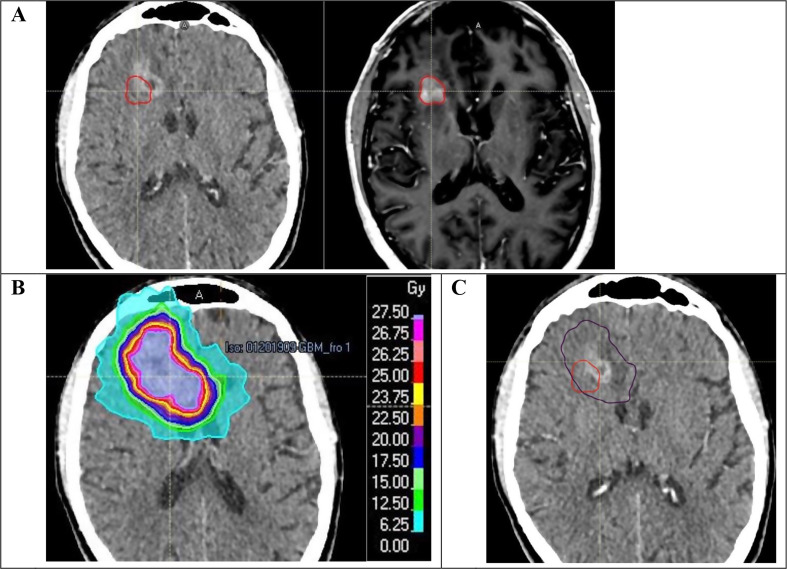
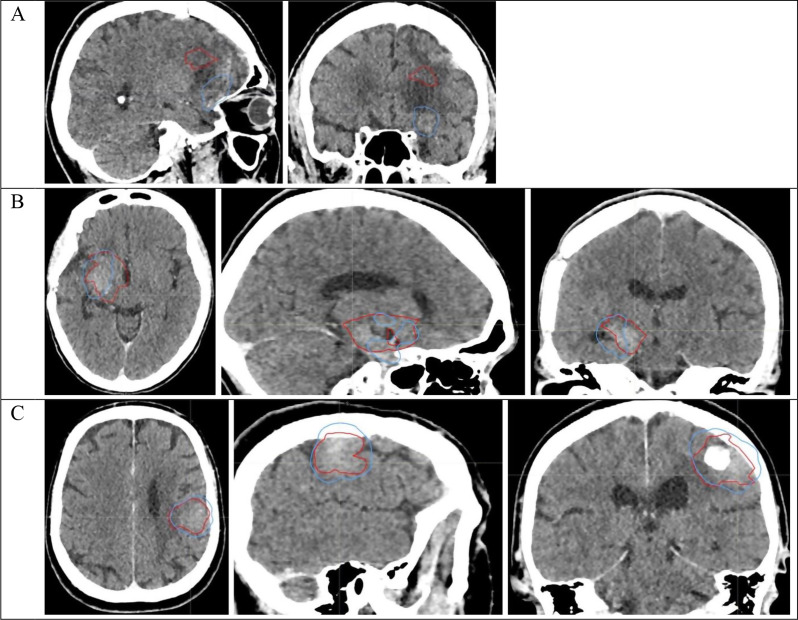
Methods: We retrospectively analyzed the data of patients with glioblastoma recurrence that had been reirradiated by fSRT in October 2010-December 2020, in 25 Gy in 5 fractions delivered by a CyberKnife® at Institut de Cancérologie de Lorraine. We matched the images of the post-fSRT relapse with the stereotactic radiation treatment planning scan to determine the relapse location.
Results: The location of recurrences after fSRT was "out-field" in 43.5%, "marginal" in 40.3%, and "in-field" in 16.1% of patients (N = 62). A GTV-PTV margin of 1 mm (versus 2-3 mm, HR = 0.38 [0.15-0.95], p = 0.037) and a PTV volume of ≥ 36 cc (HR = 5.18 [1.06-25.3], p = 0.042) were significantly associated with the "marginal" recurrences. Being ≥ 60 years old at initial treatment (HR = 3.06 [1.17-8.01], p = 0.023) and having one or more previous recurrences (HR = 5.29 [1.70-16.5], p = 0.004) were significantly associated with "out-field" recurrences. The median PFS from fSRT was 3.4 months, and OS from diagnosis and from fSRT were 25.7 and 10.8 months respectively.
Conclusion: Reirradiation of glioblastoma recurrence by fSRT with 25 Gy in 5 fractions provides good local control.
Radiation OncologyONCOLOGY-RADIOLOGY, NUCLEAR MEDICINE & MEDICAL IMAGING
CiteScore
6.50
自引率
2.80%
发文量
181
审稿时长
3-6 weeks
期刊介绍:
Radiation Oncology encompasses all aspects of research that impacts on the treatment of cancer using radiation. It publishes findings in molecular and cellular radiation biology, radiation physics, radiation technology, and clinical oncology.




 京公网安备 11010802042870号
京ICP备2023020795号-1
京公网安备 11010802042870号
京ICP备2023020795号-1

 分享
分享
 求助内容:
求助内容: 应助结果提醒方式:
 扫码关注我们
