Ning Tsao, Patrick M. Lombardi, Ajin Park, Jennifer Olabode, Rebecca Rodell, Hua Sun, Shilpa Padmanaban, Joshua R. Brickner, Miaw-Sheue Tsai, Elizabeth A. Pollina, Chun-Kan Chen, Nima Mosammaparast
{"title":"YTHDC1与THO复合物协同防止rna损伤诱导的DNA断裂","authors":"Ning Tsao, Patrick M. Lombardi, Ajin Park, Jennifer Olabode, Rebecca Rodell, Hua Sun, Shilpa Padmanaban, Joshua R. Brickner, Miaw-Sheue Tsai, Elizabeth A. Pollina, Chun-Kan Chen, Nima Mosammaparast","doi":"10.1016/j.molcel.2025.02.003","DOIUrl":null,"url":null,"abstract":"Certain environmental toxins and chemotherapeutics are nucleic acid-damaging agents, causing adducts in DNA and RNA. While most of these adducts occur in RNA, the consequences of RNA damage are largely unexplored. Here, we demonstrate that nuclear RNA damage can result in loss of genome integrity in human cells. Specifically, we show that YTHDC1 regulates alkylation damage responses with the THO complex (THOC). In addition to its established binding to <em>N</em>6-methyladenosine (m<sup>6</sup>A), YTHDC1 binds to chemically induced <em>N</em>1-methyladenosine (m<sup>1</sup>A). Without YTHDC1, cells have greater alkylation damage sensitivity and increased DNA breaks, which are rescued by an RNA-specific dealkylase. These RNA-damage-induced DNA breaks (RDIBs) depend on R-loop formation, which is converted to DNA breaks by the XPG nuclease. Strikingly, in the absence of YTHDC1 or THOC, a nuclear RNA m<sup>1</sup>A methyltransferase is sufficient to induce DNA breaks. Our results provide mechanistic insight into how damaged RNAs can impact genomic integrity.","PeriodicalId":18950,"journal":{"name":"Molecular Cell","volume":"84 1","pages":""},"PeriodicalIF":16.6000,"publicationDate":"2025-03-03","publicationTypes":"Journal Article","fieldsOfStudy":null,"isOpenAccess":false,"openAccessPdf":"","citationCount":"0","resultStr":"{\"title\":\"YTHDC1 cooperates with the THO complex to prevent RNA-damage-induced DNA breaks\",\"authors\":\"Ning Tsao, Patrick M. Lombardi, Ajin Park, Jennifer Olabode, Rebecca Rodell, Hua Sun, Shilpa Padmanaban, Joshua R. Brickner, Miaw-Sheue Tsai, Elizabeth A. Pollina, Chun-Kan Chen, Nima Mosammaparast\",\"doi\":\"10.1016/j.molcel.2025.02.003\",\"DOIUrl\":null,\"url\":null,\"abstract\":\"Certain environmental toxins and chemotherapeutics are nucleic acid-damaging agents, causing adducts in DNA and RNA. While most of these adducts occur in RNA, the consequences of RNA damage are largely unexplored. Here, we demonstrate that nuclear RNA damage can result in loss of genome integrity in human cells. Specifically, we show that YTHDC1 regulates alkylation damage responses with the THO complex (THOC). In addition to its established binding to <em>N</em>6-methyladenosine (m<sup>6</sup>A), YTHDC1 binds to chemically induced <em>N</em>1-methyladenosine (m<sup>1</sup>A). Without YTHDC1, cells have greater alkylation damage sensitivity and increased DNA breaks, which are rescued by an RNA-specific dealkylase. These RNA-damage-induced DNA breaks (RDIBs) depend on R-loop formation, which is converted to DNA breaks by the XPG nuclease. Strikingly, in the absence of YTHDC1 or THOC, a nuclear RNA m<sup>1</sup>A methyltransferase is sufficient to induce DNA breaks. Our results provide mechanistic insight into how damaged RNAs can impact genomic integrity.\",\"PeriodicalId\":18950,\"journal\":{\"name\":\"Molecular Cell\",\"volume\":\"84 1\",\"pages\":\"\"},\"PeriodicalIF\":16.6000,\"publicationDate\":\"2025-03-03\",\"publicationTypes\":\"Journal Article\",\"fieldsOfStudy\":null,\"isOpenAccess\":false,\"openAccessPdf\":\"\",\"citationCount\":\"0\",\"resultStr\":null,\"platform\":\"Semanticscholar\",\"paperid\":null,\"PeriodicalName\":\"Molecular Cell\",\"FirstCategoryId\":\"99\",\"ListUrlMain\":\"https://doi.org/10.1016/j.molcel.2025.02.003\",\"RegionNum\":1,\"RegionCategory\":\"生物学\",\"ArticlePicture\":[],\"TitleCN\":null,\"AbstractTextCN\":null,\"PMCID\":null,\"EPubDate\":\"\",\"PubModel\":\"\",\"JCR\":\"Q1\",\"JCRName\":\"BIOCHEMISTRY & MOLECULAR BIOLOGY\",\"Score\":null,\"Total\":0}","platform":"Semanticscholar","paperid":null,"PeriodicalName":"Molecular Cell","FirstCategoryId":"99","ListUrlMain":"https://doi.org/10.1016/j.molcel.2025.02.003","RegionNum":1,"RegionCategory":"生物学","ArticlePicture":[],"TitleCN":null,"AbstractTextCN":null,"PMCID":null,"EPubDate":"","PubModel":"","JCR":"Q1","JCRName":"BIOCHEMISTRY & MOLECULAR BIOLOGY","Score":null,"Total":0}
YTHDC1 cooperates with the THO complex to prevent RNA-damage-induced DNA breaks
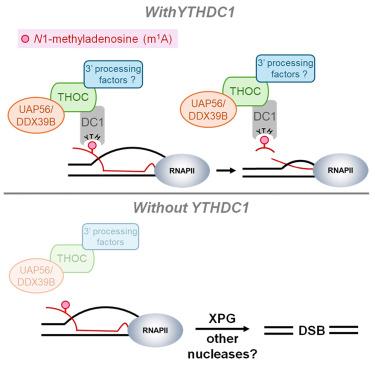
Certain environmental toxins and chemotherapeutics are nucleic acid-damaging agents, causing adducts in DNA and RNA. While most of these adducts occur in RNA, the consequences of RNA damage are largely unexplored. Here, we demonstrate that nuclear RNA damage can result in loss of genome integrity in human cells. Specifically, we show that YTHDC1 regulates alkylation damage responses with the THO complex (THOC). In addition to its established binding to N6-methyladenosine (m6A), YTHDC1 binds to chemically induced N1-methyladenosine (m1A). Without YTHDC1, cells have greater alkylation damage sensitivity and increased DNA breaks, which are rescued by an RNA-specific dealkylase. These RNA-damage-induced DNA breaks (RDIBs) depend on R-loop formation, which is converted to DNA breaks by the XPG nuclease. Strikingly, in the absence of YTHDC1 or THOC, a nuclear RNA m1A methyltransferase is sufficient to induce DNA breaks. Our results provide mechanistic insight into how damaged RNAs can impact genomic integrity.
期刊介绍:
Molecular Cell is a companion to Cell, the leading journal of biology and the highest-impact journal in the world. Launched in December 1997 and published monthly. Molecular Cell is dedicated to publishing cutting-edge research in molecular biology, focusing on fundamental cellular processes. The journal encompasses a wide range of topics, including DNA replication, recombination, and repair; Chromatin biology and genome organization; Transcription; RNA processing and decay; Non-coding RNA function; Translation; Protein folding, modification, and quality control; Signal transduction pathways; Cell cycle and checkpoints; Cell death; Autophagy; Metabolism.




 京公网安备 11010802042870号
京ICP备2023020795号-1
京公网安备 11010802042870号
京ICP备2023020795号-1

 分享
分享
 求助内容:
求助内容: 应助结果提醒方式:
 扫码关注我们
