Giulia Tarantino, Timothy G. Burrow, Matteo Aramini, Michael L. Baker, Ceri Hammond
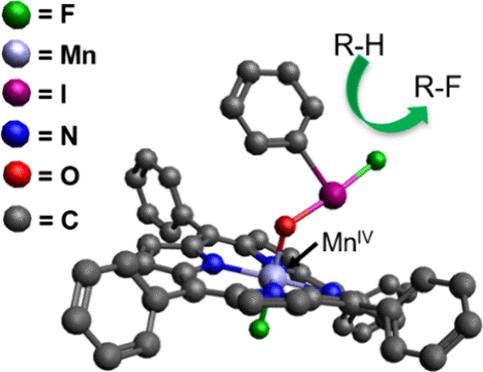
{"title":"锰卟啉催化烷烃氟化反应活性锰物质的研究","authors":"Giulia Tarantino, Timothy G. Burrow, Matteo Aramini, Michael L. Baker, Ceri Hammond","doi":"10.1021/acscatal.4c07251","DOIUrl":null,"url":null,"abstract":"The catalytic conversion of C–H to C–F bonds is a critical synthetic transformation of relevance to the pharmaceutical, agrochemical, and medicinal chemical industries. When coupled with an oxidant and a fluorine donor, biomimetic Mn-porphyrins have been shown to be capable of achieving this reaction. However, the definition of the active forms of these fluorinating Mn-porphyrins remains an unsolved challenge, which limits mechanistic understanding of the process and makes it challenging to systematically design better catalytic materials. Herein, we present a combination of kinetic, spectroscopic, and theoretical studies focused on alkane fluorination over Mn-containing porphyrins. Specifically, by correlating kinetic studies with resonance Raman, UV–vis, and high-energy resolution fluorescence detected X-ray absorption spectroscopic analysis of the various states of the catalyst, we provide evidence that a 6-coordinated Mn(IV) complex with −F and −OI(F)Ar axial ligands is the active species responsible for selective fluorination via Hydrogen Atom Transfer. This active state is distinct from the Mn═O species previously proposed to be the active intermediates for alkane fluorination and oxidation.","PeriodicalId":9,"journal":{"name":"ACS Catalysis ","volume":"66 1","pages":""},"PeriodicalIF":13.1000,"publicationDate":"2025-03-02","publicationTypes":"Journal Article","fieldsOfStudy":null,"isOpenAccess":false,"openAccessPdf":"","citationCount":"0","resultStr":"{\"title\":\"Elucidation of the Active Mn-Species Responsible for Alkane Fluorination Catalyzed by Mn Porphyrins\",\"authors\":\"Giulia Tarantino, Timothy G. Burrow, Matteo Aramini, Michael L. Baker, Ceri Hammond\",\"doi\":\"10.1021/acscatal.4c07251\",\"DOIUrl\":null,\"url\":null,\"abstract\":\"The catalytic conversion of C–H to C–F bonds is a critical synthetic transformation of relevance to the pharmaceutical, agrochemical, and medicinal chemical industries. When coupled with an oxidant and a fluorine donor, biomimetic Mn-porphyrins have been shown to be capable of achieving this reaction. However, the definition of the active forms of these fluorinating Mn-porphyrins remains an unsolved challenge, which limits mechanistic understanding of the process and makes it challenging to systematically design better catalytic materials. Herein, we present a combination of kinetic, spectroscopic, and theoretical studies focused on alkane fluorination over Mn-containing porphyrins. Specifically, by correlating kinetic studies with resonance Raman, UV–vis, and high-energy resolution fluorescence detected X-ray absorption spectroscopic analysis of the various states of the catalyst, we provide evidence that a 6-coordinated Mn(IV) complex with −F and −OI(F)Ar axial ligands is the active species responsible for selective fluorination via Hydrogen Atom Transfer. This active state is distinct from the Mn═O species previously proposed to be the active intermediates for alkane fluorination and oxidation.\",\"PeriodicalId\":9,\"journal\":{\"name\":\"ACS Catalysis \",\"volume\":\"66 1\",\"pages\":\"\"},\"PeriodicalIF\":13.1000,\"publicationDate\":\"2025-03-02\",\"publicationTypes\":\"Journal Article\",\"fieldsOfStudy\":null,\"isOpenAccess\":false,\"openAccessPdf\":\"\",\"citationCount\":\"0\",\"resultStr\":null,\"platform\":\"Semanticscholar\",\"paperid\":null,\"PeriodicalName\":\"ACS Catalysis \",\"FirstCategoryId\":\"92\",\"ListUrlMain\":\"https://doi.org/10.1021/acscatal.4c07251\",\"RegionNum\":1,\"RegionCategory\":\"化学\",\"ArticlePicture\":[],\"TitleCN\":null,\"AbstractTextCN\":null,\"PMCID\":null,\"EPubDate\":\"\",\"PubModel\":\"\",\"JCR\":\"Q1\",\"JCRName\":\"CHEMISTRY, PHYSICAL\",\"Score\":null,\"Total\":0}","platform":"Semanticscholar","paperid":null,"PeriodicalName":"ACS Catalysis ","FirstCategoryId":"92","ListUrlMain":"https://doi.org/10.1021/acscatal.4c07251","RegionNum":1,"RegionCategory":"化学","ArticlePicture":[],"TitleCN":null,"AbstractTextCN":null,"PMCID":null,"EPubDate":"","PubModel":"","JCR":"Q1","JCRName":"CHEMISTRY, PHYSICAL","Score":null,"Total":0}
Elucidation of the Active Mn-Species Responsible for Alkane Fluorination Catalyzed by Mn Porphyrins
The catalytic conversion of C–H to C–F bonds is a critical synthetic transformation of relevance to the pharmaceutical, agrochemical, and medicinal chemical industries. When coupled with an oxidant and a fluorine donor, biomimetic Mn-porphyrins have been shown to be capable of achieving this reaction. However, the definition of the active forms of these fluorinating Mn-porphyrins remains an unsolved challenge, which limits mechanistic understanding of the process and makes it challenging to systematically design better catalytic materials. Herein, we present a combination of kinetic, spectroscopic, and theoretical studies focused on alkane fluorination over Mn-containing porphyrins. Specifically, by correlating kinetic studies with resonance Raman, UV–vis, and high-energy resolution fluorescence detected X-ray absorption spectroscopic analysis of the various states of the catalyst, we provide evidence that a 6-coordinated Mn(IV) complex with −F and −OI(F)Ar axial ligands is the active species responsible for selective fluorination via Hydrogen Atom Transfer. This active state is distinct from the Mn═O species previously proposed to be the active intermediates for alkane fluorination and oxidation.
期刊介绍:
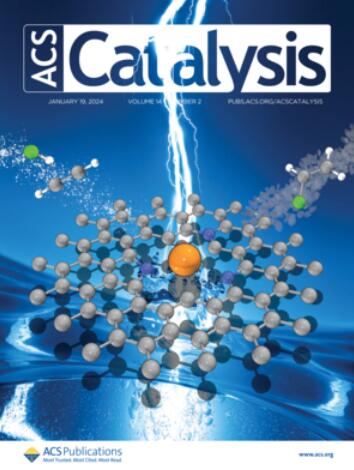
ACS Catalysis is an esteemed journal that publishes original research in the fields of heterogeneous catalysis, molecular catalysis, and biocatalysis. It offers broad coverage across diverse areas such as life sciences, organometallics and synthesis, photochemistry and electrochemistry, drug discovery and synthesis, materials science, environmental protection, polymer discovery and synthesis, and energy and fuels.
The scope of the journal is to showcase innovative work in various aspects of catalysis. This includes new reactions and novel synthetic approaches utilizing known catalysts, the discovery or modification of new catalysts, elucidation of catalytic mechanisms through cutting-edge investigations, practical enhancements of existing processes, as well as conceptual advances in the field. Contributions to ACS Catalysis can encompass both experimental and theoretical research focused on catalytic molecules, macromolecules, and materials that exhibit catalytic turnover.




 京公网安备 11010802042870号
京ICP备2023020795号-1
京公网安备 11010802042870号
京ICP备2023020795号-1

 分享
分享
 求助内容:
求助内容: 应助结果提醒方式:
 扫码关注我们
