Qian Ai, Lalith Krishna Samanth Bonagiri, Amir Farokh Payam, Narayana R. Aluru, Yingjie Zhang
{"title":"固体-液体界面三维原子力显微镜的定量解释","authors":"Qian Ai, Lalith Krishna Samanth Bonagiri, Amir Farokh Payam, Narayana R. Aluru, Yingjie Zhang","doi":"10.1021/acs.jpcc.5c00088","DOIUrl":null,"url":null,"abstract":"Three-dimensional atomic force microscopy (3D-AFM) has been a powerful tool to probe the atomic-scale structure of solid–liquid interfaces. As a nanoprobe moves along the 3D volume of interfacial liquid, the probe–sample interaction force is sensed and mapped, providing information on not only the solid morphology, but also the liquid density distribution. To date, 3D-AFM force maps of a diverse set of solid–liquid interfaces have been recorded, revealing remarkable force oscillations that are typically attributed to solvation layers or electrical double layers. However, despite the high resolution down to the subangstrom level, quantitative interpretation of the 3D force maps has been an outstanding challenge. Here we review the technical details of 3D-AFM and the existing approaches for quantitative data interpretation. Based on evidence in recent literature, we conclude that the perturbation-induced AFM force paradoxically represents the intrinsic, unperturbed liquid density profile. We will further discuss how the oscillatory force profiles can be attributed to the probe-modulation of the liquid configurational entropy and how the quantitative, atomic-scale liquid density distribution can be derived from the force maps.","PeriodicalId":61,"journal":{"name":"The Journal of Physical Chemistry C","volume":"56 1","pages":""},"PeriodicalIF":3.2000,"publicationDate":"2025-03-03","publicationTypes":"Journal Article","fieldsOfStudy":null,"isOpenAccess":false,"openAccessPdf":"","citationCount":"0","resultStr":"{\"title\":\"Toward Quantitative Interpretation of 3D Atomic Force Microscopy at Solid–Liquid Interfaces\",\"authors\":\"Qian Ai, Lalith Krishna Samanth Bonagiri, Amir Farokh Payam, Narayana R. Aluru, Yingjie Zhang\",\"doi\":\"10.1021/acs.jpcc.5c00088\",\"DOIUrl\":null,\"url\":null,\"abstract\":\"Three-dimensional atomic force microscopy (3D-AFM) has been a powerful tool to probe the atomic-scale structure of solid–liquid interfaces. As a nanoprobe moves along the 3D volume of interfacial liquid, the probe–sample interaction force is sensed and mapped, providing information on not only the solid morphology, but also the liquid density distribution. To date, 3D-AFM force maps of a diverse set of solid–liquid interfaces have been recorded, revealing remarkable force oscillations that are typically attributed to solvation layers or electrical double layers. However, despite the high resolution down to the subangstrom level, quantitative interpretation of the 3D force maps has been an outstanding challenge. Here we review the technical details of 3D-AFM and the existing approaches for quantitative data interpretation. Based on evidence in recent literature, we conclude that the perturbation-induced AFM force paradoxically represents the intrinsic, unperturbed liquid density profile. We will further discuss how the oscillatory force profiles can be attributed to the probe-modulation of the liquid configurational entropy and how the quantitative, atomic-scale liquid density distribution can be derived from the force maps.\",\"PeriodicalId\":61,\"journal\":{\"name\":\"The Journal of Physical Chemistry C\",\"volume\":\"56 1\",\"pages\":\"\"},\"PeriodicalIF\":3.2000,\"publicationDate\":\"2025-03-03\",\"publicationTypes\":\"Journal Article\",\"fieldsOfStudy\":null,\"isOpenAccess\":false,\"openAccessPdf\":\"\",\"citationCount\":\"0\",\"resultStr\":null,\"platform\":\"Semanticscholar\",\"paperid\":null,\"PeriodicalName\":\"The Journal of Physical Chemistry C\",\"FirstCategoryId\":\"1\",\"ListUrlMain\":\"https://doi.org/10.1021/acs.jpcc.5c00088\",\"RegionNum\":3,\"RegionCategory\":\"化学\",\"ArticlePicture\":[],\"TitleCN\":null,\"AbstractTextCN\":null,\"PMCID\":null,\"EPubDate\":\"\",\"PubModel\":\"\",\"JCR\":\"Q2\",\"JCRName\":\"CHEMISTRY, PHYSICAL\",\"Score\":null,\"Total\":0}","platform":"Semanticscholar","paperid":null,"PeriodicalName":"The Journal of Physical Chemistry C","FirstCategoryId":"1","ListUrlMain":"https://doi.org/10.1021/acs.jpcc.5c00088","RegionNum":3,"RegionCategory":"化学","ArticlePicture":[],"TitleCN":null,"AbstractTextCN":null,"PMCID":null,"EPubDate":"","PubModel":"","JCR":"Q2","JCRName":"CHEMISTRY, PHYSICAL","Score":null,"Total":0}
Toward Quantitative Interpretation of 3D Atomic Force Microscopy at Solid–Liquid Interfaces
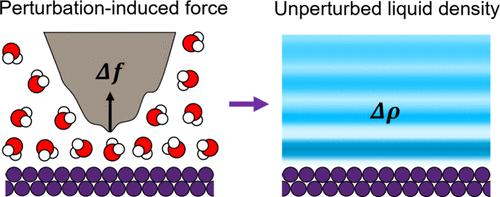
Three-dimensional atomic force microscopy (3D-AFM) has been a powerful tool to probe the atomic-scale structure of solid–liquid interfaces. As a nanoprobe moves along the 3D volume of interfacial liquid, the probe–sample interaction force is sensed and mapped, providing information on not only the solid morphology, but also the liquid density distribution. To date, 3D-AFM force maps of a diverse set of solid–liquid interfaces have been recorded, revealing remarkable force oscillations that are typically attributed to solvation layers or electrical double layers. However, despite the high resolution down to the subangstrom level, quantitative interpretation of the 3D force maps has been an outstanding challenge. Here we review the technical details of 3D-AFM and the existing approaches for quantitative data interpretation. Based on evidence in recent literature, we conclude that the perturbation-induced AFM force paradoxically represents the intrinsic, unperturbed liquid density profile. We will further discuss how the oscillatory force profiles can be attributed to the probe-modulation of the liquid configurational entropy and how the quantitative, atomic-scale liquid density distribution can be derived from the force maps.
期刊介绍:
The Journal of Physical Chemistry A/B/C is devoted to reporting new and original experimental and theoretical basic research of interest to physical chemists, biophysical chemists, and chemical physicists.




 京公网安备 11010802042870号
京ICP备2023020795号-1
京公网安备 11010802042870号
京ICP备2023020795号-1

 分享
分享
 求助内容:
求助内容: 应助结果提醒方式:
 扫码关注我们
