Murugan Sethupathi, Nallathambi Sengottuvelan, Kumar Ponnuchamy, Mandla Vincent Khumalo
{"title":"大环二茂铁查尔酮及其Co(II)和Cu(II)配合物的合成与表征:光酶和光细胞毒性","authors":"Murugan Sethupathi, Nallathambi Sengottuvelan, Kumar Ponnuchamy, Mandla Vincent Khumalo","doi":"10.1002/aoc.70101","DOIUrl":null,"url":null,"abstract":"<div>\n \n <p>Ferrocenyl chalcone complex (Fc<sub>2</sub>L) has been synthesized from the condensation of 3,4:10,11-dibenzo-1,13[N,N′-bis{(3-formyl-2-hydroxy-5-methyl)benzyl}]-5,9-dioxocyclohexa decane (the precursor compound) with acetyl ferrocene. The Co(II) and Cu(II) Complexes (CoFc<sub>2</sub>L [<b>1</b>] and CuFc<sub>2</sub>L [<b>2</b>]) were synthesized from the ferrocenyl chalcone (Fc<sub>2</sub>L) with metal chloride salts and characterized by various physicochemical techniques (UV–Vis, FT-IR, <sup>1</sup>H NMR,<sup>13</sup>C NMR, ESI-MS, and TGA). The electrochemical studies exhibit a quasireversible reduction wave with E<sub>pc</sub> near −1.02 V for Complex <b>1</b> and −0.95 V for Complex <b>2</b>. TGA analysis proposed that Complexes <b>1</b> and <b>2</b> showed thermal stability. The calf thymus DNA (CT-DNA) binding studies of the complexes were examined by spectral studies and electrochemical measurements. The absorption spectrum analyses demonstrated that Complexes <b>1</b> and <b>2</b> have intrinsic binding strengths of 7.5 × 10<sup>5</sup> M<sup>−1</sup> and 9.18 × 10<sup>5</sup> M<sup>−1</sup>, respectively, and bind to CT-DNA via an intercalative binding mechanism. The pUC19 DNA cleavage studies of the complexes using gel electrophoresis assay were performed in the presence of MPA for Complex <b>1</b> and in the presence of Asc for Complex <b>2</b>. After radiation exposure, the plasmid SC DNA in both complexes was completely cleaved into NC DNA and photo nick DNA via a singlet oxygen pathway. The antimicrobial activity of Complexes <b>1</b> and <b>2</b> exhibits better bacterial and fungal growth inhibition at the higher study concentration. The complexes' cytotoxicity was evaluated on MDA-MB-231 breast cancer cells, exhibiting IC<sub>50</sub> values of 10, 50, and 5, 25 μg/mL under dark and light irradiation, respectively. The fluorescence microscopy analysis of cell morphology studies using AO/EB dual labeling, propidium iodide (PI) staining, and the Hoechst staining on MDA-MB-231 cancer cells revealed a significant increase in cell mortality during irradiation due to the photodynamic effect. The present study demonstrates that Complexes <b>1</b> and <b>2</b> without radiation in breast cancer cells stimulate intrinsically mediated apoptosis. In the meantime, radiation triggers Complexes <b>1</b> and <b>2</b> intrinsic- and extrinsic-mediated apoptosis pathways. The biotoxicity assay using <i>Artemia nauplii</i> was evaluated for Complexes <b>1</b> and <b>2</b> to identify its biocompatibility.</p>\n </div>","PeriodicalId":8344,"journal":{"name":"Applied Organometallic Chemistry","volume":"39 4","pages":""},"PeriodicalIF":4.3000,"publicationDate":"2025-03-03","publicationTypes":"Journal Article","fieldsOfStudy":null,"isOpenAccess":false,"openAccessPdf":"","citationCount":"0","resultStr":"{\"title\":\"Synthesis and Characterization of Macrocyclic Ferrocenyl Chalcone and Their Co(II) and Cu(II) Complexes: Photonuclease and Photocytotoxicity\",\"authors\":\"Murugan Sethupathi, Nallathambi Sengottuvelan, Kumar Ponnuchamy, Mandla Vincent Khumalo\",\"doi\":\"10.1002/aoc.70101\",\"DOIUrl\":null,\"url\":null,\"abstract\":\"<div>\\n \\n <p>Ferrocenyl chalcone complex (Fc<sub>2</sub>L) has been synthesized from the condensation of 3,4:10,11-dibenzo-1,13[N,N′-bis{(3-formyl-2-hydroxy-5-methyl)benzyl}]-5,9-dioxocyclohexa decane (the precursor compound) with acetyl ferrocene. The Co(II) and Cu(II) Complexes (CoFc<sub>2</sub>L [<b>1</b>] and CuFc<sub>2</sub>L [<b>2</b>]) were synthesized from the ferrocenyl chalcone (Fc<sub>2</sub>L) with metal chloride salts and characterized by various physicochemical techniques (UV–Vis, FT-IR, <sup>1</sup>H NMR,<sup>13</sup>C NMR, ESI-MS, and TGA). The electrochemical studies exhibit a quasireversible reduction wave with E<sub>pc</sub> near −1.02 V for Complex <b>1</b> and −0.95 V for Complex <b>2</b>. TGA analysis proposed that Complexes <b>1</b> and <b>2</b> showed thermal stability. The calf thymus DNA (CT-DNA) binding studies of the complexes were examined by spectral studies and electrochemical measurements. The absorption spectrum analyses demonstrated that Complexes <b>1</b> and <b>2</b> have intrinsic binding strengths of 7.5 × 10<sup>5</sup> M<sup>−1</sup> and 9.18 × 10<sup>5</sup> M<sup>−1</sup>, respectively, and bind to CT-DNA via an intercalative binding mechanism. The pUC19 DNA cleavage studies of the complexes using gel electrophoresis assay were performed in the presence of MPA for Complex <b>1</b> and in the presence of Asc for Complex <b>2</b>. After radiation exposure, the plasmid SC DNA in both complexes was completely cleaved into NC DNA and photo nick DNA via a singlet oxygen pathway. The antimicrobial activity of Complexes <b>1</b> and <b>2</b> exhibits better bacterial and fungal growth inhibition at the higher study concentration. The complexes' cytotoxicity was evaluated on MDA-MB-231 breast cancer cells, exhibiting IC<sub>50</sub> values of 10, 50, and 5, 25 μg/mL under dark and light irradiation, respectively. The fluorescence microscopy analysis of cell morphology studies using AO/EB dual labeling, propidium iodide (PI) staining, and the Hoechst staining on MDA-MB-231 cancer cells revealed a significant increase in cell mortality during irradiation due to the photodynamic effect. The present study demonstrates that Complexes <b>1</b> and <b>2</b> without radiation in breast cancer cells stimulate intrinsically mediated apoptosis. In the meantime, radiation triggers Complexes <b>1</b> and <b>2</b> intrinsic- and extrinsic-mediated apoptosis pathways. The biotoxicity assay using <i>Artemia nauplii</i> was evaluated for Complexes <b>1</b> and <b>2</b> to identify its biocompatibility.</p>\\n </div>\",\"PeriodicalId\":8344,\"journal\":{\"name\":\"Applied Organometallic Chemistry\",\"volume\":\"39 4\",\"pages\":\"\"},\"PeriodicalIF\":4.3000,\"publicationDate\":\"2025-03-03\",\"publicationTypes\":\"Journal Article\",\"fieldsOfStudy\":null,\"isOpenAccess\":false,\"openAccessPdf\":\"\",\"citationCount\":\"0\",\"resultStr\":null,\"platform\":\"Semanticscholar\",\"paperid\":null,\"PeriodicalName\":\"Applied Organometallic Chemistry\",\"FirstCategoryId\":\"92\",\"ListUrlMain\":\"https://onlinelibrary.wiley.com/doi/10.1002/aoc.70101\",\"RegionNum\":2,\"RegionCategory\":\"化学\",\"ArticlePicture\":[],\"TitleCN\":null,\"AbstractTextCN\":null,\"PMCID\":null,\"EPubDate\":\"\",\"PubModel\":\"\",\"JCR\":\"Q2\",\"JCRName\":\"CHEMISTRY, APPLIED\",\"Score\":null,\"Total\":0}","platform":"Semanticscholar","paperid":null,"PeriodicalName":"Applied Organometallic Chemistry","FirstCategoryId":"92","ListUrlMain":"https://onlinelibrary.wiley.com/doi/10.1002/aoc.70101","RegionNum":2,"RegionCategory":"化学","ArticlePicture":[],"TitleCN":null,"AbstractTextCN":null,"PMCID":null,"EPubDate":"","PubModel":"","JCR":"Q2","JCRName":"CHEMISTRY, APPLIED","Score":null,"Total":0}
Synthesis and Characterization of Macrocyclic Ferrocenyl Chalcone and Their Co(II) and Cu(II) Complexes: Photonuclease and Photocytotoxicity
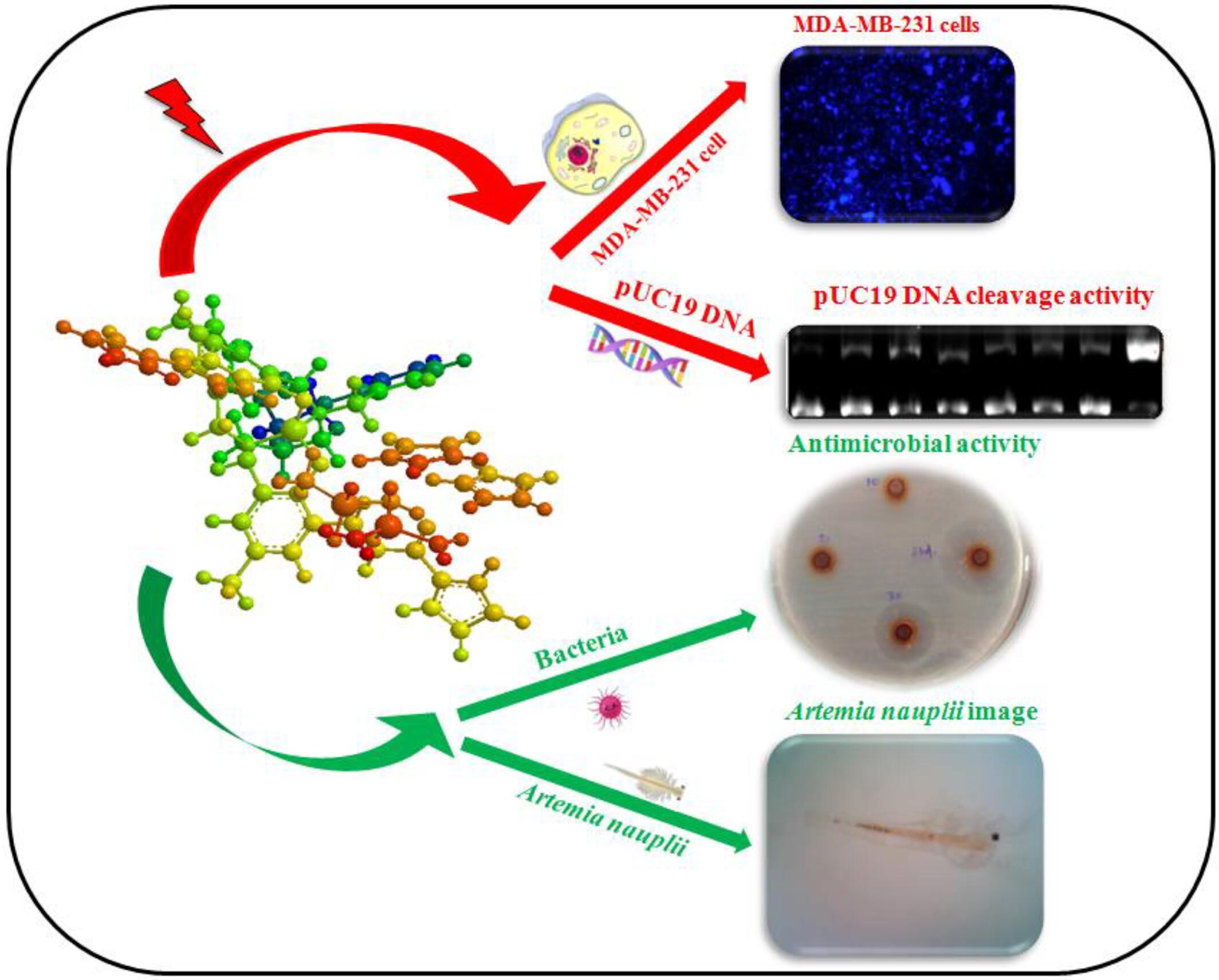
Ferrocenyl chalcone complex (Fc2L) has been synthesized from the condensation of 3,4:10,11-dibenzo-1,13[N,N′-bis{(3-formyl-2-hydroxy-5-methyl)benzyl}]-5,9-dioxocyclohexa decane (the precursor compound) with acetyl ferrocene. The Co(II) and Cu(II) Complexes (CoFc2L [1] and CuFc2L [2]) were synthesized from the ferrocenyl chalcone (Fc2L) with metal chloride salts and characterized by various physicochemical techniques (UV–Vis, FT-IR, 1H NMR,13C NMR, ESI-MS, and TGA). The electrochemical studies exhibit a quasireversible reduction wave with Epc near −1.02 V for Complex 1 and −0.95 V for Complex 2. TGA analysis proposed that Complexes 1 and 2 showed thermal stability. The calf thymus DNA (CT-DNA) binding studies of the complexes were examined by spectral studies and electrochemical measurements. The absorption spectrum analyses demonstrated that Complexes 1 and 2 have intrinsic binding strengths of 7.5 × 10⁵ M−1 and 9.18 × 10⁵ M−1, respectively, and bind to CT-DNA via an intercalative binding mechanism. The pUC19 DNA cleavage studies of the complexes using gel electrophoresis assay were performed in the presence of MPA for Complex 1 and in the presence of Asc for Complex 2. After radiation exposure, the plasmid SC DNA in both complexes was completely cleaved into NC DNA and photo nick DNA via a singlet oxygen pathway. The antimicrobial activity of Complexes 1 and 2 exhibits better bacterial and fungal growth inhibition at the higher study concentration. The complexes' cytotoxicity was evaluated on MDA-MB-231 breast cancer cells, exhibiting IC50 values of 10, 50, and 5, 25 μg/mL under dark and light irradiation, respectively. The fluorescence microscopy analysis of cell morphology studies using AO/EB dual labeling, propidium iodide (PI) staining, and the Hoechst staining on MDA-MB-231 cancer cells revealed a significant increase in cell mortality during irradiation due to the photodynamic effect. The present study demonstrates that Complexes 1 and 2 without radiation in breast cancer cells stimulate intrinsically mediated apoptosis. In the meantime, radiation triggers Complexes 1 and 2 intrinsic- and extrinsic-mediated apoptosis pathways. The biotoxicity assay using Artemia nauplii was evaluated for Complexes 1 and 2 to identify its biocompatibility.
期刊介绍:
All new compounds should be satisfactorily identified and proof of their structure given according to generally accepted standards. Structural reports, such as papers exclusively dealing with synthesis and characterization, analytical techniques, or X-ray diffraction studies of metal-organic or organometallic compounds will not be considered. The editors reserve the right to refuse without peer review any manuscript that does not comply with the aims and scope of the journal. Applied Organometallic Chemistry publishes Full Papers, Reviews, Mini Reviews and Communications of scientific research in all areas of organometallic and metal-organic chemistry involving main group metals, transition metals, lanthanides and actinides. All contributions should contain an explicit application of novel compounds, for instance in materials science, nano science, catalysis, chemical vapour deposition, metal-mediated organic synthesis, polymers, bio-organometallics, metallo-therapy, metallo-diagnostics and medicine. Reviews of books covering aspects of the fields of focus are also published.




 京公网安备 11010802042870号
京ICP备2023020795号-1
京公网安备 11010802042870号
京ICP备2023020795号-1

 分享
分享
 求助内容:
求助内容: 应助结果提醒方式:
 扫码关注我们
