Deysy Andrea Molina-Giraldo , Johan D. Lozano , Rogelio Ocampo-Cardona , Mario A. Macías , Luz Amalia Rios-Vásquez
{"title":"n -卤化四氟硼酸铵季铵盐的晶体结构、热稳定性、光谱和DFT研究","authors":"Deysy Andrea Molina-Giraldo , Johan D. Lozano , Rogelio Ocampo-Cardona , Mario A. Macías , Luz Amalia Rios-Vásquez","doi":"10.1016/j.molstruc.2025.141890","DOIUrl":null,"url":null,"abstract":"<div><div>Considering the great importance of quaternary ammonium tetrafluoroborate compounds due to their potential application in areas such as catalysis, electrochemistry, and materials chemistry, three new salts were prepared from analogous iodine salts using anion exchange reaction, in which the iodine salt was treated with AgBF<sub>4</sub> in methanol. The characterizations were performed by <sup>1</sup>H NMR and <sup>13</sup>C NMR spectroscopy. Single crystals of C<sub>4</sub>I<sup>+</sup>BF<sub>4</sub><sup>−</sup> <strong>1a</strong> and C<sub>5</sub>I<sup>+</sup>BF<sub>4</sub><sup>−</sup> <strong>1b</strong> tetrafluoroborate salts were obtained by slow evaporation and their crystal structures were determined by single crystal X-ray diffraction. In <strong>1a</strong> and <strong>1b</strong>, the packing is mainly affected by Coulombic interactions and C<img>H‧‧‧F hydrogen bonds. Interestingly, C-I‧‧‧F interactions were detected where I and fluorine atoms act as Lewis acid and base, respectively. The thermal behavior of the compounds C<sub>4</sub>I<sup>+</sup>BF<sub>4</sub><sup>−</sup> <strong>1a</strong>, C<sub>5</sub>I<sup>+</sup>BF<sub>4</sub><sup>−</sup> <strong>1b</strong> and C<sub>6</sub>I<sup>+</sup>BF<sub>4</sub><sup>−</sup> <strong>1c</strong> was studied using TGA and DSC methods, showing excellent thermal stability up to 150 °C. Geometry optimizations and frequency calculations for <strong>1a, 1b</strong> and <strong>1c</strong> were performed at DFT level of theory by B3LYP method, employing the 6–311++G(d,p) and LANL2DZ mixed basis set. FT-IR vibrational spectra were analyzed for <strong>1a, 1b</strong> and <strong>1c</strong>, and the corresponding vibrational assignments were performed. Supporting information reports the complete calculated mode frequencies for each compound and the respective correlation with the observed modes in infrared (IR) spectroscopy is reported. Electronic molecular behavior was studied by the calculation of the frontier molecular orbitals and the global chemical reactivity descriptors were calculated, showing that the length of the alkyl chains influences their molecular reactivities. Electronic UV–Vis spectra were explained showing that mainly π → π* electronic transitions occur for these compounds. These calculations were contrasted with experimental data showing excellent congruence demonstrating that calculations were performed adequately.</div></div>","PeriodicalId":16414,"journal":{"name":"Journal of Molecular Structure","volume":"1334 ","pages":"Article 141890"},"PeriodicalIF":4.7000,"publicationDate":"2025-07-05","publicationTypes":"Journal Article","fieldsOfStudy":null,"isOpenAccess":false,"openAccessPdf":"","citationCount":"0","resultStr":"{\"title\":\"Crystal structure, thermal stability, spectroscopy, and DFT studies of quaternary salts of N-halomethylated ammonium tetrafluoroborate\",\"authors\":\"Deysy Andrea Molina-Giraldo , Johan D. Lozano , Rogelio Ocampo-Cardona , Mario A. Macías , Luz Amalia Rios-Vásquez\",\"doi\":\"10.1016/j.molstruc.2025.141890\",\"DOIUrl\":null,\"url\":null,\"abstract\":\"<div><div>Considering the great importance of quaternary ammonium tetrafluoroborate compounds due to their potential application in areas such as catalysis, electrochemistry, and materials chemistry, three new salts were prepared from analogous iodine salts using anion exchange reaction, in which the iodine salt was treated with AgBF<sub>4</sub> in methanol. The characterizations were performed by <sup>1</sup>H NMR and <sup>13</sup>C NMR spectroscopy. Single crystals of C<sub>4</sub>I<sup>+</sup>BF<sub>4</sub><sup>−</sup> <strong>1a</strong> and C<sub>5</sub>I<sup>+</sup>BF<sub>4</sub><sup>−</sup> <strong>1b</strong> tetrafluoroborate salts were obtained by slow evaporation and their crystal structures were determined by single crystal X-ray diffraction. In <strong>1a</strong> and <strong>1b</strong>, the packing is mainly affected by Coulombic interactions and C<img>H‧‧‧F hydrogen bonds. Interestingly, C-I‧‧‧F interactions were detected where I and fluorine atoms act as Lewis acid and base, respectively. The thermal behavior of the compounds C<sub>4</sub>I<sup>+</sup>BF<sub>4</sub><sup>−</sup> <strong>1a</strong>, C<sub>5</sub>I<sup>+</sup>BF<sub>4</sub><sup>−</sup> <strong>1b</strong> and C<sub>6</sub>I<sup>+</sup>BF<sub>4</sub><sup>−</sup> <strong>1c</strong> was studied using TGA and DSC methods, showing excellent thermal stability up to 150 °C. Geometry optimizations and frequency calculations for <strong>1a, 1b</strong> and <strong>1c</strong> were performed at DFT level of theory by B3LYP method, employing the 6–311++G(d,p) and LANL2DZ mixed basis set. FT-IR vibrational spectra were analyzed for <strong>1a, 1b</strong> and <strong>1c</strong>, and the corresponding vibrational assignments were performed. Supporting information reports the complete calculated mode frequencies for each compound and the respective correlation with the observed modes in infrared (IR) spectroscopy is reported. Electronic molecular behavior was studied by the calculation of the frontier molecular orbitals and the global chemical reactivity descriptors were calculated, showing that the length of the alkyl chains influences their molecular reactivities. Electronic UV–Vis spectra were explained showing that mainly π → π* electronic transitions occur for these compounds. These calculations were contrasted with experimental data showing excellent congruence demonstrating that calculations were performed adequately.</div></div>\",\"PeriodicalId\":16414,\"journal\":{\"name\":\"Journal of Molecular Structure\",\"volume\":\"1334 \",\"pages\":\"Article 141890\"},\"PeriodicalIF\":4.7000,\"publicationDate\":\"2025-07-05\",\"publicationTypes\":\"Journal Article\",\"fieldsOfStudy\":null,\"isOpenAccess\":false,\"openAccessPdf\":\"\",\"citationCount\":\"0\",\"resultStr\":null,\"platform\":\"Semanticscholar\",\"paperid\":null,\"PeriodicalName\":\"Journal of Molecular Structure\",\"FirstCategoryId\":\"92\",\"ListUrlMain\":\"https://www.sciencedirect.com/science/article/pii/S0022286025005769\",\"RegionNum\":2,\"RegionCategory\":\"化学\",\"ArticlePicture\":[],\"TitleCN\":null,\"AbstractTextCN\":null,\"PMCID\":null,\"EPubDate\":\"2025/2/27 0:00:00\",\"PubModel\":\"Epub\",\"JCR\":\"Q2\",\"JCRName\":\"CHEMISTRY, PHYSICAL\",\"Score\":null,\"Total\":0}","platform":"Semanticscholar","paperid":null,"PeriodicalName":"Journal of Molecular Structure","FirstCategoryId":"92","ListUrlMain":"https://www.sciencedirect.com/science/article/pii/S0022286025005769","RegionNum":2,"RegionCategory":"化学","ArticlePicture":[],"TitleCN":null,"AbstractTextCN":null,"PMCID":null,"EPubDate":"2025/2/27 0:00:00","PubModel":"Epub","JCR":"Q2","JCRName":"CHEMISTRY, PHYSICAL","Score":null,"Total":0}
Crystal structure, thermal stability, spectroscopy, and DFT studies of quaternary salts of N-halomethylated ammonium tetrafluoroborate
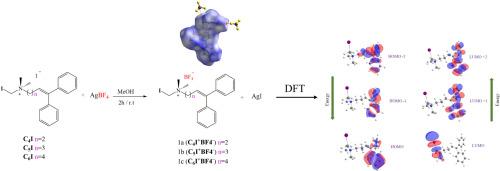
Considering the great importance of quaternary ammonium tetrafluoroborate compounds due to their potential application in areas such as catalysis, electrochemistry, and materials chemistry, three new salts were prepared from analogous iodine salts using anion exchange reaction, in which the iodine salt was treated with AgBF4 in methanol. The characterizations were performed by 1H NMR and 13C NMR spectroscopy. Single crystals of C4I+BF4−1a and C5I+BF4−1b tetrafluoroborate salts were obtained by slow evaporation and their crystal structures were determined by single crystal X-ray diffraction. In 1a and 1b, the packing is mainly affected by Coulombic interactions and CH‧‧‧F hydrogen bonds. Interestingly, C-I‧‧‧F interactions were detected where I and fluorine atoms act as Lewis acid and base, respectively. The thermal behavior of the compounds C4I+BF4−1a, C5I+BF4−1b and C6I+BF4−1c was studied using TGA and DSC methods, showing excellent thermal stability up to 150 °C. Geometry optimizations and frequency calculations for 1a, 1b and 1c were performed at DFT level of theory by B3LYP method, employing the 6–311++G(d,p) and LANL2DZ mixed basis set. FT-IR vibrational spectra were analyzed for 1a, 1b and 1c, and the corresponding vibrational assignments were performed. Supporting information reports the complete calculated mode frequencies for each compound and the respective correlation with the observed modes in infrared (IR) spectroscopy is reported. Electronic molecular behavior was studied by the calculation of the frontier molecular orbitals and the global chemical reactivity descriptors were calculated, showing that the length of the alkyl chains influences their molecular reactivities. Electronic UV–Vis spectra were explained showing that mainly π → π* electronic transitions occur for these compounds. These calculations were contrasted with experimental data showing excellent congruence demonstrating that calculations were performed adequately.
期刊介绍:
The Journal of Molecular Structure is dedicated to the publication of full-length articles and review papers, providing important new structural information on all types of chemical species including:
• Stable and unstable molecules in all types of environments (vapour, molecular beam, liquid, solution, liquid crystal, solid state, matrix-isolated, surface-absorbed etc.)
• Chemical intermediates
• Molecules in excited states
• Biological molecules
• Polymers.
The methods used may include any combination of spectroscopic and non-spectroscopic techniques, for example:
• Infrared spectroscopy (mid, far, near)
• Raman spectroscopy and non-linear Raman methods (CARS, etc.)
• Electronic absorption spectroscopy
• Optical rotatory dispersion and circular dichroism
• Fluorescence and phosphorescence techniques
• Electron spectroscopies (PES, XPS), EXAFS, etc.
• Microwave spectroscopy
• Electron diffraction
• NMR and ESR spectroscopies
• Mössbauer spectroscopy
• X-ray crystallography
• Charge Density Analyses
• Computational Studies (supplementing experimental methods)
We encourage publications combining theoretical and experimental approaches. The structural insights gained by the studies should be correlated with the properties, activity and/ or reactivity of the molecule under investigation and the relevance of this molecule and its implications should be discussed.





 京公网安备 11010802042870号
京ICP备2023020795号-1
京公网安备 11010802042870号
京ICP备2023020795号-1

 分享
分享
 求助内容:
求助内容: 应助结果提醒方式:
 扫码关注我们
