Yuxin Wang, Yan Guo, Yaqi Song, Shiwei Yang, Meng Wu, Jiawei Song, Jingjie Yu and Yanjie Zhang
{"title":"荧光测温用亮橙红色BaAl4Sb2O12:Bi3+荧光粉的光致发光特性的温度依赖性研究","authors":"Yuxin Wang, Yan Guo, Yaqi Song, Shiwei Yang, Meng Wu, Jiawei Song, Jingjie Yu and Yanjie Zhang","doi":"10.1039/D4NJ04619F","DOIUrl":null,"url":null,"abstract":"<p >Herein, a series of BaAl<small><sub>4</sub></small>Sb<small><sub>2</sub></small>O<small><sub>12</sub></small>:Bi<small><sup>3+</sup></small> phosphors (BASO:Bi<small><sup>3+</sup></small>) with desired orange-red emission were synthesized through a high-temperature solid-state reaction method. Under 365 nm excitation, an orange-red emission with the main peak at 598 nm and a full width at half maximum (FWHM) of 60 nm appeared, attributed to the transition from the <small><sup>3</sup></small>P<small><sub>1</sub></small> → <small><sup>1</sup></small>S<small><sub>0</sub></small> energy level of Bi<small><sup>3+</sup></small> ions. The emission intensity of BASO:<em>x</em>Bi<small><sup>3+</sup></small> (0.01 ≤ <em>x</em> ≤ 0.03) phosphors first increased along with Bi<small><sup>3+</sup></small> doping and reached the maximum at <em>x</em> = 0.02 under excitation at 365 nm. Interestingly, the emission coefficient of the prepared phosphors is linearly related to temperature, and the intensity decreases sharply with increasing temperature. Bi<small><sup>3+</sup></small>-doped BASO host phosphors exhibit strong temperature-dependence within the range of 298 K to 473 K, and their activation energy is 0.30 eV for the thermal quenching mechanism. The temperature-dependent characteristics of luminescent materials doped with Bi<small><sup>3+</sup></small> suggest that the maximum relative sensitivity of BASO:Bi<small><sup>3+</sup></small> at 473 K is 2.59% K<small><sup>−1</sup></small>, indicating that the sample is suitable for measurement in a wider temperature range. Under the co-doping of Bi<small><sup>3+</sup></small>/Eu<small><sup>3+</sup></small>, single-phase white light emission was achieved, and the CIE coordinates (0.3320, 0.3812) were extremely close to the standard white light coordinates. Thus, BaAl<small><sub>4</sub></small>Sb<small><sub>2</sub></small>O<small><sub>12</sub></small>:Bi<small><sup>3+</sup></small> phosphors show potential applications in optical temperature sensing fields.</p>","PeriodicalId":95,"journal":{"name":"New Journal of Chemistry","volume":" 10","pages":" 4042-4049"},"PeriodicalIF":2.6000,"publicationDate":"2025-02-09","publicationTypes":"Journal Article","fieldsOfStudy":null,"isOpenAccess":false,"openAccessPdf":"","citationCount":"0","resultStr":"{\"title\":\"Insight into temperature dependence of the photoluminescence properties of bright orange-red BaAl4Sb2O12:Bi3+ phosphors for fluorescence thermometry\",\"authors\":\"Yuxin Wang, Yan Guo, Yaqi Song, Shiwei Yang, Meng Wu, Jiawei Song, Jingjie Yu and Yanjie Zhang\",\"doi\":\"10.1039/D4NJ04619F\",\"DOIUrl\":null,\"url\":null,\"abstract\":\"<p >Herein, a series of BaAl<small><sub>4</sub></small>Sb<small><sub>2</sub></small>O<small><sub>12</sub></small>:Bi<small><sup>3+</sup></small> phosphors (BASO:Bi<small><sup>3+</sup></small>) with desired orange-red emission were synthesized through a high-temperature solid-state reaction method. Under 365 nm excitation, an orange-red emission with the main peak at 598 nm and a full width at half maximum (FWHM) of 60 nm appeared, attributed to the transition from the <small><sup>3</sup></small>P<small><sub>1</sub></small> → <small><sup>1</sup></small>S<small><sub>0</sub></small> energy level of Bi<small><sup>3+</sup></small> ions. The emission intensity of BASO:<em>x</em>Bi<small><sup>3+</sup></small> (0.01 ≤ <em>x</em> ≤ 0.03) phosphors first increased along with Bi<small><sup>3+</sup></small> doping and reached the maximum at <em>x</em> = 0.02 under excitation at 365 nm. Interestingly, the emission coefficient of the prepared phosphors is linearly related to temperature, and the intensity decreases sharply with increasing temperature. Bi<small><sup>3+</sup></small>-doped BASO host phosphors exhibit strong temperature-dependence within the range of 298 K to 473 K, and their activation energy is 0.30 eV for the thermal quenching mechanism. The temperature-dependent characteristics of luminescent materials doped with Bi<small><sup>3+</sup></small> suggest that the maximum relative sensitivity of BASO:Bi<small><sup>3+</sup></small> at 473 K is 2.59% K<small><sup>−1</sup></small>, indicating that the sample is suitable for measurement in a wider temperature range. Under the co-doping of Bi<small><sup>3+</sup></small>/Eu<small><sup>3+</sup></small>, single-phase white light emission was achieved, and the CIE coordinates (0.3320, 0.3812) were extremely close to the standard white light coordinates. Thus, BaAl<small><sub>4</sub></small>Sb<small><sub>2</sub></small>O<small><sub>12</sub></small>:Bi<small><sup>3+</sup></small> phosphors show potential applications in optical temperature sensing fields.</p>\",\"PeriodicalId\":95,\"journal\":{\"name\":\"New Journal of Chemistry\",\"volume\":\" 10\",\"pages\":\" 4042-4049\"},\"PeriodicalIF\":2.6000,\"publicationDate\":\"2025-02-09\",\"publicationTypes\":\"Journal Article\",\"fieldsOfStudy\":null,\"isOpenAccess\":false,\"openAccessPdf\":\"\",\"citationCount\":\"0\",\"resultStr\":null,\"platform\":\"Semanticscholar\",\"paperid\":null,\"PeriodicalName\":\"New Journal of Chemistry\",\"FirstCategoryId\":\"92\",\"ListUrlMain\":\"https://pubs.rsc.org/en/content/articlelanding/2025/nj/d4nj04619f\",\"RegionNum\":3,\"RegionCategory\":\"化学\",\"ArticlePicture\":[],\"TitleCN\":null,\"AbstractTextCN\":null,\"PMCID\":null,\"EPubDate\":\"\",\"PubModel\":\"\",\"JCR\":\"Q2\",\"JCRName\":\"CHEMISTRY, MULTIDISCIPLINARY\",\"Score\":null,\"Total\":0}","platform":"Semanticscholar","paperid":null,"PeriodicalName":"New Journal of Chemistry","FirstCategoryId":"92","ListUrlMain":"https://pubs.rsc.org/en/content/articlelanding/2025/nj/d4nj04619f","RegionNum":3,"RegionCategory":"化学","ArticlePicture":[],"TitleCN":null,"AbstractTextCN":null,"PMCID":null,"EPubDate":"","PubModel":"","JCR":"Q2","JCRName":"CHEMISTRY, MULTIDISCIPLINARY","Score":null,"Total":0}
Insight into temperature dependence of the photoluminescence properties of bright orange-red BaAl4Sb2O12:Bi3+ phosphors for fluorescence thermometry
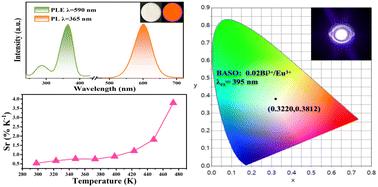
Herein, a series of BaAl4Sb2O12:Bi3+ phosphors (BASO:Bi3+) with desired orange-red emission were synthesized through a high-temperature solid-state reaction method. Under 365 nm excitation, an orange-red emission with the main peak at 598 nm and a full width at half maximum (FWHM) of 60 nm appeared, attributed to the transition from the 3P1 → 1S0 energy level of Bi3+ ions. The emission intensity of BASO:xBi3+ (0.01 ≤ x ≤ 0.03) phosphors first increased along with Bi3+ doping and reached the maximum at x = 0.02 under excitation at 365 nm. Interestingly, the emission coefficient of the prepared phosphors is linearly related to temperature, and the intensity decreases sharply with increasing temperature. Bi3+-doped BASO host phosphors exhibit strong temperature-dependence within the range of 298 K to 473 K, and their activation energy is 0.30 eV for the thermal quenching mechanism. The temperature-dependent characteristics of luminescent materials doped with Bi3+ suggest that the maximum relative sensitivity of BASO:Bi3+ at 473 K is 2.59% K−1, indicating that the sample is suitable for measurement in a wider temperature range. Under the co-doping of Bi3+/Eu3+, single-phase white light emission was achieved, and the CIE coordinates (0.3320, 0.3812) were extremely close to the standard white light coordinates. Thus, BaAl4Sb2O12:Bi3+ phosphors show potential applications in optical temperature sensing fields.




 京公网安备 11010802042870号
京ICP备2023020795号-1
京公网安备 11010802042870号
京ICP备2023020795号-1

 分享
分享
 求助内容:
求助内容: 应助结果提醒方式:
 扫码关注我们
