Jieying Wan, Ji Yang, Na Yang, Yifei Sun, Chuansheng Hu, Yang Zhao, Xiaoyan Xu, Haifeng Qi, Xiaodong Li, Hao Zhang
{"title":"轴向氯诱导对称破缺铁单原子电化学合成氨催化剂","authors":"Jieying Wan, Ji Yang, Na Yang, Yifei Sun, Chuansheng Hu, Yang Zhao, Xiaoyan Xu, Haifeng Qi, Xiaodong Li, Hao Zhang","doi":"10.1021/acscatal.4c06501","DOIUrl":null,"url":null,"abstract":"Electrochemical nitrate reduction reaction (NO<sub>3</sub><sup>–</sup>RR) presents a sustainable method for ammonia synthesis. Single-atom catalysts possessing the symmetric planar four-ligand structure (M-N<sub>4</sub>) serve as advantageous catalytic active sites for NO<sub>3</sub><sup>–</sup>RR. However, the inherent extreme symmetry of the standard M-N<sub>4</sub> structure limits the reaction kinetics. Herein, we introduce a symmetry-breaking iron single-atom catalyst coordinated with axial chlorine on nitrogen-doped carbon (Cl-Fe-NC) for NO<sub>3</sub><sup>–</sup>RR. Cl-Fe-NC exhibits a 99.4% ammonia Faradaic efficiency (FE) at −0.28 V vs reversible hydrogen electrode (RHE) with a 9396.7 μg<sub>NH3</sub> h<sup>–1</sup> cm<sup>–2</sup> yield rate at −0.68 V vs RHE, remarkably surpassing that of Fe-NC (<80%, 4330.9 μg<sub>NH3</sub> h<sup>–1</sup> cm<sup>–2</sup> at the same potential). Operando synchrotron radiation Fourier transform infrared (SR-FTIR) spectroscopy confirms that key intermediates, such as *NO, *NO-H<sub><i>x</i></sub>, and σ(N–H), are formed. Density functional theory (DFT) calculations attribute the optimized free energy of NO<sub>3</sub><sup>–</sup>RR intermediates to the axial chlorine design, reducing the potential determination step barrier energy by up to 0.66 eV. The presence of axial Cl atoms modulates the symmetry of the single Fe atom, enhancing the adsorption of nitrate ions and the enrichment of critical intermediates during NO<sub>3</sub><sup>–</sup>RR while inhibiting the hydrogen evolution reaction (HER). This discovery opens avenues for boosting electrochemical ammonia synthesis through the precise modulation of atomic structures by doping heteroatoms for symmetry breaking.","PeriodicalId":9,"journal":{"name":"ACS Catalysis ","volume":"12 1","pages":""},"PeriodicalIF":13.6000,"publicationDate":"2025-03-03","publicationTypes":"Journal Article","fieldsOfStudy":null,"isOpenAccess":false,"openAccessPdf":"","citationCount":"0","resultStr":"{\"title\":\"Axial Chlorine-Induced Symmetry-Breaking Iron Single-Atom Catalyst for Electrochemical Ammonia Synthesis\",\"authors\":\"Jieying Wan, Ji Yang, Na Yang, Yifei Sun, Chuansheng Hu, Yang Zhao, Xiaoyan Xu, Haifeng Qi, Xiaodong Li, Hao Zhang\",\"doi\":\"10.1021/acscatal.4c06501\",\"DOIUrl\":null,\"url\":null,\"abstract\":\"Electrochemical nitrate reduction reaction (NO<sub>3</sub><sup>–</sup>RR) presents a sustainable method for ammonia synthesis. Single-atom catalysts possessing the symmetric planar four-ligand structure (M-N<sub>4</sub>) serve as advantageous catalytic active sites for NO<sub>3</sub><sup>–</sup>RR. However, the inherent extreme symmetry of the standard M-N<sub>4</sub> structure limits the reaction kinetics. Herein, we introduce a symmetry-breaking iron single-atom catalyst coordinated with axial chlorine on nitrogen-doped carbon (Cl-Fe-NC) for NO<sub>3</sub><sup>–</sup>RR. Cl-Fe-NC exhibits a 99.4% ammonia Faradaic efficiency (FE) at −0.28 V vs reversible hydrogen electrode (RHE) with a 9396.7 μg<sub>NH3</sub> h<sup>–1</sup> cm<sup>–2</sup> yield rate at −0.68 V vs RHE, remarkably surpassing that of Fe-NC (<80%, 4330.9 μg<sub>NH3</sub> h<sup>–1</sup> cm<sup>–2</sup> at the same potential). Operando synchrotron radiation Fourier transform infrared (SR-FTIR) spectroscopy confirms that key intermediates, such as *NO, *NO-H<sub><i>x</i></sub>, and σ(N–H), are formed. Density functional theory (DFT) calculations attribute the optimized free energy of NO<sub>3</sub><sup>–</sup>RR intermediates to the axial chlorine design, reducing the potential determination step barrier energy by up to 0.66 eV. The presence of axial Cl atoms modulates the symmetry of the single Fe atom, enhancing the adsorption of nitrate ions and the enrichment of critical intermediates during NO<sub>3</sub><sup>–</sup>RR while inhibiting the hydrogen evolution reaction (HER). This discovery opens avenues for boosting electrochemical ammonia synthesis through the precise modulation of atomic structures by doping heteroatoms for symmetry breaking.\",\"PeriodicalId\":9,\"journal\":{\"name\":\"ACS Catalysis \",\"volume\":\"12 1\",\"pages\":\"\"},\"PeriodicalIF\":13.6000,\"publicationDate\":\"2025-03-03\",\"publicationTypes\":\"Journal Article\",\"fieldsOfStudy\":null,\"isOpenAccess\":false,\"openAccessPdf\":\"\",\"citationCount\":\"0\",\"resultStr\":null,\"platform\":\"Semanticscholar\",\"paperid\":null,\"PeriodicalName\":\"ACS Catalysis \",\"FirstCategoryId\":\"92\",\"ListUrlMain\":\"https://doi.org/10.1021/acscatal.4c06501\",\"RegionNum\":1,\"RegionCategory\":\"化学\",\"ArticlePicture\":[],\"TitleCN\":null,\"AbstractTextCN\":null,\"PMCID\":null,\"EPubDate\":\"\",\"PubModel\":\"\",\"JCR\":\"Q1\",\"JCRName\":\"CHEMISTRY, PHYSICAL\",\"Score\":null,\"Total\":0}","platform":"Semanticscholar","paperid":null,"PeriodicalName":"ACS Catalysis ","FirstCategoryId":"92","ListUrlMain":"https://doi.org/10.1021/acscatal.4c06501","RegionNum":1,"RegionCategory":"化学","ArticlePicture":[],"TitleCN":null,"AbstractTextCN":null,"PMCID":null,"EPubDate":"","PubModel":"","JCR":"Q1","JCRName":"CHEMISTRY, PHYSICAL","Score":null,"Total":0}
Axial Chlorine-Induced Symmetry-Breaking Iron Single-Atom Catalyst for Electrochemical Ammonia Synthesis
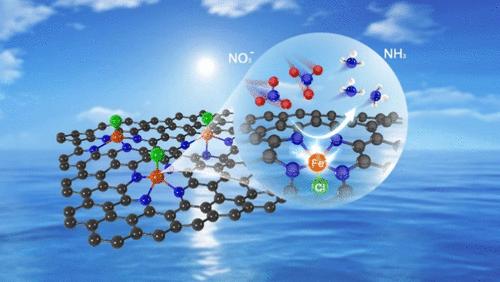
Electrochemical nitrate reduction reaction (NO3–RR) presents a sustainable method for ammonia synthesis. Single-atom catalysts possessing the symmetric planar four-ligand structure (M-N4) serve as advantageous catalytic active sites for NO3–RR. However, the inherent extreme symmetry of the standard M-N4 structure limits the reaction kinetics. Herein, we introduce a symmetry-breaking iron single-atom catalyst coordinated with axial chlorine on nitrogen-doped carbon (Cl-Fe-NC) for NO3–RR. Cl-Fe-NC exhibits a 99.4% ammonia Faradaic efficiency (FE) at −0.28 V vs reversible hydrogen electrode (RHE) with a 9396.7 μgNH3 h–1 cm–2 yield rate at −0.68 V vs RHE, remarkably surpassing that of Fe-NC (<80%, 4330.9 μgNH3 h–1 cm–2 at the same potential). Operando synchrotron radiation Fourier transform infrared (SR-FTIR) spectroscopy confirms that key intermediates, such as *NO, *NO-Hx, and σ(N–H), are formed. Density functional theory (DFT) calculations attribute the optimized free energy of NO3–RR intermediates to the axial chlorine design, reducing the potential determination step barrier energy by up to 0.66 eV. The presence of axial Cl atoms modulates the symmetry of the single Fe atom, enhancing the adsorption of nitrate ions and the enrichment of critical intermediates during NO3–RR while inhibiting the hydrogen evolution reaction (HER). This discovery opens avenues for boosting electrochemical ammonia synthesis through the precise modulation of atomic structures by doping heteroatoms for symmetry breaking.
期刊介绍:
ACS Catalysis is an esteemed journal that publishes original research in the fields of heterogeneous catalysis, molecular catalysis, and biocatalysis. It offers broad coverage across diverse areas such as life sciences, organometallics and synthesis, photochemistry and electrochemistry, drug discovery and synthesis, materials science, environmental protection, polymer discovery and synthesis, and energy and fuels.
The scope of the journal is to showcase innovative work in various aspects of catalysis. This includes new reactions and novel synthetic approaches utilizing known catalysts, the discovery or modification of new catalysts, elucidation of catalytic mechanisms through cutting-edge investigations, practical enhancements of existing processes, as well as conceptual advances in the field. Contributions to ACS Catalysis can encompass both experimental and theoretical research focused on catalytic molecules, macromolecules, and materials that exhibit catalytic turnover.




 京公网安备 11010802042870号
京ICP备2023020795号-1
京公网安备 11010802042870号
京ICP备2023020795号-1

 分享
分享
 求助内容:
求助内容: 应助结果提醒方式:
 扫码关注我们
