Anastasios Orestis Grammenos, Rémi F. André, Fernando Igoa Saldaña, Mahima Kamra, Markus Antonietti, Mateusz Odziomek
{"title":"利用n掺杂碳的电化学储氢能力进行无金属加氢","authors":"Anastasios Orestis Grammenos, Rémi F. André, Fernando Igoa Saldaña, Mahima Kamra, Markus Antonietti, Mateusz Odziomek","doi":"10.1021/acscatal.4c06929","DOIUrl":null,"url":null,"abstract":"Electrochemically driven organic reactions present an appealing alternative to traditional catalytic methods, which often involve harsh conditions. To date, commercial (noble) metal electrodes have dominated the field, with the development of effective, cheap, and stable electrode materials being overlooked. Nitrogen-doped carbons (NDCs) are widely used in electrocatalysis, energy storage, and even electrochemical hydrogen storage, which can be potentially beneficial in hydrogenation reactions, yet their potential in organic electrosynthesis has remained underexplored. In this study, we synthesized a nanoporous NDC from 7,7,8,8-tetracyanoquinodimethane via the salt-melt method and employed it for the electrochemical hydrogenation of maleic acid to succinic acid (SA). The NDC demonstrated high SA yield rates with nearly 100% Faradaic efficiency, with its performance being comparable or better than conventional (photo)catalytic methods, while using milder conditions, with water as the hydrogen source, and without any metal catalysts. Owing to the NDC’s chemical structure, which causes specific adsorptive interactions, the reaction mechanism resembles that of noble metals, where protons reduced in the Volmer step recombine with coadsorbed maleic acid in a subsequent chemical step. Additionally, due to these adsorptive interactions, the reaction could be directed at will toward the nonredox electrochemical isomerization to fumaric acid, by simply adjusting the potential and electrolyte acidity.","PeriodicalId":9,"journal":{"name":"ACS Catalysis ","volume":"52 1","pages":""},"PeriodicalIF":13.1000,"publicationDate":"2025-03-03","publicationTypes":"Journal Article","fieldsOfStudy":null,"isOpenAccess":false,"openAccessPdf":"","citationCount":"0","resultStr":"{\"title\":\"Harnessing the Electrochemical Hydrogen Storage Capability of N-Doped Carbons for Metal-Free Hydrogenations\",\"authors\":\"Anastasios Orestis Grammenos, Rémi F. André, Fernando Igoa Saldaña, Mahima Kamra, Markus Antonietti, Mateusz Odziomek\",\"doi\":\"10.1021/acscatal.4c06929\",\"DOIUrl\":null,\"url\":null,\"abstract\":\"Electrochemically driven organic reactions present an appealing alternative to traditional catalytic methods, which often involve harsh conditions. To date, commercial (noble) metal electrodes have dominated the field, with the development of effective, cheap, and stable electrode materials being overlooked. Nitrogen-doped carbons (NDCs) are widely used in electrocatalysis, energy storage, and even electrochemical hydrogen storage, which can be potentially beneficial in hydrogenation reactions, yet their potential in organic electrosynthesis has remained underexplored. In this study, we synthesized a nanoporous NDC from 7,7,8,8-tetracyanoquinodimethane via the salt-melt method and employed it for the electrochemical hydrogenation of maleic acid to succinic acid (SA). The NDC demonstrated high SA yield rates with nearly 100% Faradaic efficiency, with its performance being comparable or better than conventional (photo)catalytic methods, while using milder conditions, with water as the hydrogen source, and without any metal catalysts. Owing to the NDC’s chemical structure, which causes specific adsorptive interactions, the reaction mechanism resembles that of noble metals, where protons reduced in the Volmer step recombine with coadsorbed maleic acid in a subsequent chemical step. Additionally, due to these adsorptive interactions, the reaction could be directed at will toward the nonredox electrochemical isomerization to fumaric acid, by simply adjusting the potential and electrolyte acidity.\",\"PeriodicalId\":9,\"journal\":{\"name\":\"ACS Catalysis \",\"volume\":\"52 1\",\"pages\":\"\"},\"PeriodicalIF\":13.1000,\"publicationDate\":\"2025-03-03\",\"publicationTypes\":\"Journal Article\",\"fieldsOfStudy\":null,\"isOpenAccess\":false,\"openAccessPdf\":\"\",\"citationCount\":\"0\",\"resultStr\":null,\"platform\":\"Semanticscholar\",\"paperid\":null,\"PeriodicalName\":\"ACS Catalysis \",\"FirstCategoryId\":\"92\",\"ListUrlMain\":\"https://doi.org/10.1021/acscatal.4c06929\",\"RegionNum\":1,\"RegionCategory\":\"化学\",\"ArticlePicture\":[],\"TitleCN\":null,\"AbstractTextCN\":null,\"PMCID\":null,\"EPubDate\":\"\",\"PubModel\":\"\",\"JCR\":\"Q1\",\"JCRName\":\"CHEMISTRY, PHYSICAL\",\"Score\":null,\"Total\":0}","platform":"Semanticscholar","paperid":null,"PeriodicalName":"ACS Catalysis ","FirstCategoryId":"92","ListUrlMain":"https://doi.org/10.1021/acscatal.4c06929","RegionNum":1,"RegionCategory":"化学","ArticlePicture":[],"TitleCN":null,"AbstractTextCN":null,"PMCID":null,"EPubDate":"","PubModel":"","JCR":"Q1","JCRName":"CHEMISTRY, PHYSICAL","Score":null,"Total":0}
Harnessing the Electrochemical Hydrogen Storage Capability of N-Doped Carbons for Metal-Free Hydrogenations
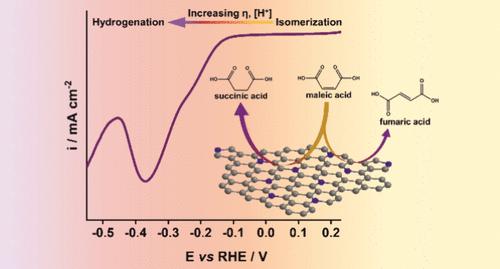
Electrochemically driven organic reactions present an appealing alternative to traditional catalytic methods, which often involve harsh conditions. To date, commercial (noble) metal electrodes have dominated the field, with the development of effective, cheap, and stable electrode materials being overlooked. Nitrogen-doped carbons (NDCs) are widely used in electrocatalysis, energy storage, and even electrochemical hydrogen storage, which can be potentially beneficial in hydrogenation reactions, yet their potential in organic electrosynthesis has remained underexplored. In this study, we synthesized a nanoporous NDC from 7,7,8,8-tetracyanoquinodimethane via the salt-melt method and employed it for the electrochemical hydrogenation of maleic acid to succinic acid (SA). The NDC demonstrated high SA yield rates with nearly 100% Faradaic efficiency, with its performance being comparable or better than conventional (photo)catalytic methods, while using milder conditions, with water as the hydrogen source, and without any metal catalysts. Owing to the NDC’s chemical structure, which causes specific adsorptive interactions, the reaction mechanism resembles that of noble metals, where protons reduced in the Volmer step recombine with coadsorbed maleic acid in a subsequent chemical step. Additionally, due to these adsorptive interactions, the reaction could be directed at will toward the nonredox electrochemical isomerization to fumaric acid, by simply adjusting the potential and electrolyte acidity.
期刊介绍:
ACS Catalysis is an esteemed journal that publishes original research in the fields of heterogeneous catalysis, molecular catalysis, and biocatalysis. It offers broad coverage across diverse areas such as life sciences, organometallics and synthesis, photochemistry and electrochemistry, drug discovery and synthesis, materials science, environmental protection, polymer discovery and synthesis, and energy and fuels.
The scope of the journal is to showcase innovative work in various aspects of catalysis. This includes new reactions and novel synthetic approaches utilizing known catalysts, the discovery or modification of new catalysts, elucidation of catalytic mechanisms through cutting-edge investigations, practical enhancements of existing processes, as well as conceptual advances in the field. Contributions to ACS Catalysis can encompass both experimental and theoretical research focused on catalytic molecules, macromolecules, and materials that exhibit catalytic turnover.




 京公网安备 11010802042870号
京ICP备2023020795号-1
京公网安备 11010802042870号
京ICP备2023020795号-1

 分享
分享
 求助内容:
求助内容: 应助结果提醒方式:
 扫码关注我们
