Manali Basu, Avijit Mainan, Susmita Roy and Padmaja Prasad Mishra
{"title":"动态g -四聚体支架的出现:揭示低盐诱导的构象异质性和折叠机制","authors":"Manali Basu, Avijit Mainan, Susmita Roy and Padmaja Prasad Mishra","doi":"10.1039/D4CP04362F","DOIUrl":null,"url":null,"abstract":"<p >The topological diversity of human telomeric G-quadruplex structures is intrinsically related to their folding mechanisms, and is significantly modulated by ion-atmospheric conditions. Unlike previous studies that focused on higher Na<small><sup>+</sup></small> or K<small><sup>+</sup></small> concentrations, this study explores G-quadruplex folding and dynamics under low NaCl conditions (≤100 mM) using single-molecule FRET microscopy and advanced structure-based DNA simulation techniques. The smFRET data reveal three distinct populations: unfolded, intermediate dynamic triplex, and dynamic tetraplex structural ensemble. The broad distribution of the folded population highlights the dynamic nature of the quadruplex structure under low salt conditions. In agreement with smFRET results, free energy simulations show that with the increase of NaCl concentration, the population shifts towards the folded state, and differentiates all intermediate structural ensembles. The dynamic equilibrium between the triplex and tetraplex scaffolds explains the microscopic basis of conformational heterogeneity within the folded basin. Simulations also reveal that the flexibility of dynamic tetraplex bases depends on the equilibrium distribution of ions underpinning a few ion-mediated dynamic non-native interactions in the G-quadruplex structure. Contrary to the previously held belief that Na<small><sup>+</sup></small> induces minimal structural heterogeneity, our combined experimental and simulation approaches demonstrate and rationalize the structural variability in G-quadruplexes under low NaCl concentrations.</p>","PeriodicalId":99,"journal":{"name":"Physical Chemistry Chemical Physics","volume":" 14","pages":" 7104-7119"},"PeriodicalIF":2.9000,"publicationDate":"2025-03-04","publicationTypes":"Journal Article","fieldsOfStudy":null,"isOpenAccess":false,"openAccessPdf":"","citationCount":"0","resultStr":"{\"title\":\"Emergence of a dynamic G-tetraplex scaffold: uncovering low salt-induced conformational heterogeneity and the folding mechanism of telomeric DNA†\",\"authors\":\"Manali Basu, Avijit Mainan, Susmita Roy and Padmaja Prasad Mishra\",\"doi\":\"10.1039/D4CP04362F\",\"DOIUrl\":null,\"url\":null,\"abstract\":\"<p >The topological diversity of human telomeric G-quadruplex structures is intrinsically related to their folding mechanisms, and is significantly modulated by ion-atmospheric conditions. Unlike previous studies that focused on higher Na<small><sup>+</sup></small> or K<small><sup>+</sup></small> concentrations, this study explores G-quadruplex folding and dynamics under low NaCl conditions (≤100 mM) using single-molecule FRET microscopy and advanced structure-based DNA simulation techniques. The smFRET data reveal three distinct populations: unfolded, intermediate dynamic triplex, and dynamic tetraplex structural ensemble. The broad distribution of the folded population highlights the dynamic nature of the quadruplex structure under low salt conditions. In agreement with smFRET results, free energy simulations show that with the increase of NaCl concentration, the population shifts towards the folded state, and differentiates all intermediate structural ensembles. The dynamic equilibrium between the triplex and tetraplex scaffolds explains the microscopic basis of conformational heterogeneity within the folded basin. Simulations also reveal that the flexibility of dynamic tetraplex bases depends on the equilibrium distribution of ions underpinning a few ion-mediated dynamic non-native interactions in the G-quadruplex structure. Contrary to the previously held belief that Na<small><sup>+</sup></small> induces minimal structural heterogeneity, our combined experimental and simulation approaches demonstrate and rationalize the structural variability in G-quadruplexes under low NaCl concentrations.</p>\",\"PeriodicalId\":99,\"journal\":{\"name\":\"Physical Chemistry Chemical Physics\",\"volume\":\" 14\",\"pages\":\" 7104-7119\"},\"PeriodicalIF\":2.9000,\"publicationDate\":\"2025-03-04\",\"publicationTypes\":\"Journal Article\",\"fieldsOfStudy\":null,\"isOpenAccess\":false,\"openAccessPdf\":\"\",\"citationCount\":\"0\",\"resultStr\":null,\"platform\":\"Semanticscholar\",\"paperid\":null,\"PeriodicalName\":\"Physical Chemistry Chemical Physics\",\"FirstCategoryId\":\"92\",\"ListUrlMain\":\"https://pubs.rsc.org/en/content/articlelanding/2025/cp/d4cp04362f\",\"RegionNum\":3,\"RegionCategory\":\"化学\",\"ArticlePicture\":[],\"TitleCN\":null,\"AbstractTextCN\":null,\"PMCID\":null,\"EPubDate\":\"\",\"PubModel\":\"\",\"JCR\":\"Q3\",\"JCRName\":\"CHEMISTRY, PHYSICAL\",\"Score\":null,\"Total\":0}","platform":"Semanticscholar","paperid":null,"PeriodicalName":"Physical Chemistry Chemical Physics","FirstCategoryId":"92","ListUrlMain":"https://pubs.rsc.org/en/content/articlelanding/2025/cp/d4cp04362f","RegionNum":3,"RegionCategory":"化学","ArticlePicture":[],"TitleCN":null,"AbstractTextCN":null,"PMCID":null,"EPubDate":"","PubModel":"","JCR":"Q3","JCRName":"CHEMISTRY, PHYSICAL","Score":null,"Total":0}
引用次数: 0
摘要
人类端粒g -四重体结构的拓扑多样性与其折叠机制有着内在的联系,并受到离子大气条件的显著调节。与以往的研究不同,该研究主要关注较高的Na+或K+浓度,该研究利用单分子FRET显微镜和先进的基于结构的DNA模拟技术,探索了低NaCl条件下(≤100 mM) g -四联体折叠和动力学。smFRET数据揭示了三个不同的群体;展开、中间动态三聚体和动态四聚体结构集合。折叠种群的广泛分布突出了低盐条件下四重结构的动态性。自由能模拟结果与smFRET结果一致,表明随着NaCl浓度的增加,居群向折叠态转移,并分化出所有中间结构系综。三联体和四联体支架之间的动态平衡解释了褶皱盆地内部构象非均质性的微观基础。模拟还表明,动态四聚体碱的柔韧性取决于离子的平衡分布,从而支持了g -四聚体结构中一些离子介导的动态非原生相互作用。与之前认为Na+诱导最小结构异质性的观点相反,我们将实验和模拟相结合的方法证明并合理化了低NaCl浓度下g -四络合物的结构变异性。
Emergence of a dynamic G-tetraplex scaffold: uncovering low salt-induced conformational heterogeneity and the folding mechanism of telomeric DNA†
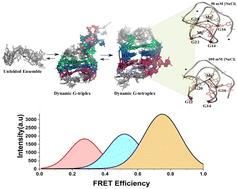
The topological diversity of human telomeric G-quadruplex structures is intrinsically related to their folding mechanisms, and is significantly modulated by ion-atmospheric conditions. Unlike previous studies that focused on higher Na+ or K+ concentrations, this study explores G-quadruplex folding and dynamics under low NaCl conditions (≤100 mM) using single-molecule FRET microscopy and advanced structure-based DNA simulation techniques. The smFRET data reveal three distinct populations: unfolded, intermediate dynamic triplex, and dynamic tetraplex structural ensemble. The broad distribution of the folded population highlights the dynamic nature of the quadruplex structure under low salt conditions. In agreement with smFRET results, free energy simulations show that with the increase of NaCl concentration, the population shifts towards the folded state, and differentiates all intermediate structural ensembles. The dynamic equilibrium between the triplex and tetraplex scaffolds explains the microscopic basis of conformational heterogeneity within the folded basin. Simulations also reveal that the flexibility of dynamic tetraplex bases depends on the equilibrium distribution of ions underpinning a few ion-mediated dynamic non-native interactions in the G-quadruplex structure. Contrary to the previously held belief that Na+ induces minimal structural heterogeneity, our combined experimental and simulation approaches demonstrate and rationalize the structural variability in G-quadruplexes under low NaCl concentrations.
期刊介绍:
Physical Chemistry Chemical Physics (PCCP) is an international journal co-owned by 19 physical chemistry and physics societies from around the world. This journal publishes original, cutting-edge research in physical chemistry, chemical physics and biophysical chemistry. To be suitable for publication in PCCP, articles must include significant innovation and/or insight into physical chemistry; this is the most important criterion that reviewers and Editors will judge against when evaluating submissions.
The journal has a broad scope and welcomes contributions spanning experiment, theory, computation and data science. Topical coverage includes spectroscopy, dynamics, kinetics, statistical mechanics, thermodynamics, electrochemistry, catalysis, surface science, quantum mechanics, quantum computing and machine learning. Interdisciplinary research areas such as polymers and soft matter, materials, nanoscience, energy, surfaces/interfaces, and biophysical chemistry are welcomed if they demonstrate significant innovation and/or insight into physical chemistry. Joined experimental/theoretical studies are particularly appreciated when complementary and based on up-to-date approaches.





 京公网安备 11010802042870号
京ICP备2023020795号-1
京公网安备 11010802042870号
京ICP备2023020795号-1

 分享
分享
 求助内容:
求助内容: 应助结果提醒方式:
 扫码关注我们
