Xin-Xin Jin, Zhen Shao, Peng-Xiang Fu, Yi-Fan Deng, Qi Sui, Yi-Han Wang, Jin Xiong, Bing-Wu Wang, Zhe-Ming Wang and Song Gao
{"title":"利用不同的双金属-氰基紫外光杂化材料调节光致变色和光磁性","authors":"Xin-Xin Jin, Zhen Shao, Peng-Xiang Fu, Yi-Fan Deng, Qi Sui, Yi-Han Wang, Jin Xiong, Bing-Wu Wang, Zhe-Ming Wang and Song Gao","doi":"10.1039/D4QI03115F","DOIUrl":null,"url":null,"abstract":"<p >The integration of photochromism and photomagnetism is of great significance for developing photo-responsive multifunctional materials. Herein, we successfully synthesized four cyanido-bridged bimetallic frameworks formulated as (MV<small><sup>II</sup></small>)<small><sub>0.5</sub></small>[M<small><sup>III</sup></small>M<small><sup>II</sup></small>(CN)<small><sub>6</sub></small>]·(H<small><sub>2</sub></small>O)<small><sub><em>n</em></sub></small> (<em>i.e.</em>, <strong>FeMn</strong>, <strong>FeZn</strong>, <strong>CrMn</strong>, and <strong>CrZn</strong>; MV<small><sup>II</sup></small> = 1,1′-dimethyl-4,4′-bipyridine dication; M<small><sup>III</sup></small> = Fe<small><sup>III</sup></small>, Cr<small><sup>III</sup></small>; M<small><sup>II</sup></small> = Mn<small><sup>II</sup></small>, Zn<small><sup>II</sup></small>), by incorporating diverse polycyanidometallates and viologen moieties into donor–acceptor (D–A) hybrid molecule-based materials. <strong>FeZn</strong> and <strong>CrZn</strong> both exhibit visible photoinduced electron transfer (PET) processes upon Xe lamp irradiation at room temperature. However, while <strong>CrZn</strong> undergoes reversible photochromism, <strong>FeZn</strong> exhibits irreversible photochromism, which originates not only from photoinduced radicals but also from Fe reduction. Interestingly, the change in the absorption band of <strong>FeZn</strong> spans the UV-visible-near infrared (UV-Vis-NIR) region (<em>ca.</em> 200–2600 nm) after irradiation. Although <strong>FeMn</strong> and <strong>CrMn</strong> do not exhibit photoinduced colour changes, they behave as two-dimensional (2D) and three-dimensional (3D) ferrimagnets, respectively, with <strong>CrMn</strong> exhibiting long-range ordering below <em>ca.</em> 80 K. <strong>FeZn</strong> exhibits photomagnetic behavior upon irradiation due to magnetic interactions between photoinduced viologen radicals and low-spin (LS) Fe<small><sup>III</sup></small> ions. Additionally, we investigate the remarkable influence of metal ions on photochromism and (photo)magnetism through detailed crystal structure analysis. This work provides a novel approach for synthesizing photo-responsive multifunctional materials using cyanidometallic viologen hybrid compounds.</p>","PeriodicalId":79,"journal":{"name":"Inorganic Chemistry Frontiers","volume":" 8","pages":" 3294-3304"},"PeriodicalIF":6.2000,"publicationDate":"2025-03-04","publicationTypes":"Journal Article","fieldsOfStudy":null,"isOpenAccess":false,"openAccessPdf":"","citationCount":"0","resultStr":"{\"title\":\"Tuning photochromism and photomagnetism via diverse bimetallic cyanido viologen hybrid materials†\",\"authors\":\"Xin-Xin Jin, Zhen Shao, Peng-Xiang Fu, Yi-Fan Deng, Qi Sui, Yi-Han Wang, Jin Xiong, Bing-Wu Wang, Zhe-Ming Wang and Song Gao\",\"doi\":\"10.1039/D4QI03115F\",\"DOIUrl\":null,\"url\":null,\"abstract\":\"<p >The integration of photochromism and photomagnetism is of great significance for developing photo-responsive multifunctional materials. Herein, we successfully synthesized four cyanido-bridged bimetallic frameworks formulated as (MV<small><sup>II</sup></small>)<small><sub>0.5</sub></small>[M<small><sup>III</sup></small>M<small><sup>II</sup></small>(CN)<small><sub>6</sub></small>]·(H<small><sub>2</sub></small>O)<small><sub><em>n</em></sub></small> (<em>i.e.</em>, <strong>FeMn</strong>, <strong>FeZn</strong>, <strong>CrMn</strong>, and <strong>CrZn</strong>; MV<small><sup>II</sup></small> = 1,1′-dimethyl-4,4′-bipyridine dication; M<small><sup>III</sup></small> = Fe<small><sup>III</sup></small>, Cr<small><sup>III</sup></small>; M<small><sup>II</sup></small> = Mn<small><sup>II</sup></small>, Zn<small><sup>II</sup></small>), by incorporating diverse polycyanidometallates and viologen moieties into donor–acceptor (D–A) hybrid molecule-based materials. <strong>FeZn</strong> and <strong>CrZn</strong> both exhibit visible photoinduced electron transfer (PET) processes upon Xe lamp irradiation at room temperature. However, while <strong>CrZn</strong> undergoes reversible photochromism, <strong>FeZn</strong> exhibits irreversible photochromism, which originates not only from photoinduced radicals but also from Fe reduction. Interestingly, the change in the absorption band of <strong>FeZn</strong> spans the UV-visible-near infrared (UV-Vis-NIR) region (<em>ca.</em> 200–2600 nm) after irradiation. Although <strong>FeMn</strong> and <strong>CrMn</strong> do not exhibit photoinduced colour changes, they behave as two-dimensional (2D) and three-dimensional (3D) ferrimagnets, respectively, with <strong>CrMn</strong> exhibiting long-range ordering below <em>ca.</em> 80 K. <strong>FeZn</strong> exhibits photomagnetic behavior upon irradiation due to magnetic interactions between photoinduced viologen radicals and low-spin (LS) Fe<small><sup>III</sup></small> ions. Additionally, we investigate the remarkable influence of metal ions on photochromism and (photo)magnetism through detailed crystal structure analysis. This work provides a novel approach for synthesizing photo-responsive multifunctional materials using cyanidometallic viologen hybrid compounds.</p>\",\"PeriodicalId\":79,\"journal\":{\"name\":\"Inorganic Chemistry Frontiers\",\"volume\":\" 8\",\"pages\":\" 3294-3304\"},\"PeriodicalIF\":6.2000,\"publicationDate\":\"2025-03-04\",\"publicationTypes\":\"Journal Article\",\"fieldsOfStudy\":null,\"isOpenAccess\":false,\"openAccessPdf\":\"\",\"citationCount\":\"0\",\"resultStr\":null,\"platform\":\"Semanticscholar\",\"paperid\":null,\"PeriodicalName\":\"Inorganic Chemistry Frontiers\",\"FirstCategoryId\":\"92\",\"ListUrlMain\":\"https://pubs.rsc.org/en/content/articlelanding/2025/qi/d4qi03115f\",\"RegionNum\":1,\"RegionCategory\":\"化学\",\"ArticlePicture\":[],\"TitleCN\":null,\"AbstractTextCN\":null,\"PMCID\":null,\"EPubDate\":\"\",\"PubModel\":\"\",\"JCR\":\"Q1\",\"JCRName\":\"CHEMISTRY, INORGANIC & NUCLEAR\",\"Score\":null,\"Total\":0}","platform":"Semanticscholar","paperid":null,"PeriodicalName":"Inorganic Chemistry Frontiers","FirstCategoryId":"92","ListUrlMain":"https://pubs.rsc.org/en/content/articlelanding/2025/qi/d4qi03115f","RegionNum":1,"RegionCategory":"化学","ArticlePicture":[],"TitleCN":null,"AbstractTextCN":null,"PMCID":null,"EPubDate":"","PubModel":"","JCR":"Q1","JCRName":"CHEMISTRY, INORGANIC & NUCLEAR","Score":null,"Total":0}
Tuning photochromism and photomagnetism via diverse bimetallic cyanido viologen hybrid materials†
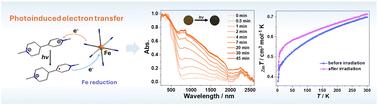
The integration of photochromism and photomagnetism is of great significance for developing photo-responsive multifunctional materials. Herein, we successfully synthesized four cyanido-bridged bimetallic frameworks formulated as (MVII)0.5[MIIIMII(CN)6]·(H2O)n (i.e., FeMn, FeZn, CrMn, and CrZn; MVII = 1,1′-dimethyl-4,4′-bipyridine dication; MIII = FeIII, CrIII; MII = MnII, ZnII), by incorporating diverse polycyanidometallates and viologen moieties into donor–acceptor (D–A) hybrid molecule-based materials. FeZn and CrZn both exhibit visible photoinduced electron transfer (PET) processes upon Xe lamp irradiation at room temperature. However, while CrZn undergoes reversible photochromism, FeZn exhibits irreversible photochromism, which originates not only from photoinduced radicals but also from Fe reduction. Interestingly, the change in the absorption band of FeZn spans the UV-visible-near infrared (UV-Vis-NIR) region (ca. 200–2600 nm) after irradiation. Although FeMn and CrMn do not exhibit photoinduced colour changes, they behave as two-dimensional (2D) and three-dimensional (3D) ferrimagnets, respectively, with CrMn exhibiting long-range ordering below ca. 80 K. FeZn exhibits photomagnetic behavior upon irradiation due to magnetic interactions between photoinduced viologen radicals and low-spin (LS) FeIII ions. Additionally, we investigate the remarkable influence of metal ions on photochromism and (photo)magnetism through detailed crystal structure analysis. This work provides a novel approach for synthesizing photo-responsive multifunctional materials using cyanidometallic viologen hybrid compounds.





 京公网安备 11010802042870号
京ICP备2023020795号-1
京公网安备 11010802042870号
京ICP备2023020795号-1

 分享
分享
 求助内容:
求助内容: 应助结果提醒方式:
 扫码关注我们
