Dan Wu, Congmin Fan, Wusi Luo, Yingzhi Jin, Qinchuan He and Yiqun Wang
{"title":"中空合金 CoFe-ZIF 纳米ocage/Carbon 纳米纤维的中空工程诱导的界面极化损耗增强,可实现高效微波吸收","authors":"Dan Wu, Congmin Fan, Wusi Luo, Yingzhi Jin, Qinchuan He and Yiqun Wang","doi":"10.1039/D5QI00118H","DOIUrl":null,"url":null,"abstract":"<p >Metal organic frameworks (MOFs) have been widely studied in the field of microwave absorption due to their high porosity and large specific surface area. The weak dielectric loss limits the enhancement of their absorption performance. In this study, hollow alloyed CoFe-ZIF/CNF composite fibers were successfully synthesized by electrospinning and high-temperature carbonization. The carbon fiber with dielectric loss wraps hollow alloyed CoFe-ZIF nanocages with magnetic loss to form a bamboo-shaped composite fiber to achieve magnetoelectric synergy. The core advantages of the hollow structure are optimized impedance matching, extended propagation path and enhanced multi-mechanism loss. The construction of the hollow structure of hollow alloyed CoFe-ZIF nanocages and the combination of carbon fiber not only enriches substantial heterogeneous interfaces, but also optimizes impedance matching, which is beneficial for the attenuation dissipation of EMW. The results show that hollow alloyed CoFe-ZIF/CNF composite fibers exhibit excellent electromagnetic wave absorption performance. When the filling is only 10 wt%, the minimum reflection loss is −59.61 dB, and the effective absorption bandwidth reaches 6.64 GHz. This study used a combination of MOF alloy cages and carbon fibers to regulate the absorption properties, providing new insights into the preparation and application of 1D structural composite absorbers.</p>","PeriodicalId":79,"journal":{"name":"Inorganic Chemistry Frontiers","volume":" 8","pages":" 3083-3097"},"PeriodicalIF":6.4000,"publicationDate":"2025-03-04","publicationTypes":"Journal Article","fieldsOfStudy":null,"isOpenAccess":false,"openAccessPdf":"","citationCount":"0","resultStr":"{\"title\":\"Enhanced interfacial polarization loss induced by hollow engineering of hollow alloyed CoFe-ZIF nanocages/carbon nanofibers for efficient microwave absorption†\",\"authors\":\"Dan Wu, Congmin Fan, Wusi Luo, Yingzhi Jin, Qinchuan He and Yiqun Wang\",\"doi\":\"10.1039/D5QI00118H\",\"DOIUrl\":null,\"url\":null,\"abstract\":\"<p >Metal organic frameworks (MOFs) have been widely studied in the field of microwave absorption due to their high porosity and large specific surface area. The weak dielectric loss limits the enhancement of their absorption performance. In this study, hollow alloyed CoFe-ZIF/CNF composite fibers were successfully synthesized by electrospinning and high-temperature carbonization. The carbon fiber with dielectric loss wraps hollow alloyed CoFe-ZIF nanocages with magnetic loss to form a bamboo-shaped composite fiber to achieve magnetoelectric synergy. The core advantages of the hollow structure are optimized impedance matching, extended propagation path and enhanced multi-mechanism loss. The construction of the hollow structure of hollow alloyed CoFe-ZIF nanocages and the combination of carbon fiber not only enriches substantial heterogeneous interfaces, but also optimizes impedance matching, which is beneficial for the attenuation dissipation of EMW. The results show that hollow alloyed CoFe-ZIF/CNF composite fibers exhibit excellent electromagnetic wave absorption performance. When the filling is only 10 wt%, the minimum reflection loss is −59.61 dB, and the effective absorption bandwidth reaches 6.64 GHz. This study used a combination of MOF alloy cages and carbon fibers to regulate the absorption properties, providing new insights into the preparation and application of 1D structural composite absorbers.</p>\",\"PeriodicalId\":79,\"journal\":{\"name\":\"Inorganic Chemistry Frontiers\",\"volume\":\" 8\",\"pages\":\" 3083-3097\"},\"PeriodicalIF\":6.4000,\"publicationDate\":\"2025-03-04\",\"publicationTypes\":\"Journal Article\",\"fieldsOfStudy\":null,\"isOpenAccess\":false,\"openAccessPdf\":\"\",\"citationCount\":\"0\",\"resultStr\":null,\"platform\":\"Semanticscholar\",\"paperid\":null,\"PeriodicalName\":\"Inorganic Chemistry Frontiers\",\"FirstCategoryId\":\"92\",\"ListUrlMain\":\"https://pubs.rsc.org/en/content/articlelanding/2025/qi/d5qi00118h\",\"RegionNum\":1,\"RegionCategory\":\"化学\",\"ArticlePicture\":[],\"TitleCN\":null,\"AbstractTextCN\":null,\"PMCID\":null,\"EPubDate\":\"\",\"PubModel\":\"\",\"JCR\":\"Q1\",\"JCRName\":\"CHEMISTRY, INORGANIC & NUCLEAR\",\"Score\":null,\"Total\":0}","platform":"Semanticscholar","paperid":null,"PeriodicalName":"Inorganic Chemistry Frontiers","FirstCategoryId":"92","ListUrlMain":"https://pubs.rsc.org/en/content/articlelanding/2025/qi/d5qi00118h","RegionNum":1,"RegionCategory":"化学","ArticlePicture":[],"TitleCN":null,"AbstractTextCN":null,"PMCID":null,"EPubDate":"","PubModel":"","JCR":"Q1","JCRName":"CHEMISTRY, INORGANIC & NUCLEAR","Score":null,"Total":0}
Enhanced interfacial polarization loss induced by hollow engineering of hollow alloyed CoFe-ZIF nanocages/carbon nanofibers for efficient microwave absorption†
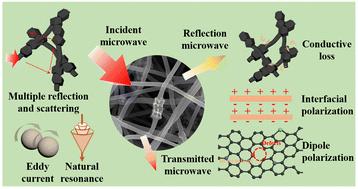
Metal organic frameworks (MOFs) have been widely studied in the field of microwave absorption due to their high porosity and large specific surface area. The weak dielectric loss limits the enhancement of their absorption performance. In this study, hollow alloyed CoFe-ZIF/CNF composite fibers were successfully synthesized by electrospinning and high-temperature carbonization. The carbon fiber with dielectric loss wraps hollow alloyed CoFe-ZIF nanocages with magnetic loss to form a bamboo-shaped composite fiber to achieve magnetoelectric synergy. The core advantages of the hollow structure are optimized impedance matching, extended propagation path and enhanced multi-mechanism loss. The construction of the hollow structure of hollow alloyed CoFe-ZIF nanocages and the combination of carbon fiber not only enriches substantial heterogeneous interfaces, but also optimizes impedance matching, which is beneficial for the attenuation dissipation of EMW. The results show that hollow alloyed CoFe-ZIF/CNF composite fibers exhibit excellent electromagnetic wave absorption performance. When the filling is only 10 wt%, the minimum reflection loss is −59.61 dB, and the effective absorption bandwidth reaches 6.64 GHz. This study used a combination of MOF alloy cages and carbon fibers to regulate the absorption properties, providing new insights into the preparation and application of 1D structural composite absorbers.





 京公网安备 11010802042870号
京ICP备2023020795号-1
京公网安备 11010802042870号
京ICP备2023020795号-1

 分享
分享
 求助内容:
求助内容: 应助结果提醒方式:
 扫码关注我们
