Salvatore Caterino, Iulia Maria Caniola, Marc Pignitter, Alfonso Zoleo, Claudia Crestini, Santiago Sanchez-Cortés, Katja Sterflinger, Federica Cappa
{"title":"铁胆油墨中铁多酚配合物的系统多分析方法:探索拉曼和电子顺磁共振的潜力","authors":"Salvatore Caterino, Iulia Maria Caniola, Marc Pignitter, Alfonso Zoleo, Claudia Crestini, Santiago Sanchez-Cortés, Katja Sterflinger, Federica Cappa","doi":"10.1021/acs.inorgchem.4c04232","DOIUrl":null,"url":null,"abstract":"Iron-gall inks (IGIs) are some of the most used writing materials in ancient times. Several efforts have been devoted to the identification and characterization of this type of ink in ancient manuscripts, with a particular focus on their degradation patterns. However, due to their complexity, the in-depth characterization of IGIs poses some challenges related in particular to their variability. Within this research, the main elements of variability associated with the chemical structure have been systematically investigated. The study involved the preparation of iron complexes of gallic acid, tannic acid, and polyphenols contained in oak-gall aqueous extracts, in pH-controlled regimes, and with different iron-to-ligand ratios. The so-prepared complexes have been then characterized via Raman, electron paramagnetic resonance (EPR), and infrared (IR) spectroscopies. The results obtained support the hypothesis of a strong dependence of the chemical structure on the pH condition prior to iron addition. At the same time, it has been possible to prove the efficiency of Raman spectroscopy in the in-depth characterization of historical inks and to explore the potential of IR and EPR in such studies.","PeriodicalId":40,"journal":{"name":"Inorganic Chemistry","volume":"211 1","pages":""},"PeriodicalIF":4.7000,"publicationDate":"2025-03-03","publicationTypes":"Journal Article","fieldsOfStudy":null,"isOpenAccess":false,"openAccessPdf":"","citationCount":"0","resultStr":"{\"title\":\"A Systematic Multianalytical Approach in the Study of Iron–Polyphenolic Complexes in Iron-Gall Inks: Exploring the Potentialities of Raman and Electron Paramagnetic Resonance\",\"authors\":\"Salvatore Caterino, Iulia Maria Caniola, Marc Pignitter, Alfonso Zoleo, Claudia Crestini, Santiago Sanchez-Cortés, Katja Sterflinger, Federica Cappa\",\"doi\":\"10.1021/acs.inorgchem.4c04232\",\"DOIUrl\":null,\"url\":null,\"abstract\":\"Iron-gall inks (IGIs) are some of the most used writing materials in ancient times. Several efforts have been devoted to the identification and characterization of this type of ink in ancient manuscripts, with a particular focus on their degradation patterns. However, due to their complexity, the in-depth characterization of IGIs poses some challenges related in particular to their variability. Within this research, the main elements of variability associated with the chemical structure have been systematically investigated. The study involved the preparation of iron complexes of gallic acid, tannic acid, and polyphenols contained in oak-gall aqueous extracts, in pH-controlled regimes, and with different iron-to-ligand ratios. The so-prepared complexes have been then characterized via Raman, electron paramagnetic resonance (EPR), and infrared (IR) spectroscopies. The results obtained support the hypothesis of a strong dependence of the chemical structure on the pH condition prior to iron addition. At the same time, it has been possible to prove the efficiency of Raman spectroscopy in the in-depth characterization of historical inks and to explore the potential of IR and EPR in such studies.\",\"PeriodicalId\":40,\"journal\":{\"name\":\"Inorganic Chemistry\",\"volume\":\"211 1\",\"pages\":\"\"},\"PeriodicalIF\":4.7000,\"publicationDate\":\"2025-03-03\",\"publicationTypes\":\"Journal Article\",\"fieldsOfStudy\":null,\"isOpenAccess\":false,\"openAccessPdf\":\"\",\"citationCount\":\"0\",\"resultStr\":null,\"platform\":\"Semanticscholar\",\"paperid\":null,\"PeriodicalName\":\"Inorganic Chemistry\",\"FirstCategoryId\":\"92\",\"ListUrlMain\":\"https://doi.org/10.1021/acs.inorgchem.4c04232\",\"RegionNum\":2,\"RegionCategory\":\"化学\",\"ArticlePicture\":[],\"TitleCN\":null,\"AbstractTextCN\":null,\"PMCID\":null,\"EPubDate\":\"\",\"PubModel\":\"\",\"JCR\":\"Q1\",\"JCRName\":\"CHEMISTRY, INORGANIC & NUCLEAR\",\"Score\":null,\"Total\":0}","platform":"Semanticscholar","paperid":null,"PeriodicalName":"Inorganic Chemistry","FirstCategoryId":"92","ListUrlMain":"https://doi.org/10.1021/acs.inorgchem.4c04232","RegionNum":2,"RegionCategory":"化学","ArticlePicture":[],"TitleCN":null,"AbstractTextCN":null,"PMCID":null,"EPubDate":"","PubModel":"","JCR":"Q1","JCRName":"CHEMISTRY, INORGANIC & NUCLEAR","Score":null,"Total":0}
A Systematic Multianalytical Approach in the Study of Iron–Polyphenolic Complexes in Iron-Gall Inks: Exploring the Potentialities of Raman and Electron Paramagnetic Resonance
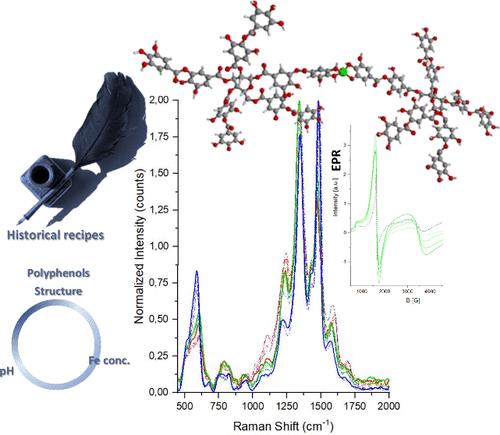
Iron-gall inks (IGIs) are some of the most used writing materials in ancient times. Several efforts have been devoted to the identification and characterization of this type of ink in ancient manuscripts, with a particular focus on their degradation patterns. However, due to their complexity, the in-depth characterization of IGIs poses some challenges related in particular to their variability. Within this research, the main elements of variability associated with the chemical structure have been systematically investigated. The study involved the preparation of iron complexes of gallic acid, tannic acid, and polyphenols contained in oak-gall aqueous extracts, in pH-controlled regimes, and with different iron-to-ligand ratios. The so-prepared complexes have been then characterized via Raman, electron paramagnetic resonance (EPR), and infrared (IR) spectroscopies. The results obtained support the hypothesis of a strong dependence of the chemical structure on the pH condition prior to iron addition. At the same time, it has been possible to prove the efficiency of Raman spectroscopy in the in-depth characterization of historical inks and to explore the potential of IR and EPR in such studies.
期刊介绍:
Inorganic Chemistry publishes fundamental studies in all phases of inorganic chemistry. Coverage includes experimental and theoretical reports on quantitative studies of structure and thermodynamics, kinetics, mechanisms of inorganic reactions, bioinorganic chemistry, and relevant aspects of organometallic chemistry, solid-state phenomena, and chemical bonding theory. Emphasis is placed on the synthesis, structure, thermodynamics, reactivity, spectroscopy, and bonding properties of significant new and known compounds.




 京公网安备 11010802042870号
京ICP备2023020795号-1
京公网安备 11010802042870号
京ICP备2023020795号-1

 分享
分享
 求助内容:
求助内容: 应助结果提醒方式:
 扫码关注我们
