Ravi Retnakaran, Chang Ye, Caroline K. Kramer, Anthony J. Hanley, Philip W. Connelly, Mathew Sermer, Bernard Zinman
{"title":"妊娠期高血糖妇女产后再分类的1小时口服糖耐量试验","authors":"Ravi Retnakaran, Chang Ye, Caroline K. Kramer, Anthony J. Hanley, Philip W. Connelly, Mathew Sermer, Bernard Zinman","doi":"10.2337/dc24-1848","DOIUrl":null,"url":null,"abstract":"OBJECTIVE The International Diabetes Federation recently endorsed a 1-h oral glucose tolerance test (OGTT) as more convenient than the conventional 2-h OGTT. In practice, women with hyperglycemia in pregnancy are advised to undergo a 2-h OGTT within 6 months after delivery, but this test is often not completed, partly owing to its inconvenience for busy mothers. Recognizing the potential advantage of the 1-h OGTT in this setting, we sought to compare 1-h and 2-h OGTT glucose measurements at 3 months postpartum as predictors of dysglycemia (prediabetes/diabetes) over the first 5 years postpartum. RESEARCH DESIGN AND METHODS A total of 369 women across a range of glucose tolerance in pregnancy (from normoglycemia to gestational diabetes [GDM]) underwent multisample 2-h 75-g OGTTs at 3 months, 1 year, 3 years, and 5 years postpartum. Glucose measurements from the 3-month OGTT were ranked as predictors of dysglycemia (both criteria) by change in concordance index (CCI) of Cox proportional hazard regression models. RESULTS At the 3-month OGTT, 1-h glucose identified all but 10 of 70 women concurrently diagnosed with dysglycemia by 2-h glucose, while diagnosing an additional 96 women. The cumulative incidence of dysglycemia progressively increased over 5 years by tertile of 1-h glucose on the 3-month OGTT (P < 0.0001). On regression analyses, the strongest predictor of dysglycemia was 1-h glucose (change in CCI: 16.1%), followed by 2-h glucose (14.9%). In women with GDM, 1-h glucose again emerged as strongest predictor of dysglycemia (13.0%), followed by 2-h glucose (12.8%). CONCLUSIONS The 1-h OGTT may offer a strategy for increasing rates of postpartum reclassification following hyperglycemia in pregnancy.","PeriodicalId":11140,"journal":{"name":"Diabetes Care","volume":"35 1","pages":""},"PeriodicalIF":16.6000,"publicationDate":"2025-03-03","publicationTypes":"Journal Article","fieldsOfStudy":null,"isOpenAccess":false,"openAccessPdf":"","citationCount":"0","resultStr":"{\"title\":\"One-Hour Oral Glucose Tolerance Test for the Postpartum Reclassification of Women With Hyperglycemia in Pregnancy\",\"authors\":\"Ravi Retnakaran, Chang Ye, Caroline K. Kramer, Anthony J. Hanley, Philip W. Connelly, Mathew Sermer, Bernard Zinman\",\"doi\":\"10.2337/dc24-1848\",\"DOIUrl\":null,\"url\":null,\"abstract\":\"OBJECTIVE The International Diabetes Federation recently endorsed a 1-h oral glucose tolerance test (OGTT) as more convenient than the conventional 2-h OGTT. In practice, women with hyperglycemia in pregnancy are advised to undergo a 2-h OGTT within 6 months after delivery, but this test is often not completed, partly owing to its inconvenience for busy mothers. Recognizing the potential advantage of the 1-h OGTT in this setting, we sought to compare 1-h and 2-h OGTT glucose measurements at 3 months postpartum as predictors of dysglycemia (prediabetes/diabetes) over the first 5 years postpartum. RESEARCH DESIGN AND METHODS A total of 369 women across a range of glucose tolerance in pregnancy (from normoglycemia to gestational diabetes [GDM]) underwent multisample 2-h 75-g OGTTs at 3 months, 1 year, 3 years, and 5 years postpartum. Glucose measurements from the 3-month OGTT were ranked as predictors of dysglycemia (both criteria) by change in concordance index (CCI) of Cox proportional hazard regression models. RESULTS At the 3-month OGTT, 1-h glucose identified all but 10 of 70 women concurrently diagnosed with dysglycemia by 2-h glucose, while diagnosing an additional 96 women. The cumulative incidence of dysglycemia progressively increased over 5 years by tertile of 1-h glucose on the 3-month OGTT (P < 0.0001). On regression analyses, the strongest predictor of dysglycemia was 1-h glucose (change in CCI: 16.1%), followed by 2-h glucose (14.9%). In women with GDM, 1-h glucose again emerged as strongest predictor of dysglycemia (13.0%), followed by 2-h glucose (12.8%). CONCLUSIONS The 1-h OGTT may offer a strategy for increasing rates of postpartum reclassification following hyperglycemia in pregnancy.\",\"PeriodicalId\":11140,\"journal\":{\"name\":\"Diabetes Care\",\"volume\":\"35 1\",\"pages\":\"\"},\"PeriodicalIF\":16.6000,\"publicationDate\":\"2025-03-03\",\"publicationTypes\":\"Journal Article\",\"fieldsOfStudy\":null,\"isOpenAccess\":false,\"openAccessPdf\":\"\",\"citationCount\":\"0\",\"resultStr\":null,\"platform\":\"Semanticscholar\",\"paperid\":null,\"PeriodicalName\":\"Diabetes Care\",\"FirstCategoryId\":\"3\",\"ListUrlMain\":\"https://doi.org/10.2337/dc24-1848\",\"RegionNum\":1,\"RegionCategory\":\"医学\",\"ArticlePicture\":[],\"TitleCN\":null,\"AbstractTextCN\":null,\"PMCID\":null,\"EPubDate\":\"\",\"PubModel\":\"\",\"JCR\":\"Q1\",\"JCRName\":\"ENDOCRINOLOGY & METABOLISM\",\"Score\":null,\"Total\":0}","platform":"Semanticscholar","paperid":null,"PeriodicalName":"Diabetes Care","FirstCategoryId":"3","ListUrlMain":"https://doi.org/10.2337/dc24-1848","RegionNum":1,"RegionCategory":"医学","ArticlePicture":[],"TitleCN":null,"AbstractTextCN":null,"PMCID":null,"EPubDate":"","PubModel":"","JCR":"Q1","JCRName":"ENDOCRINOLOGY & METABOLISM","Score":null,"Total":0}
One-Hour Oral Glucose Tolerance Test for the Postpartum Reclassification of Women With Hyperglycemia in Pregnancy
OBJECTIVE The International Diabetes Federation recently endorsed a 1-h oral glucose tolerance test (OGTT) as more convenient than the conventional 2-h OGTT. In practice, women with hyperglycemia in pregnancy are advised to undergo a 2-h OGTT within 6 months after delivery, but this test is often not completed, partly owing to its inconvenience for busy mothers. Recognizing the potential advantage of the 1-h OGTT in this setting, we sought to compare 1-h and 2-h OGTT glucose measurements at 3 months postpartum as predictors of dysglycemia (prediabetes/diabetes) over the first 5 years postpartum. RESEARCH DESIGN AND METHODS A total of 369 women across a range of glucose tolerance in pregnancy (from normoglycemia to gestational diabetes [GDM]) underwent multisample 2-h 75-g OGTTs at 3 months, 1 year, 3 years, and 5 years postpartum. Glucose measurements from the 3-month OGTT were ranked as predictors of dysglycemia (both criteria) by change in concordance index (CCI) of Cox proportional hazard regression models. RESULTS At the 3-month OGTT, 1-h glucose identified all but 10 of 70 women concurrently diagnosed with dysglycemia by 2-h glucose, while diagnosing an additional 96 women. The cumulative incidence of dysglycemia progressively increased over 5 years by tertile of 1-h glucose on the 3-month OGTT (P < 0.0001). On regression analyses, the strongest predictor of dysglycemia was 1-h glucose (change in CCI: 16.1%), followed by 2-h glucose (14.9%). In women with GDM, 1-h glucose again emerged as strongest predictor of dysglycemia (13.0%), followed by 2-h glucose (12.8%). CONCLUSIONS The 1-h OGTT may offer a strategy for increasing rates of postpartum reclassification following hyperglycemia in pregnancy.
期刊介绍:
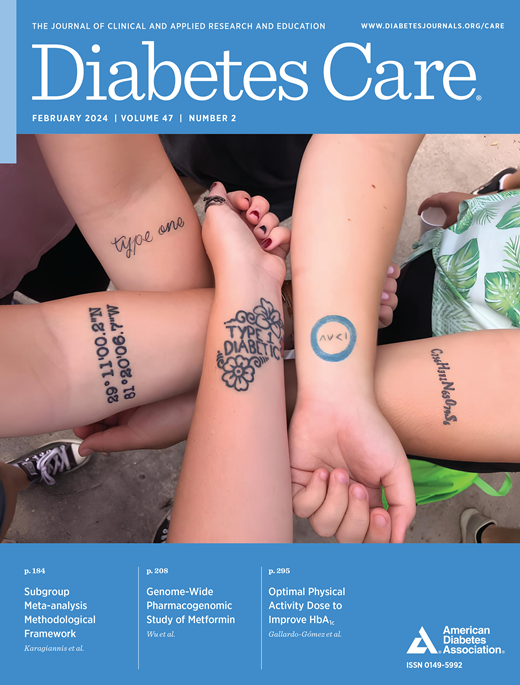
The journal's overarching mission can be captured by the simple word "Care," reflecting its commitment to enhancing patient well-being. Diabetes Care aims to support better patient care by addressing the comprehensive needs of healthcare professionals dedicated to managing diabetes.
Diabetes Care serves as a valuable resource for healthcare practitioners, aiming to advance knowledge, foster research, and improve diabetes management. The journal publishes original research across various categories, including Clinical Care, Education, Nutrition, Psychosocial Research, Epidemiology, Health Services Research, Emerging Treatments and Technologies, Pathophysiology, Complications, and Cardiovascular and Metabolic Risk. Additionally, Diabetes Care features ADA statements, consensus reports, review articles, letters to the editor, and health/medical news, appealing to a diverse audience of physicians, researchers, psychologists, educators, and other healthcare professionals.




 京公网安备 11010802042870号
京ICP备2023020795号-1
京公网安备 11010802042870号
京ICP备2023020795号-1

 分享
分享
 求助内容:
求助内容: 应助结果提醒方式:
 扫码关注我们
