{"title":"最佳投料减甲烷饲料对埃塞俄比亚当地Menz种羊采食量、消化率、活重变化和甲烷排放的影响","authors":"Wondimagegne Bekele, Abiy Zegeye, Addis Simachew, Nobuyuki Kobayashi","doi":"10.3389/fvets.2025.1538758","DOIUrl":null,"url":null,"abstract":"<p><p>This study continued the <i>in vitro</i> screening of locally available ruminant feedstuffs for optimum nutrient composition and low methane (CH<sub>4</sub>) production in Ethiopia. The best bet feeds from the <i>in vitro</i> study, hereafter called the test feeds, include dried leaves of <i>Acacia nilotica</i>, <i>Ziziphus spina-christi</i>, and brewery spent grains (BSG). The study involves four treatments: Control, Acacia, BSG, and Ziziphus; each treatment provided an equivalent crude protein and estimated enteric CH<sub>4</sub> emissions using Modeling and a Laser CH<sub>4</sub> detector (LMD). The experiment was designed as a randomized complete block, using initial weight as the blocking factor for 21 yearling castrated Menz sheep. The study spanned 90 days, and digestibility trials were carried out following a month of the feeding trial. The control group exhibited a significantly (<i>p</i> < 0.001) lower dry matter intake (DMI) compared to the test feed group, which had a higher intake, particularly in the Ziziphus group. However, the Ziziphus group demonstrated significantly (<i>p</i> < 0.01) lower CP digestibility than the other groups. The test diet also led to a significantly (<i>p</i> < 0.001) higher weight gain. Notably, the Ziziphus group demonstrated superior performance in weight change (BWC), final body weight (FBW), and average daily gain (ADG). Similar results were observed for CH<sub>4</sub> production (g/day), CH<sub>4</sub> yield (g/kg DMI), and CH<sub>4</sub> intensity (g CH<sub>4</sub>/kg ADG) using both CH<sub>4</sub> measuring methods. The CH<sub>4</sub> emission intensity was significantly (<i>p</i> < 0.04) lower in the test feed groups than in the control group. The control group emitted 808.7 and 825.3 g of CH<sub>4</sub>, while the Ziziphus group emitted 220 and 265.3 g of CH<sub>4</sub> per kg of ADG using the Modeling and LMD methods, respectively. This study indicates that LMD could yield biologically plausible data for sheep. Although the small sample size in the Ziziphus group was a limitation of this study, leaf meals from <i>Ziziphus spina-christi and Acacia nilotica</i>, which are rich in condensed tannins (CTs), have resulted in considerable weight gain and enhanced feed efficiency, thereby making these leaf meals a viable and sustainable feed option for ruminants in Ethiopia.</p>","PeriodicalId":12772,"journal":{"name":"Frontiers in Veterinary Science","volume":"12 ","pages":"1538758"},"PeriodicalIF":3.1000,"publicationDate":"2025-02-14","publicationTypes":"Journal Article","fieldsOfStudy":null,"isOpenAccess":false,"openAccessPdf":"https://www.ncbi.nlm.nih.gov/pmc/articles/PMC11868066/pdf/","citationCount":"0","resultStr":"{\"title\":\"Effect of best bet methane abatement feed on feed intake, digestibility, live weight change, and methane emission in local Menz breed sheep in Ethiopia.\",\"authors\":\"Wondimagegne Bekele, Abiy Zegeye, Addis Simachew, Nobuyuki Kobayashi\",\"doi\":\"10.3389/fvets.2025.1538758\",\"DOIUrl\":null,\"url\":null,\"abstract\":\"<p><p>This study continued the <i>in vitro</i> screening of locally available ruminant feedstuffs for optimum nutrient composition and low methane (CH<sub>4</sub>) production in Ethiopia. The best bet feeds from the <i>in vitro</i> study, hereafter called the test feeds, include dried leaves of <i>Acacia nilotica</i>, <i>Ziziphus spina-christi</i>, and brewery spent grains (BSG). The study involves four treatments: Control, Acacia, BSG, and Ziziphus; each treatment provided an equivalent crude protein and estimated enteric CH<sub>4</sub> emissions using Modeling and a Laser CH<sub>4</sub> detector (LMD). The experiment was designed as a randomized complete block, using initial weight as the blocking factor for 21 yearling castrated Menz sheep. The study spanned 90 days, and digestibility trials were carried out following a month of the feeding trial. The control group exhibited a significantly (<i>p</i> < 0.001) lower dry matter intake (DMI) compared to the test feed group, which had a higher intake, particularly in the Ziziphus group. However, the Ziziphus group demonstrated significantly (<i>p</i> < 0.01) lower CP digestibility than the other groups. The test diet also led to a significantly (<i>p</i> < 0.001) higher weight gain. Notably, the Ziziphus group demonstrated superior performance in weight change (BWC), final body weight (FBW), and average daily gain (ADG). Similar results were observed for CH<sub>4</sub> production (g/day), CH<sub>4</sub> yield (g/kg DMI), and CH<sub>4</sub> intensity (g CH<sub>4</sub>/kg ADG) using both CH<sub>4</sub> measuring methods. The CH<sub>4</sub> emission intensity was significantly (<i>p</i> < 0.04) lower in the test feed groups than in the control group. The control group emitted 808.7 and 825.3 g of CH<sub>4</sub>, while the Ziziphus group emitted 220 and 265.3 g of CH<sub>4</sub> per kg of ADG using the Modeling and LMD methods, respectively. This study indicates that LMD could yield biologically plausible data for sheep. Although the small sample size in the Ziziphus group was a limitation of this study, leaf meals from <i>Ziziphus spina-christi and Acacia nilotica</i>, which are rich in condensed tannins (CTs), have resulted in considerable weight gain and enhanced feed efficiency, thereby making these leaf meals a viable and sustainable feed option for ruminants in Ethiopia.</p>\",\"PeriodicalId\":12772,\"journal\":{\"name\":\"Frontiers in Veterinary Science\",\"volume\":\"12 \",\"pages\":\"1538758\"},\"PeriodicalIF\":3.1000,\"publicationDate\":\"2025-02-14\",\"publicationTypes\":\"Journal Article\",\"fieldsOfStudy\":null,\"isOpenAccess\":false,\"openAccessPdf\":\"https://www.ncbi.nlm.nih.gov/pmc/articles/PMC11868066/pdf/\",\"citationCount\":\"0\",\"resultStr\":null,\"platform\":\"Semanticscholar\",\"paperid\":null,\"PeriodicalName\":\"Frontiers in Veterinary Science\",\"FirstCategoryId\":\"97\",\"ListUrlMain\":\"https://doi.org/10.3389/fvets.2025.1538758\",\"RegionNum\":2,\"RegionCategory\":\"农林科学\",\"ArticlePicture\":[],\"TitleCN\":null,\"AbstractTextCN\":null,\"PMCID\":null,\"EPubDate\":\"2025/1/1 0:00:00\",\"PubModel\":\"eCollection\",\"JCR\":\"Q1\",\"JCRName\":\"VETERINARY SCIENCES\",\"Score\":null,\"Total\":0}","platform":"Semanticscholar","paperid":null,"PeriodicalName":"Frontiers in Veterinary Science","FirstCategoryId":"97","ListUrlMain":"https://doi.org/10.3389/fvets.2025.1538758","RegionNum":2,"RegionCategory":"农林科学","ArticlePicture":[],"TitleCN":null,"AbstractTextCN":null,"PMCID":null,"EPubDate":"2025/1/1 0:00:00","PubModel":"eCollection","JCR":"Q1","JCRName":"VETERINARY SCIENCES","Score":null,"Total":0}
引用次数: 0
摘要
本研究继续在埃塞俄比亚对当地可用的反刍动物饲料进行体外筛选,以获得最佳营养成分和低甲烷(CH4)产量。从体外研究中获得的最佳饲料,以下称为试验饲料,包括金合欢干叶、紫皮草和啤酒废谷物(BSG)。该研究包括四种处理:对照、金合欢、BSG和Ziziphus;利用建模和激光CH4检测器(LMD),每个处理提供了等效的粗蛋白质和估计的肠道CH4排放量。本试验采用完全随机区组设计,以初始体重为阻滞因子,选取21只阉羊。该研究持续90 天,并在一个月的喂养试验后进行消化率试验。两种CH4测定方法下,对照组的CH4产量(g/day)、CH4产量(g/kg DMI)和CH4强度(g CH4/kg ADG)均显著高于对照组(p p p )。CH4排放强度显著(p 4),而Ziziphus组每kg ADG的CH4排放量分别为220 g和265.3 g。这项研究表明,LMD可以为绵羊提供生物学上可信的数据。虽然紫穗槐组的小样本量是本研究的局限性,但富含浓缩单宁(CTs)的紫穗槐和尼罗卡金合欢的叶粕导致了相当大的体重增加和饲料效率的提高,从而使这些叶粕成为埃塞俄比亚反刍动物可行和可持续的饲料选择。
Effect of best bet methane abatement feed on feed intake, digestibility, live weight change, and methane emission in local Menz breed sheep in Ethiopia.
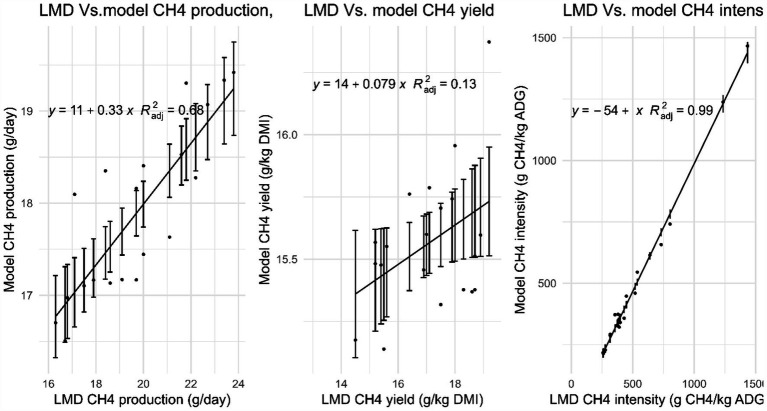
This study continued the in vitro screening of locally available ruminant feedstuffs for optimum nutrient composition and low methane (CH4) production in Ethiopia. The best bet feeds from the in vitro study, hereafter called the test feeds, include dried leaves of Acacia nilotica, Ziziphus spina-christi, and brewery spent grains (BSG). The study involves four treatments: Control, Acacia, BSG, and Ziziphus; each treatment provided an equivalent crude protein and estimated enteric CH4 emissions using Modeling and a Laser CH4 detector (LMD). The experiment was designed as a randomized complete block, using initial weight as the blocking factor for 21 yearling castrated Menz sheep. The study spanned 90 days, and digestibility trials were carried out following a month of the feeding trial. The control group exhibited a significantly (p < 0.001) lower dry matter intake (DMI) compared to the test feed group, which had a higher intake, particularly in the Ziziphus group. However, the Ziziphus group demonstrated significantly (p < 0.01) lower CP digestibility than the other groups. The test diet also led to a significantly (p < 0.001) higher weight gain. Notably, the Ziziphus group demonstrated superior performance in weight change (BWC), final body weight (FBW), and average daily gain (ADG). Similar results were observed for CH4 production (g/day), CH4 yield (g/kg DMI), and CH4 intensity (g CH4/kg ADG) using both CH4 measuring methods. The CH4 emission intensity was significantly (p < 0.04) lower in the test feed groups than in the control group. The control group emitted 808.7 and 825.3 g of CH4, while the Ziziphus group emitted 220 and 265.3 g of CH4 per kg of ADG using the Modeling and LMD methods, respectively. This study indicates that LMD could yield biologically plausible data for sheep. Although the small sample size in the Ziziphus group was a limitation of this study, leaf meals from Ziziphus spina-christi and Acacia nilotica, which are rich in condensed tannins (CTs), have resulted in considerable weight gain and enhanced feed efficiency, thereby making these leaf meals a viable and sustainable feed option for ruminants in Ethiopia.
期刊介绍:
Frontiers in Veterinary Science is a global, peer-reviewed, Open Access journal that bridges animal and human health, brings a comparative approach to medical and surgical challenges, and advances innovative biotechnology and therapy.
Veterinary research today is interdisciplinary, collaborative, and socially relevant, transforming how we understand and investigate animal health and disease. Fundamental research in emerging infectious diseases, predictive genomics, stem cell therapy, and translational modelling is grounded within the integrative social context of public and environmental health, wildlife conservation, novel biomarkers, societal well-being, and cutting-edge clinical practice and specialization. Frontiers in Veterinary Science brings a 21st-century approach—networked, collaborative, and Open Access—to communicate this progress and innovation to both the specialist and to the wider audience of readers in the field.
Frontiers in Veterinary Science publishes articles on outstanding discoveries across a wide spectrum of translational, foundational, and clinical research. The journal''s mission is to bring all relevant veterinary sciences together on a single platform with the goal of improving animal and human health.






 京公网安备 11010802042870号
京ICP备2023020795号-1
京公网安备 11010802042870号
京ICP备2023020795号-1

 分享
分享
 求助内容:
求助内容: 应助结果提醒方式:
 扫码关注我们
