Jisoon Park, Oussama Chaar, Jayakrishnan Narayanakurup, Alamedin Sobhe Abdelsamea Abdelhamead, Du Hyun Ro, Sung Eun Kim
{"title":"中东和东亚人群的膝关节排列模式不同吗?使用人工智能进行倾向匹配分析。","authors":"Jisoon Park, Oussama Chaar, Jayakrishnan Narayanakurup, Alamedin Sobhe Abdelsamea Abdelhamead, Du Hyun Ro, Sung Eun Kim","doi":"10.1186/s43019-025-00261-w","DOIUrl":null,"url":null,"abstract":"<p><strong>Introduction: </strong>Population-based differences in knee alignment patterns may impact osteoarthritis (OA) progression. This study compares lower extremity alignment in knee OA between Middle Eastern (UAE) and East Asian (South Korean) populations using artificial intelligence (AI)-assisted analysis.</p><p><strong>Methods: </strong>A retrospective review included patients with knee symptoms from South Korea (2009-2019) and the United Arab Emirates (UAE) (2015-2024). Exclusion criteria comprised prior knee surgeries, significant bony attrition, and low-quality radiographs. Propensity score matching controlled for age and sex differences between populations. Alignment parameters (hip-knee-ankle angle (HKA), medial proximal tibial angle (MPTA), lateral distal femoral angle (LDFA), and joint line convergence angle (JLCA)) and OA severity (Kellgren-Lawrence (KL) grade) were measured using artificial intelligence (AI) software, along with the analysis of coronal plane alignment of the knee (CPAK) classification. Subanalyses by sex and age group (under 40, 40-60, and over 60 years) were also conducted.</p><p><strong>Results: </strong>A total of 1098 UAE and 7138 South Korean patients (2196 and 14,276 knees, respectively) were evaluated in this study. Post-matching (1:2), body mass index was significantly higher in UAE patients (p < 0.001). CPAK type 1 was predominant in UAE male patients (42.4%), whereas type 2 was more common in South Korean male patients (30.6%). Female patients in both populations predominantly exhibited CPAK type 2 (UAE 30.6%; South Korea 35.3%). UAE patients showed a lower MPTA with increasing age, indicating a trend toward more varus alignment in older individuals.</p><p><strong>Conclusions: </strong>A propensity score-matched analysis revealed significant alignment differences between Middle Eastern and East Asian populations, underscoring the importance of population-specific considerations in OA management.</p>","PeriodicalId":36317,"journal":{"name":"Knee Surgery and Related Research","volume":"37 1","pages":"11"},"PeriodicalIF":4.4000,"publicationDate":"2025-03-03","publicationTypes":"Journal Article","fieldsOfStudy":null,"isOpenAccess":false,"openAccessPdf":"https://www.ncbi.nlm.nih.gov/pmc/articles/PMC11877683/pdf/","citationCount":"0","resultStr":"{\"title\":\"Do knee alignment patterns differ between Middle Eastern and East Asian populations? A propensity-matched analysis using artificial intelligence.\",\"authors\":\"Jisoon Park, Oussama Chaar, Jayakrishnan Narayanakurup, Alamedin Sobhe Abdelsamea Abdelhamead, Du Hyun Ro, Sung Eun Kim\",\"doi\":\"10.1186/s43019-025-00261-w\",\"DOIUrl\":null,\"url\":null,\"abstract\":\"<p><strong>Introduction: </strong>Population-based differences in knee alignment patterns may impact osteoarthritis (OA) progression. This study compares lower extremity alignment in knee OA between Middle Eastern (UAE) and East Asian (South Korean) populations using artificial intelligence (AI)-assisted analysis.</p><p><strong>Methods: </strong>A retrospective review included patients with knee symptoms from South Korea (2009-2019) and the United Arab Emirates (UAE) (2015-2024). Exclusion criteria comprised prior knee surgeries, significant bony attrition, and low-quality radiographs. Propensity score matching controlled for age and sex differences between populations. Alignment parameters (hip-knee-ankle angle (HKA), medial proximal tibial angle (MPTA), lateral distal femoral angle (LDFA), and joint line convergence angle (JLCA)) and OA severity (Kellgren-Lawrence (KL) grade) were measured using artificial intelligence (AI) software, along with the analysis of coronal plane alignment of the knee (CPAK) classification. Subanalyses by sex and age group (under 40, 40-60, and over 60 years) were also conducted.</p><p><strong>Results: </strong>A total of 1098 UAE and 7138 South Korean patients (2196 and 14,276 knees, respectively) were evaluated in this study. Post-matching (1:2), body mass index was significantly higher in UAE patients (p < 0.001). CPAK type 1 was predominant in UAE male patients (42.4%), whereas type 2 was more common in South Korean male patients (30.6%). Female patients in both populations predominantly exhibited CPAK type 2 (UAE 30.6%; South Korea 35.3%). UAE patients showed a lower MPTA with increasing age, indicating a trend toward more varus alignment in older individuals.</p><p><strong>Conclusions: </strong>A propensity score-matched analysis revealed significant alignment differences between Middle Eastern and East Asian populations, underscoring the importance of population-specific considerations in OA management.</p>\",\"PeriodicalId\":36317,\"journal\":{\"name\":\"Knee Surgery and Related Research\",\"volume\":\"37 1\",\"pages\":\"11\"},\"PeriodicalIF\":4.4000,\"publicationDate\":\"2025-03-03\",\"publicationTypes\":\"Journal Article\",\"fieldsOfStudy\":null,\"isOpenAccess\":false,\"openAccessPdf\":\"https://www.ncbi.nlm.nih.gov/pmc/articles/PMC11877683/pdf/\",\"citationCount\":\"0\",\"resultStr\":null,\"platform\":\"Semanticscholar\",\"paperid\":null,\"PeriodicalName\":\"Knee Surgery and Related Research\",\"FirstCategoryId\":\"1085\",\"ListUrlMain\":\"https://doi.org/10.1186/s43019-025-00261-w\",\"RegionNum\":0,\"RegionCategory\":null,\"ArticlePicture\":[],\"TitleCN\":null,\"AbstractTextCN\":null,\"PMCID\":null,\"EPubDate\":\"\",\"PubModel\":\"\",\"JCR\":\"Q2\",\"JCRName\":\"Medicine\",\"Score\":null,\"Total\":0}","platform":"Semanticscholar","paperid":null,"PeriodicalName":"Knee Surgery and Related Research","FirstCategoryId":"1085","ListUrlMain":"https://doi.org/10.1186/s43019-025-00261-w","RegionNum":0,"RegionCategory":null,"ArticlePicture":[],"TitleCN":null,"AbstractTextCN":null,"PMCID":null,"EPubDate":"","PubModel":"","JCR":"Q2","JCRName":"Medicine","Score":null,"Total":0}
Do knee alignment patterns differ between Middle Eastern and East Asian populations? A propensity-matched analysis using artificial intelligence.
Introduction: Population-based differences in knee alignment patterns may impact osteoarthritis (OA) progression. This study compares lower extremity alignment in knee OA between Middle Eastern (UAE) and East Asian (South Korean) populations using artificial intelligence (AI)-assisted analysis.
Methods: A retrospective review included patients with knee symptoms from South Korea (2009-2019) and the United Arab Emirates (UAE) (2015-2024). Exclusion criteria comprised prior knee surgeries, significant bony attrition, and low-quality radiographs. Propensity score matching controlled for age and sex differences between populations. Alignment parameters (hip-knee-ankle angle (HKA), medial proximal tibial angle (MPTA), lateral distal femoral angle (LDFA), and joint line convergence angle (JLCA)) and OA severity (Kellgren-Lawrence (KL) grade) were measured using artificial intelligence (AI) software, along with the analysis of coronal plane alignment of the knee (CPAK) classification. Subanalyses by sex and age group (under 40, 40-60, and over 60 years) were also conducted.
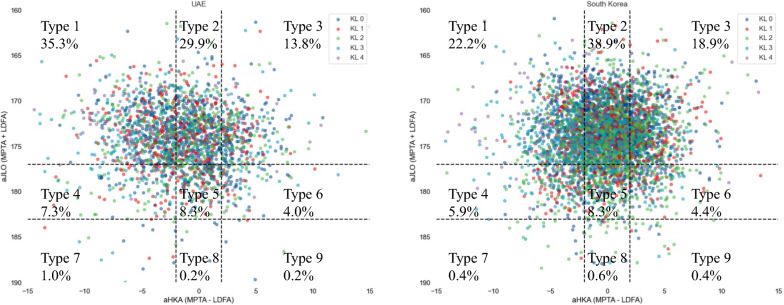
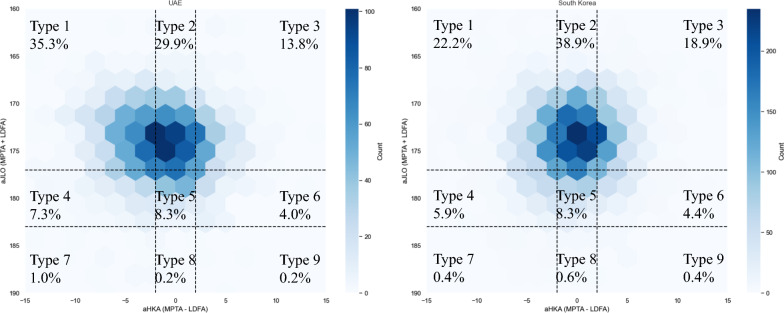
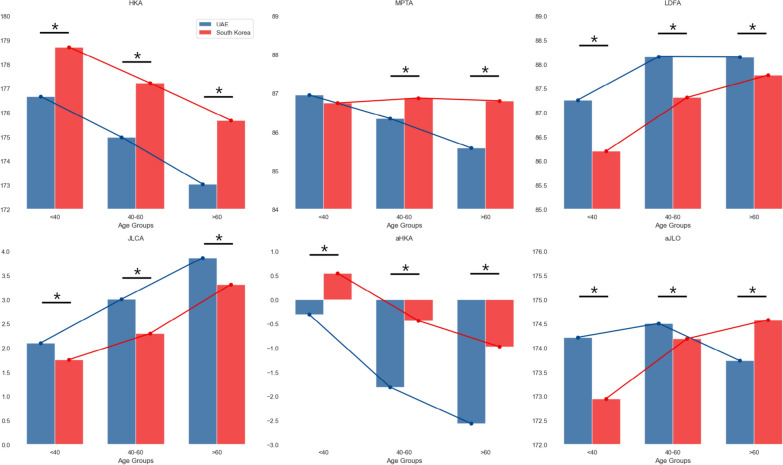
Results: A total of 1098 UAE and 7138 South Korean patients (2196 and 14,276 knees, respectively) were evaluated in this study. Post-matching (1:2), body mass index was significantly higher in UAE patients (p < 0.001). CPAK type 1 was predominant in UAE male patients (42.4%), whereas type 2 was more common in South Korean male patients (30.6%). Female patients in both populations predominantly exhibited CPAK type 2 (UAE 30.6%; South Korea 35.3%). UAE patients showed a lower MPTA with increasing age, indicating a trend toward more varus alignment in older individuals.
Conclusions: A propensity score-matched analysis revealed significant alignment differences between Middle Eastern and East Asian populations, underscoring the importance of population-specific considerations in OA management.




 京公网安备 11010802042870号
京ICP备2023020795号-1
京公网安备 11010802042870号
京ICP备2023020795号-1

 分享
分享
 求助内容:
求助内容: 应助结果提醒方式:
 扫码关注我们
