Dong-Ming Shen, Kate F. Byth, Damien Bertheloot, Simona Braams, Sarah Bradley, Dennis Dean, Carien Dekker, Ayman F. El-Kattan, Luigi Franchi, Gary D. Glick, Shomir Ghosh, Alexandra Hinniger, Jason D. Katz, Ana Kitanovic, Xiaokang Lu, Edward J. Olhava, Anthony W. Opipari, Brian Sanchez, H. Martin Seidel, James Stunden, Andrea Stutz, Alissa Telling, Shankar Venkatraman, David G. Winkler, William R. Roush
{"title":"一种有效的含磺胺类NLRP3炎症小体抑制剂DFV890的发现","authors":"Dong-Ming Shen, Kate F. Byth, Damien Bertheloot, Simona Braams, Sarah Bradley, Dennis Dean, Carien Dekker, Ayman F. El-Kattan, Luigi Franchi, Gary D. Glick, Shomir Ghosh, Alexandra Hinniger, Jason D. Katz, Ana Kitanovic, Xiaokang Lu, Edward J. Olhava, Anthony W. Opipari, Brian Sanchez, H. Martin Seidel, James Stunden, Andrea Stutz, Alissa Telling, Shankar Venkatraman, David G. Winkler, William R. Roush","doi":"10.1021/acs.jmedchem.4c02759","DOIUrl":null,"url":null,"abstract":"The discovery of DFV890 ((<i>R</i>)-<b>1</b>), a potent and selective NLRP3 antagonist, is described. Replacement of the sulfonyl urea core from the first-generation NLRP3 antagonist CRID3 with a sulfonimidamide core afforded a novel and potent series of NLRP3 antagonists. The <i>(R)-</i>enantiomers of the sulfonimidamide series were found to be consistently more potent than structurally related sulfonyl ureas. Replacement of the furan unit of CRID3 with a 5-substituted thiazole unit led to DFV890 ((<i>R</i>)-<b>1</b>), which potently inhibited IL-1β production in THP-1 cells and in primary human cells, blocked multiple downstream effectors of NLRP3 activation, and substantially improved PK properties and significantly lowered the predicted human dose compared to that for CRID3. DFV890 ((<i>R</i>)-<b>1</b>) was also effective in an air pouch model of gout.","PeriodicalId":46,"journal":{"name":"Journal of Medicinal Chemistry","volume":"30 1","pages":""},"PeriodicalIF":6.8000,"publicationDate":"2025-03-04","publicationTypes":"Journal Article","fieldsOfStudy":null,"isOpenAccess":false,"openAccessPdf":"","citationCount":"0","resultStr":"{\"title\":\"Discovery of DFV890, a Potent Sulfonimidamide-Containing NLRP3 Inflammasome Inhibitor\",\"authors\":\"Dong-Ming Shen, Kate F. Byth, Damien Bertheloot, Simona Braams, Sarah Bradley, Dennis Dean, Carien Dekker, Ayman F. El-Kattan, Luigi Franchi, Gary D. Glick, Shomir Ghosh, Alexandra Hinniger, Jason D. Katz, Ana Kitanovic, Xiaokang Lu, Edward J. Olhava, Anthony W. Opipari, Brian Sanchez, H. Martin Seidel, James Stunden, Andrea Stutz, Alissa Telling, Shankar Venkatraman, David G. Winkler, William R. Roush\",\"doi\":\"10.1021/acs.jmedchem.4c02759\",\"DOIUrl\":null,\"url\":null,\"abstract\":\"The discovery of DFV890 ((<i>R</i>)-<b>1</b>), a potent and selective NLRP3 antagonist, is described. Replacement of the sulfonyl urea core from the first-generation NLRP3 antagonist CRID3 with a sulfonimidamide core afforded a novel and potent series of NLRP3 antagonists. The <i>(R)-</i>enantiomers of the sulfonimidamide series were found to be consistently more potent than structurally related sulfonyl ureas. Replacement of the furan unit of CRID3 with a 5-substituted thiazole unit led to DFV890 ((<i>R</i>)-<b>1</b>), which potently inhibited IL-1β production in THP-1 cells and in primary human cells, blocked multiple downstream effectors of NLRP3 activation, and substantially improved PK properties and significantly lowered the predicted human dose compared to that for CRID3. DFV890 ((<i>R</i>)-<b>1</b>) was also effective in an air pouch model of gout.\",\"PeriodicalId\":46,\"journal\":{\"name\":\"Journal of Medicinal Chemistry\",\"volume\":\"30 1\",\"pages\":\"\"},\"PeriodicalIF\":6.8000,\"publicationDate\":\"2025-03-04\",\"publicationTypes\":\"Journal Article\",\"fieldsOfStudy\":null,\"isOpenAccess\":false,\"openAccessPdf\":\"\",\"citationCount\":\"0\",\"resultStr\":null,\"platform\":\"Semanticscholar\",\"paperid\":null,\"PeriodicalName\":\"Journal of Medicinal Chemistry\",\"FirstCategoryId\":\"3\",\"ListUrlMain\":\"https://doi.org/10.1021/acs.jmedchem.4c02759\",\"RegionNum\":1,\"RegionCategory\":\"医学\",\"ArticlePicture\":[],\"TitleCN\":null,\"AbstractTextCN\":null,\"PMCID\":null,\"EPubDate\":\"\",\"PubModel\":\"\",\"JCR\":\"Q1\",\"JCRName\":\"CHEMISTRY, MEDICINAL\",\"Score\":null,\"Total\":0}","platform":"Semanticscholar","paperid":null,"PeriodicalName":"Journal of Medicinal Chemistry","FirstCategoryId":"3","ListUrlMain":"https://doi.org/10.1021/acs.jmedchem.4c02759","RegionNum":1,"RegionCategory":"医学","ArticlePicture":[],"TitleCN":null,"AbstractTextCN":null,"PMCID":null,"EPubDate":"","PubModel":"","JCR":"Q1","JCRName":"CHEMISTRY, MEDICINAL","Score":null,"Total":0}
Discovery of DFV890, a Potent Sulfonimidamide-Containing NLRP3 Inflammasome Inhibitor
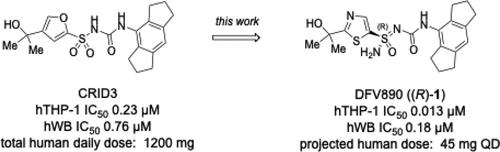
The discovery of DFV890 ((R)-1), a potent and selective NLRP3 antagonist, is described. Replacement of the sulfonyl urea core from the first-generation NLRP3 antagonist CRID3 with a sulfonimidamide core afforded a novel and potent series of NLRP3 antagonists. The (R)-enantiomers of the sulfonimidamide series were found to be consistently more potent than structurally related sulfonyl ureas. Replacement of the furan unit of CRID3 with a 5-substituted thiazole unit led to DFV890 ((R)-1), which potently inhibited IL-1β production in THP-1 cells and in primary human cells, blocked multiple downstream effectors of NLRP3 activation, and substantially improved PK properties and significantly lowered the predicted human dose compared to that for CRID3. DFV890 ((R)-1) was also effective in an air pouch model of gout.
期刊介绍:
The Journal of Medicinal Chemistry is a prestigious biweekly peer-reviewed publication that focuses on the multifaceted field of medicinal chemistry. Since its inception in 1959 as the Journal of Medicinal and Pharmaceutical Chemistry, it has evolved to become a cornerstone in the dissemination of research findings related to the design, synthesis, and development of therapeutic agents.
The Journal of Medicinal Chemistry is recognized for its significant impact in the scientific community, as evidenced by its 2022 impact factor of 7.3. This metric reflects the journal's influence and the importance of its content in shaping the future of drug discovery and development. The journal serves as a vital resource for chemists, pharmacologists, and other researchers interested in the molecular mechanisms of drug action and the optimization of therapeutic compounds.




 京公网安备 11010802042870号
京ICP备2023020795号-1
京公网安备 11010802042870号
京ICP备2023020795号-1

 分享
分享
 求助内容:
求助内容: 应助结果提醒方式:
 扫码关注我们
