Chitosan double-stranded RNA nanocomplexes for Piezodorus guildinii control
BACKGROUND
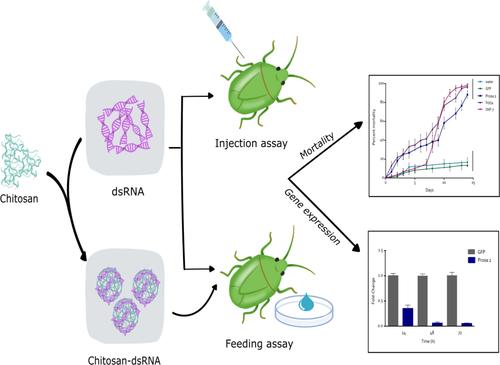
Piezodorus guildinii (Westwood, Hemiptera: Pentatomidae) causes economic losses in soybean crops by diminishing productivity, impacting grain size, oil content, and germination power. RNA interference (RNAi), a conserved gene regulation process initiated by double-stranded RNA (dsRNA), may be used as a safe technique in integrated pest management strategies. Conjugating dsRNA with cationic polymers, which protect dsRNA from degradation has shown to enhance this response. This study aims to assess the impact of dsRNA administration on the viability of P. guildinii and evaluate dsRNA-chitosan nanocomplexes as a pest control strategy.
RESULTS
Ten target genes were selected, dsRNAs were designed and synthesized. In injection assays, significant mortality exceeding 76% was observed, while mortality from ingestion also showed significant differences, reaching 49%. The dsRNA targeting Srp54k gene was selected and a chitosan-dsRNA nanocomplex was synthesized. These nanocomplexes demonstrated enhanced stability under RNase treatment in vitro, and, in in vivo assays, a cumulative corrected mortality rate of 66% was reported. Consistent with these findings, RT-qPCR analysis revealed that gene expression levels in treated insects were significantly reduced compared to control at 24, 48, and 72 h post treatment for targeted genes.
期刊介绍:
Pest Management Science is the international journal of research and development in crop protection and pest control. Since its launch in 1970, the journal has become the premier forum for papers on the discovery, application, and impact on the environment of products and strategies designed for pest management.
Published for SCI by John Wiley & Sons Ltd.








 京公网安备 11010802042870号
京ICP备2023020795号-1
京公网安备 11010802042870号
京ICP备2023020795号-1

 分享
分享
 求助内容:
求助内容: 应助结果提醒方式:
 扫码关注我们
