Encouraging native predators of invasive yellow-legged hornets: breeding habitat preferences of European honey buzzards in exotic Eucalyptus plantations
BACKGROUND
While natural forests have decreased globally, forest plantations have expanded highlighting the need for studies on plantations’ capacity to sustain biodiversity and provide ecosystem services within agroforestry mosaics. This study examined the breeding habitat preferences of European honey buzzards Pernis apivorus (a native predator of the invasive yellow-legged hornet) and their relationship with reproductive performance in exotic Eucalyptus plantations in southwestern Europe. We expected better reproductive performance in preferred habitats.
RESULTS
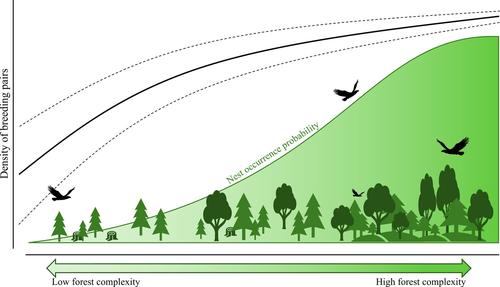
Breeding habitats (n = 57 nesting locations) and randomly selected control points (n = 77) were compared across spatial scales. We analyzed the relative importance of vegetation and topographic features, intraspecific territorial behavior, and interspecific interactions within the diurnal raptor guild. Two complementary approaches were employed: binomial generalized linear models for predictive habitat models, and random forest classification models to assess the relative importance of habitat factors. We examined the relationship between habitat preferences and reproductive performance based on laying phenology and fledgling success. Vegetation and topography were the most influential factors affecting habitat preferences, especially around nests (a 200 m-radius circle). Honey-buzzards preferred large nest trees within forest patches exhibiting high structural complexity and maturity. Preferred habitats were negatively associated with fledgling success, and no significant relationship was detected with laying phenology.
期刊介绍:
Pest Management Science is the international journal of research and development in crop protection and pest control. Since its launch in 1970, the journal has become the premier forum for papers on the discovery, application, and impact on the environment of products and strategies designed for pest management.
Published for SCI by John Wiley & Sons Ltd.








 京公网安备 11010802042870号
京ICP备2023020795号-1
京公网安备 11010802042870号
京ICP备2023020795号-1

 分享
分享
 求助内容:
求助内容: 应助结果提醒方式:
 扫码关注我们
