Chenlin Tu , Xiang Gao , Hong Zheng , Rui Huang , Fengkai Yang , Yeying Dong , Kaipeng Jing , Thomas Groth , Mingyan Zhao
{"title":"创新的可注射的,自我修复的,外泌体交联的软骨再生仿生水凝胶","authors":"Chenlin Tu , Xiang Gao , Hong Zheng , Rui Huang , Fengkai Yang , Yeying Dong , Kaipeng Jing , Thomas Groth , Mingyan Zhao","doi":"10.1016/j.jconrel.2025.113608","DOIUrl":null,"url":null,"abstract":"<div><div>The limited self-healing capacity of cartilage hinders its repair and regeneration at the defect sites. Recent research into small-molecular compounds has shown promise in achieving a better regeneration of cartilage. In this study, we encapsulate kartogenin (KGN) and transforming growth factor β1 (TGF-β1) within mesenchymal stem cells derived exosomes (EKT), and then coated them with succinylated chitosan (sCH) to create positively charged exosomes, termed CEKT. These CEKT exhibit exceptional chondrogenic promoting capabilities shown during <em>in vitro</em> studies with bone marrow derived mesenchymal stem cells (BMSCs). They also can penetrate deep into cartilage tissue derived from porcine knee joints guided by their positive charge. Subsequently, a dynamic exosomes-crosslinked hydrogel (Gel-CEKT) is fabricated by crosslinking CEKT with oxidized chondroitin sulfate (oCS) and Wharton's jelly (WJ) through imine bond formation. Physicochemical studies revealed the injectability, excellent adhesive, and self-healing abilities of this hydrogel, which enables minimally invasive and precise treatment of cartilage defects, assisted by the enriched and sustained administration of CEKT. <em>In vitro</em> cell experiments show that Gel-CEKT can efficiently recruit BMSCs and significantly promote the gene expression of Sox9 and protein expression of collagen II and aggrecan. Furthermore, we show in a rat model of cartilage defect that the Gel-CEKT demonstrates superior performance compared to Gel@EKT, which has freely encapsulated exosomes in the hydrogel. The freely encapsulated exosomes are rapidly released, whereas the exosome-crosslinked gel structure ensures sustained retention and functionality at the site of defect. This leads to impressive outcomings, including extensive new cartilage tissue formation, a smoother cartilage surface, significant chondrocyte production, and seamless integration with orderly and continuous structure formation between cartilage and subchondral bone. This study underscores the potential of exosomes-crosslinked hydrogels as a novel and promising therapeutic approach for clinical cartilage regeneration.</div></div>","PeriodicalId":15450,"journal":{"name":"Journal of Controlled Release","volume":"381 ","pages":"Article 113608"},"PeriodicalIF":11.5000,"publicationDate":"2025-05-10","publicationTypes":"Journal Article","fieldsOfStudy":null,"isOpenAccess":false,"openAccessPdf":"","citationCount":"0","resultStr":"{\"title\":\"Innovative injectable, self-healing, exosome cross-linked biomimetic hydrogel for cartilage regeneration\",\"authors\":\"Chenlin Tu , Xiang Gao , Hong Zheng , Rui Huang , Fengkai Yang , Yeying Dong , Kaipeng Jing , Thomas Groth , Mingyan Zhao\",\"doi\":\"10.1016/j.jconrel.2025.113608\",\"DOIUrl\":null,\"url\":null,\"abstract\":\"<div><div>The limited self-healing capacity of cartilage hinders its repair and regeneration at the defect sites. Recent research into small-molecular compounds has shown promise in achieving a better regeneration of cartilage. In this study, we encapsulate kartogenin (KGN) and transforming growth factor β1 (TGF-β1) within mesenchymal stem cells derived exosomes (EKT), and then coated them with succinylated chitosan (sCH) to create positively charged exosomes, termed CEKT. These CEKT exhibit exceptional chondrogenic promoting capabilities shown during <em>in vitro</em> studies with bone marrow derived mesenchymal stem cells (BMSCs). They also can penetrate deep into cartilage tissue derived from porcine knee joints guided by their positive charge. Subsequently, a dynamic exosomes-crosslinked hydrogel (Gel-CEKT) is fabricated by crosslinking CEKT with oxidized chondroitin sulfate (oCS) and Wharton's jelly (WJ) through imine bond formation. Physicochemical studies revealed the injectability, excellent adhesive, and self-healing abilities of this hydrogel, which enables minimally invasive and precise treatment of cartilage defects, assisted by the enriched and sustained administration of CEKT. <em>In vitro</em> cell experiments show that Gel-CEKT can efficiently recruit BMSCs and significantly promote the gene expression of Sox9 and protein expression of collagen II and aggrecan. Furthermore, we show in a rat model of cartilage defect that the Gel-CEKT demonstrates superior performance compared to Gel@EKT, which has freely encapsulated exosomes in the hydrogel. The freely encapsulated exosomes are rapidly released, whereas the exosome-crosslinked gel structure ensures sustained retention and functionality at the site of defect. This leads to impressive outcomings, including extensive new cartilage tissue formation, a smoother cartilage surface, significant chondrocyte production, and seamless integration with orderly and continuous structure formation between cartilage and subchondral bone. This study underscores the potential of exosomes-crosslinked hydrogels as a novel and promising therapeutic approach for clinical cartilage regeneration.</div></div>\",\"PeriodicalId\":15450,\"journal\":{\"name\":\"Journal of Controlled Release\",\"volume\":\"381 \",\"pages\":\"Article 113608\"},\"PeriodicalIF\":11.5000,\"publicationDate\":\"2025-05-10\",\"publicationTypes\":\"Journal Article\",\"fieldsOfStudy\":null,\"isOpenAccess\":false,\"openAccessPdf\":\"\",\"citationCount\":\"0\",\"resultStr\":null,\"platform\":\"Semanticscholar\",\"paperid\":null,\"PeriodicalName\":\"Journal of Controlled Release\",\"FirstCategoryId\":\"3\",\"ListUrlMain\":\"https://www.sciencedirect.com/science/article/pii/S0168365925002172\",\"RegionNum\":1,\"RegionCategory\":\"医学\",\"ArticlePicture\":[],\"TitleCN\":null,\"AbstractTextCN\":null,\"PMCID\":null,\"EPubDate\":\"2025/3/5 0:00:00\",\"PubModel\":\"Epub\",\"JCR\":\"Q1\",\"JCRName\":\"CHEMISTRY, MULTIDISCIPLINARY\",\"Score\":null,\"Total\":0}","platform":"Semanticscholar","paperid":null,"PeriodicalName":"Journal of Controlled Release","FirstCategoryId":"3","ListUrlMain":"https://www.sciencedirect.com/science/article/pii/S0168365925002172","RegionNum":1,"RegionCategory":"医学","ArticlePicture":[],"TitleCN":null,"AbstractTextCN":null,"PMCID":null,"EPubDate":"2025/3/5 0:00:00","PubModel":"Epub","JCR":"Q1","JCRName":"CHEMISTRY, MULTIDISCIPLINARY","Score":null,"Total":0}
Innovative injectable, self-healing, exosome cross-linked biomimetic hydrogel for cartilage regeneration
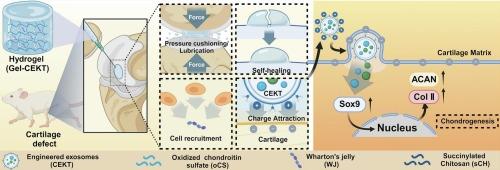
The limited self-healing capacity of cartilage hinders its repair and regeneration at the defect sites. Recent research into small-molecular compounds has shown promise in achieving a better regeneration of cartilage. In this study, we encapsulate kartogenin (KGN) and transforming growth factor β1 (TGF-β1) within mesenchymal stem cells derived exosomes (EKT), and then coated them with succinylated chitosan (sCH) to create positively charged exosomes, termed CEKT. These CEKT exhibit exceptional chondrogenic promoting capabilities shown during in vitro studies with bone marrow derived mesenchymal stem cells (BMSCs). They also can penetrate deep into cartilage tissue derived from porcine knee joints guided by their positive charge. Subsequently, a dynamic exosomes-crosslinked hydrogel (Gel-CEKT) is fabricated by crosslinking CEKT with oxidized chondroitin sulfate (oCS) and Wharton's jelly (WJ) through imine bond formation. Physicochemical studies revealed the injectability, excellent adhesive, and self-healing abilities of this hydrogel, which enables minimally invasive and precise treatment of cartilage defects, assisted by the enriched and sustained administration of CEKT. In vitro cell experiments show that Gel-CEKT can efficiently recruit BMSCs and significantly promote the gene expression of Sox9 and protein expression of collagen II and aggrecan. Furthermore, we show in a rat model of cartilage defect that the Gel-CEKT demonstrates superior performance compared to Gel@EKT, which has freely encapsulated exosomes in the hydrogel. The freely encapsulated exosomes are rapidly released, whereas the exosome-crosslinked gel structure ensures sustained retention and functionality at the site of defect. This leads to impressive outcomings, including extensive new cartilage tissue formation, a smoother cartilage surface, significant chondrocyte production, and seamless integration with orderly and continuous structure formation between cartilage and subchondral bone. This study underscores the potential of exosomes-crosslinked hydrogels as a novel and promising therapeutic approach for clinical cartilage regeneration.
期刊介绍:
The Journal of Controlled Release (JCR) proudly serves as the Official Journal of the Controlled Release Society and the Japan Society of Drug Delivery System.
Dedicated to the broad field of delivery science and technology, JCR publishes high-quality research articles covering drug delivery systems and all facets of formulations. This includes the physicochemical and biological properties of drugs, design and characterization of dosage forms, release mechanisms, in vivo testing, and formulation research and development across pharmaceutical, diagnostic, agricultural, environmental, cosmetic, and food industries.
Priority is given to manuscripts that contribute to the fundamental understanding of principles or demonstrate the advantages of novel technologies in terms of safety and efficacy over current clinical standards. JCR strives to be a leading platform for advancements in delivery science and technology.





 京公网安备 11010802042870号
京ICP备2023020795号-1
京公网安备 11010802042870号
京ICP备2023020795号-1

 分享
分享
 求助内容:
求助内容: 应助结果提醒方式:
 扫码关注我们
