Lizhen Wu, Anurupa Devi Yadavalli, Filip Senigl, Gabriel Matos-Rodrigues, Dijin Xu, Andreas P. Pintado-Urbanc, Matthew D. Simon, Wei Wu, André Nussenzweig, David G. Schatz
{"title":"转录延伸因子ELOF1是高效体细胞超突变和类开关重组所必需的","authors":"Lizhen Wu, Anurupa Devi Yadavalli, Filip Senigl, Gabriel Matos-Rodrigues, Dijin Xu, Andreas P. Pintado-Urbanc, Matthew D. Simon, Wei Wu, André Nussenzweig, David G. Schatz","doi":"10.1016/j.molcel.2025.02.007","DOIUrl":null,"url":null,"abstract":"Somatic hypermutation (SHM) and class switch recombination (CSR) diversify immunoglobulin (Ig) genes and are initiated by the activation-induced deaminase (AID), a single-stranded DNA cytidine deaminase thought to engage its substrate during RNA polymerase II (RNAPII) transcription. Through a genetic screen, we identified numerous potential factors involved in SHM, including elongation factor 1 homolog (ELOF1), a component of the RNAPII elongation complex that functions in transcription-coupled nucleotide excision repair (TC-NER) and transcription elongation. Loss of ELOF1 compromises SHM, CSR, and AID action in mammalian B cells and alters RNAPII transcription by reducing RNAPII pausing downstream of transcription start sites and levels of serine 5 but not serine 2 phosphorylated RNAPII throughout transcribed genes. ELOF1 must bind to RNAPII to be a proximity partner for AID and to function in SHM and CSR, and TC-NER is not required for SHM. We propose that ELOF1 helps create the appropriate stalled RNAPII substrate on which AID acts.","PeriodicalId":18950,"journal":{"name":"Molecular Cell","volume":"35 1","pages":""},"PeriodicalIF":16.6000,"publicationDate":"2025-03-05","publicationTypes":"Journal Article","fieldsOfStudy":null,"isOpenAccess":false,"openAccessPdf":"","citationCount":"0","resultStr":"{\"title\":\"Transcription elongation factor ELOF1 is required for efficient somatic hypermutation and class switch recombination\",\"authors\":\"Lizhen Wu, Anurupa Devi Yadavalli, Filip Senigl, Gabriel Matos-Rodrigues, Dijin Xu, Andreas P. Pintado-Urbanc, Matthew D. Simon, Wei Wu, André Nussenzweig, David G. Schatz\",\"doi\":\"10.1016/j.molcel.2025.02.007\",\"DOIUrl\":null,\"url\":null,\"abstract\":\"Somatic hypermutation (SHM) and class switch recombination (CSR) diversify immunoglobulin (Ig) genes and are initiated by the activation-induced deaminase (AID), a single-stranded DNA cytidine deaminase thought to engage its substrate during RNA polymerase II (RNAPII) transcription. Through a genetic screen, we identified numerous potential factors involved in SHM, including elongation factor 1 homolog (ELOF1), a component of the RNAPII elongation complex that functions in transcription-coupled nucleotide excision repair (TC-NER) and transcription elongation. Loss of ELOF1 compromises SHM, CSR, and AID action in mammalian B cells and alters RNAPII transcription by reducing RNAPII pausing downstream of transcription start sites and levels of serine 5 but not serine 2 phosphorylated RNAPII throughout transcribed genes. ELOF1 must bind to RNAPII to be a proximity partner for AID and to function in SHM and CSR, and TC-NER is not required for SHM. We propose that ELOF1 helps create the appropriate stalled RNAPII substrate on which AID acts.\",\"PeriodicalId\":18950,\"journal\":{\"name\":\"Molecular Cell\",\"volume\":\"35 1\",\"pages\":\"\"},\"PeriodicalIF\":16.6000,\"publicationDate\":\"2025-03-05\",\"publicationTypes\":\"Journal Article\",\"fieldsOfStudy\":null,\"isOpenAccess\":false,\"openAccessPdf\":\"\",\"citationCount\":\"0\",\"resultStr\":null,\"platform\":\"Semanticscholar\",\"paperid\":null,\"PeriodicalName\":\"Molecular Cell\",\"FirstCategoryId\":\"99\",\"ListUrlMain\":\"https://doi.org/10.1016/j.molcel.2025.02.007\",\"RegionNum\":1,\"RegionCategory\":\"生物学\",\"ArticlePicture\":[],\"TitleCN\":null,\"AbstractTextCN\":null,\"PMCID\":null,\"EPubDate\":\"\",\"PubModel\":\"\",\"JCR\":\"Q1\",\"JCRName\":\"BIOCHEMISTRY & MOLECULAR BIOLOGY\",\"Score\":null,\"Total\":0}","platform":"Semanticscholar","paperid":null,"PeriodicalName":"Molecular Cell","FirstCategoryId":"99","ListUrlMain":"https://doi.org/10.1016/j.molcel.2025.02.007","RegionNum":1,"RegionCategory":"生物学","ArticlePicture":[],"TitleCN":null,"AbstractTextCN":null,"PMCID":null,"EPubDate":"","PubModel":"","JCR":"Q1","JCRName":"BIOCHEMISTRY & MOLECULAR BIOLOGY","Score":null,"Total":0}
Transcription elongation factor ELOF1 is required for efficient somatic hypermutation and class switch recombination
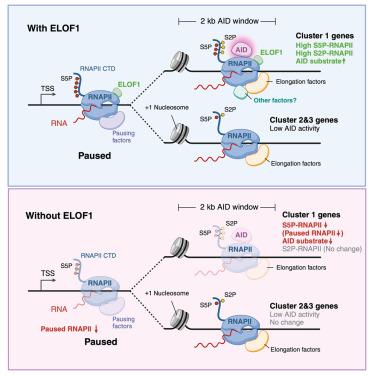
Somatic hypermutation (SHM) and class switch recombination (CSR) diversify immunoglobulin (Ig) genes and are initiated by the activation-induced deaminase (AID), a single-stranded DNA cytidine deaminase thought to engage its substrate during RNA polymerase II (RNAPII) transcription. Through a genetic screen, we identified numerous potential factors involved in SHM, including elongation factor 1 homolog (ELOF1), a component of the RNAPII elongation complex that functions in transcription-coupled nucleotide excision repair (TC-NER) and transcription elongation. Loss of ELOF1 compromises SHM, CSR, and AID action in mammalian B cells and alters RNAPII transcription by reducing RNAPII pausing downstream of transcription start sites and levels of serine 5 but not serine 2 phosphorylated RNAPII throughout transcribed genes. ELOF1 must bind to RNAPII to be a proximity partner for AID and to function in SHM and CSR, and TC-NER is not required for SHM. We propose that ELOF1 helps create the appropriate stalled RNAPII substrate on which AID acts.
期刊介绍:
Molecular Cell is a companion to Cell, the leading journal of biology and the highest-impact journal in the world. Launched in December 1997 and published monthly. Molecular Cell is dedicated to publishing cutting-edge research in molecular biology, focusing on fundamental cellular processes. The journal encompasses a wide range of topics, including DNA replication, recombination, and repair; Chromatin biology and genome organization; Transcription; RNA processing and decay; Non-coding RNA function; Translation; Protein folding, modification, and quality control; Signal transduction pathways; Cell cycle and checkpoints; Cell death; Autophagy; Metabolism.




 京公网安备 11010802042870号
京ICP备2023020795号-1
京公网安备 11010802042870号
京ICP备2023020795号-1

 分享
分享
 求助内容:
求助内容: 应助结果提醒方式:
 扫码关注我们
