{"title":"转录偶联的AID脱质损伤依赖于elof1相关的RNA聚合酶II","authors":"Pengfei Dai, Yuanqing Tan, Yifeng Luo, Tingting Liu, Yanchao Huang, Yafang Shang, Min Emma Huang, Xiaojing Liu, Senxin Zhang, Yanyan Wang, Qian-Xi Li, Niu Li, Lulu Li, Yining Qin, Junqi Liu, Liu Daisy Liu, Xia Xie, Yanni Cai, Fei Xavier Chen, Xiaoqi Zheng, Fei-Long Meng","doi":"10.1016/j.molcel.2025.02.006","DOIUrl":null,"url":null,"abstract":"In adaptive immunity, transcription-coupled damage (TCD) is introduced into antibody genes by activation-induced cytidine deaminase (AID) to diversify antibody repertoire. However, the coordination between transcription and DNA damage/repair remains elusive. Here, we find that transcription elongation factor 1 (ELOF1) stabilizes paused RNA polymerase II (RNAPII) at transcription barriers, providing a platform for transcription-coupled DNA damage/repair. Using a genetic screen, we discover that ELOF1 is required for AID targeting and that ELOF1 deficiency results in defective antibody class switch recombination and somatic hypermutation in mice. While downstream transcription-coupled repair factors are dispensable for AID damage, ELOF1 mechanistically facilitates both TCD and repair by stabilizing chromatin-bound RNAPII. In ELOF1-deficient cells, paused RNAPII tends to detach from chromatin and fails to recruit factors to induce or repair DNA damage. Our study places ELOF1 at the center of transcription-coupled DNA metabolism processes and suggests a transition of RNAPII from elongation to a DNA damage/repair scaffold.","PeriodicalId":18950,"journal":{"name":"Molecular Cell","volume":"42 1","pages":""},"PeriodicalIF":16.0000,"publicationDate":"2025-03-05","publicationTypes":"Journal Article","fieldsOfStudy":null,"isOpenAccess":false,"openAccessPdf":"","citationCount":"0","resultStr":"{\"title\":\"Transcription-coupled AID deamination damage depends on ELOF1-associated RNA polymerase II\",\"authors\":\"Pengfei Dai, Yuanqing Tan, Yifeng Luo, Tingting Liu, Yanchao Huang, Yafang Shang, Min Emma Huang, Xiaojing Liu, Senxin Zhang, Yanyan Wang, Qian-Xi Li, Niu Li, Lulu Li, Yining Qin, Junqi Liu, Liu Daisy Liu, Xia Xie, Yanni Cai, Fei Xavier Chen, Xiaoqi Zheng, Fei-Long Meng\",\"doi\":\"10.1016/j.molcel.2025.02.006\",\"DOIUrl\":null,\"url\":null,\"abstract\":\"In adaptive immunity, transcription-coupled damage (TCD) is introduced into antibody genes by activation-induced cytidine deaminase (AID) to diversify antibody repertoire. However, the coordination between transcription and DNA damage/repair remains elusive. Here, we find that transcription elongation factor 1 (ELOF1) stabilizes paused RNA polymerase II (RNAPII) at transcription barriers, providing a platform for transcription-coupled DNA damage/repair. Using a genetic screen, we discover that ELOF1 is required for AID targeting and that ELOF1 deficiency results in defective antibody class switch recombination and somatic hypermutation in mice. While downstream transcription-coupled repair factors are dispensable for AID damage, ELOF1 mechanistically facilitates both TCD and repair by stabilizing chromatin-bound RNAPII. In ELOF1-deficient cells, paused RNAPII tends to detach from chromatin and fails to recruit factors to induce or repair DNA damage. Our study places ELOF1 at the center of transcription-coupled DNA metabolism processes and suggests a transition of RNAPII from elongation to a DNA damage/repair scaffold.\",\"PeriodicalId\":18950,\"journal\":{\"name\":\"Molecular Cell\",\"volume\":\"42 1\",\"pages\":\"\"},\"PeriodicalIF\":16.0000,\"publicationDate\":\"2025-03-05\",\"publicationTypes\":\"Journal Article\",\"fieldsOfStudy\":null,\"isOpenAccess\":false,\"openAccessPdf\":\"\",\"citationCount\":\"0\",\"resultStr\":null,\"platform\":\"Semanticscholar\",\"paperid\":null,\"PeriodicalName\":\"Molecular Cell\",\"FirstCategoryId\":\"99\",\"ListUrlMain\":\"https://doi.org/10.1016/j.molcel.2025.02.006\",\"RegionNum\":1,\"RegionCategory\":\"生物学\",\"ArticlePicture\":[],\"TitleCN\":null,\"AbstractTextCN\":null,\"PMCID\":null,\"EPubDate\":\"\",\"PubModel\":\"\",\"JCR\":\"Q1\",\"JCRName\":\"BIOCHEMISTRY & MOLECULAR BIOLOGY\",\"Score\":null,\"Total\":0}","platform":"Semanticscholar","paperid":null,"PeriodicalName":"Molecular Cell","FirstCategoryId":"99","ListUrlMain":"https://doi.org/10.1016/j.molcel.2025.02.006","RegionNum":1,"RegionCategory":"生物学","ArticlePicture":[],"TitleCN":null,"AbstractTextCN":null,"PMCID":null,"EPubDate":"","PubModel":"","JCR":"Q1","JCRName":"BIOCHEMISTRY & MOLECULAR BIOLOGY","Score":null,"Total":0}
Transcription-coupled AID deamination damage depends on ELOF1-associated RNA polymerase II
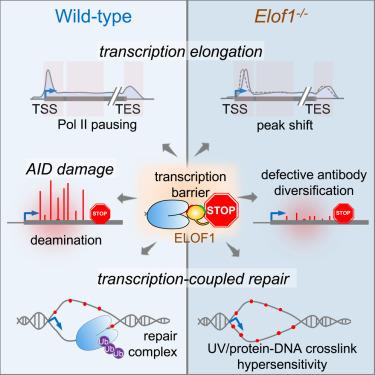
In adaptive immunity, transcription-coupled damage (TCD) is introduced into antibody genes by activation-induced cytidine deaminase (AID) to diversify antibody repertoire. However, the coordination between transcription and DNA damage/repair remains elusive. Here, we find that transcription elongation factor 1 (ELOF1) stabilizes paused RNA polymerase II (RNAPII) at transcription barriers, providing a platform for transcription-coupled DNA damage/repair. Using a genetic screen, we discover that ELOF1 is required for AID targeting and that ELOF1 deficiency results in defective antibody class switch recombination and somatic hypermutation in mice. While downstream transcription-coupled repair factors are dispensable for AID damage, ELOF1 mechanistically facilitates both TCD and repair by stabilizing chromatin-bound RNAPII. In ELOF1-deficient cells, paused RNAPII tends to detach from chromatin and fails to recruit factors to induce or repair DNA damage. Our study places ELOF1 at the center of transcription-coupled DNA metabolism processes and suggests a transition of RNAPII from elongation to a DNA damage/repair scaffold.
期刊介绍:
Molecular Cell is a companion to Cell, the leading journal of biology and the highest-impact journal in the world. Launched in December 1997 and published monthly. Molecular Cell is dedicated to publishing cutting-edge research in molecular biology, focusing on fundamental cellular processes. The journal encompasses a wide range of topics, including DNA replication, recombination, and repair; Chromatin biology and genome organization; Transcription; RNA processing and decay; Non-coding RNA function; Translation; Protein folding, modification, and quality control; Signal transduction pathways; Cell cycle and checkpoints; Cell death; Autophagy; Metabolism.




 京公网安备 11010802042870号
京ICP备2023020795号-1
京公网安备 11010802042870号
京ICP备2023020795号-1

 分享
分享
 求助内容:
求助内容: 应助结果提醒方式:
 扫码关注我们
