{"title":"砷/g-C6N6 Van Der Waals异质结的理论研究:高光催化效率的直接z方案","authors":"Zhengdong Sun, Jiaxin Ma, Junhao Zhu, Yifei Shen, Xiao Wang, Meng Zhang and Kaiyi Zhen","doi":"10.1039/D5CP00081E","DOIUrl":null,"url":null,"abstract":"<p >With advancements in algorithms and computational power, theoretical calculations have become increasingly feasible for designing and constructing functional materials. In this study, we utilized density functional theory (DFT) to investigate the new arsenene/g-C<small><sub>6</sub></small>N<small><sub>6</sub></small> van der Waals heterojunction, which forms a direct Z-scheme system with an indirect bandgap of 1.41 eV and a minimal lattice mismatch of just 1.4%. The heterojunction's band edge positions are favorable for overall water splitting across a wide strain range (−6% to +6%) and varying pH conditions. Photocatalytic analysis reveals that the oxygen evolution reaction (OER) proceeds spontaneously under light irradiation, while the hydrogen evolution reaction (HER) requires an energy barrier of 0.47 eV, which can be further reduced to 0.2 eV under −6% compressive strain. The heterojunction also demonstrates enhanced visible light absorption, with a redshift in the absorption spectrum under biaxial strain, significantly boosting solar energy utilization. Remarkably, the heterojunction achieves a solar-to-hydrogen (STH) conversion efficiency of 47.84%, outperforming many previously reported photocatalytic materials. With a strong interfacial binding energy of −27.54 meV Å<small><sup>−2</sup></small>, confirmed by molecular dynamics simulations, its exceptional structural stability positions it as a promising candidate for experimental realization. These findings underscore the potential of the arsenene/g-C<small><sub>6</sub></small>N<small><sub>6</sub></small> heterojunction as a high-performance platform for advanced photocatalytic applications.</p>","PeriodicalId":99,"journal":{"name":"Physical Chemistry Chemical Physics","volume":" 13","pages":" 6473-6485"},"PeriodicalIF":3.0000,"publicationDate":"2025-03-05","publicationTypes":"Journal Article","fieldsOfStudy":null,"isOpenAccess":false,"openAccessPdf":"","citationCount":"0","resultStr":"{\"title\":\"Theoretical investigation of an arsenene/g-C6N6 van der Waals heterojunction: a direct Z-scheme system with high photocatalytic efficiency†\",\"authors\":\"Zhengdong Sun, Jiaxin Ma, Junhao Zhu, Yifei Shen, Xiao Wang, Meng Zhang and Kaiyi Zhen\",\"doi\":\"10.1039/D5CP00081E\",\"DOIUrl\":null,\"url\":null,\"abstract\":\"<p >With advancements in algorithms and computational power, theoretical calculations have become increasingly feasible for designing and constructing functional materials. In this study, we utilized density functional theory (DFT) to investigate the new arsenene/g-C<small><sub>6</sub></small>N<small><sub>6</sub></small> van der Waals heterojunction, which forms a direct Z-scheme system with an indirect bandgap of 1.41 eV and a minimal lattice mismatch of just 1.4%. The heterojunction's band edge positions are favorable for overall water splitting across a wide strain range (−6% to +6%) and varying pH conditions. Photocatalytic analysis reveals that the oxygen evolution reaction (OER) proceeds spontaneously under light irradiation, while the hydrogen evolution reaction (HER) requires an energy barrier of 0.47 eV, which can be further reduced to 0.2 eV under −6% compressive strain. The heterojunction also demonstrates enhanced visible light absorption, with a redshift in the absorption spectrum under biaxial strain, significantly boosting solar energy utilization. Remarkably, the heterojunction achieves a solar-to-hydrogen (STH) conversion efficiency of 47.84%, outperforming many previously reported photocatalytic materials. With a strong interfacial binding energy of −27.54 meV Å<small><sup>−2</sup></small>, confirmed by molecular dynamics simulations, its exceptional structural stability positions it as a promising candidate for experimental realization. These findings underscore the potential of the arsenene/g-C<small><sub>6</sub></small>N<small><sub>6</sub></small> heterojunction as a high-performance platform for advanced photocatalytic applications.</p>\",\"PeriodicalId\":99,\"journal\":{\"name\":\"Physical Chemistry Chemical Physics\",\"volume\":\" 13\",\"pages\":\" 6473-6485\"},\"PeriodicalIF\":3.0000,\"publicationDate\":\"2025-03-05\",\"publicationTypes\":\"Journal Article\",\"fieldsOfStudy\":null,\"isOpenAccess\":false,\"openAccessPdf\":\"\",\"citationCount\":\"0\",\"resultStr\":null,\"platform\":\"Semanticscholar\",\"paperid\":null,\"PeriodicalName\":\"Physical Chemistry Chemical Physics\",\"FirstCategoryId\":\"92\",\"ListUrlMain\":\"https://pubs.rsc.org/en/content/articlelanding/2025/cp/d5cp00081e\",\"RegionNum\":3,\"RegionCategory\":\"化学\",\"ArticlePicture\":[],\"TitleCN\":null,\"AbstractTextCN\":null,\"PMCID\":null,\"EPubDate\":\"\",\"PubModel\":\"\",\"JCR\":\"Q3\",\"JCRName\":\"CHEMISTRY, PHYSICAL\",\"Score\":null,\"Total\":0}","platform":"Semanticscholar","paperid":null,"PeriodicalName":"Physical Chemistry Chemical Physics","FirstCategoryId":"92","ListUrlMain":"https://pubs.rsc.org/en/content/articlelanding/2025/cp/d5cp00081e","RegionNum":3,"RegionCategory":"化学","ArticlePicture":[],"TitleCN":null,"AbstractTextCN":null,"PMCID":null,"EPubDate":"","PubModel":"","JCR":"Q3","JCRName":"CHEMISTRY, PHYSICAL","Score":null,"Total":0}
引用次数: 0
摘要
随着算法和计算能力的进步,理论计算在设计和构建功能材料方面变得越来越可行。本研究利用密度泛函理论(DFT)研究了新型的arsenene/g-C₆N₆van der Waals异质结,该异质结形成了直接z型体系,间接带隙为1.41 eV,晶格失配最小仅为1.4%。异质结的能带边缘位置有利于在宽应变范围(-6%至+6%)和不同pH条件下的整体水分裂。光催化分析表明,析氧反应(OER)在光照射下自发进行,而析氢反应(HER)需要0.47 eV的能垒,在-6%的压缩应变下可以进一步降低到0.2 eV。异质结还表现出增强的可见光吸收,在双轴应变下吸收光谱出现红移,显著提高了太阳能利用率。值得注意的是,异质结实现了47.84%的太阳能到氢(STH)转换效率,优于许多先前报道的光催化材料。分子动力学模拟证实其界面结合能为-37.73 meV/Ų,具有良好的结构稳定性,是一种很有前景的实验实现方案。这些发现强调了arsenene/g-C₆N₆异质结作为先进光催化应用的高性能平台的潜力。
Theoretical investigation of an arsenene/g-C6N6 van der Waals heterojunction: a direct Z-scheme system with high photocatalytic efficiency†
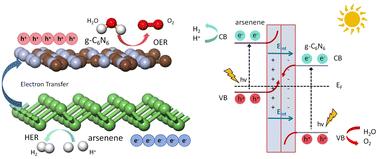
With advancements in algorithms and computational power, theoretical calculations have become increasingly feasible for designing and constructing functional materials. In this study, we utilized density functional theory (DFT) to investigate the new arsenene/g-C6N6 van der Waals heterojunction, which forms a direct Z-scheme system with an indirect bandgap of 1.41 eV and a minimal lattice mismatch of just 1.4%. The heterojunction's band edge positions are favorable for overall water splitting across a wide strain range (−6% to +6%) and varying pH conditions. Photocatalytic analysis reveals that the oxygen evolution reaction (OER) proceeds spontaneously under light irradiation, while the hydrogen evolution reaction (HER) requires an energy barrier of 0.47 eV, which can be further reduced to 0.2 eV under −6% compressive strain. The heterojunction also demonstrates enhanced visible light absorption, with a redshift in the absorption spectrum under biaxial strain, significantly boosting solar energy utilization. Remarkably, the heterojunction achieves a solar-to-hydrogen (STH) conversion efficiency of 47.84%, outperforming many previously reported photocatalytic materials. With a strong interfacial binding energy of −27.54 meV Å−2, confirmed by molecular dynamics simulations, its exceptional structural stability positions it as a promising candidate for experimental realization. These findings underscore the potential of the arsenene/g-C6N6 heterojunction as a high-performance platform for advanced photocatalytic applications.
期刊介绍:
Physical Chemistry Chemical Physics (PCCP) is an international journal co-owned by 19 physical chemistry and physics societies from around the world. This journal publishes original, cutting-edge research in physical chemistry, chemical physics and biophysical chemistry. To be suitable for publication in PCCP, articles must include significant innovation and/or insight into physical chemistry; this is the most important criterion that reviewers and Editors will judge against when evaluating submissions.
The journal has a broad scope and welcomes contributions spanning experiment, theory, computation and data science. Topical coverage includes spectroscopy, dynamics, kinetics, statistical mechanics, thermodynamics, electrochemistry, catalysis, surface science, quantum mechanics, quantum computing and machine learning. Interdisciplinary research areas such as polymers and soft matter, materials, nanoscience, energy, surfaces/interfaces, and biophysical chemistry are welcomed if they demonstrate significant innovation and/or insight into physical chemistry. Joined experimental/theoretical studies are particularly appreciated when complementary and based on up-to-date approaches.





 京公网安备 11010802042870号
京ICP备2023020795号-1
京公网安备 11010802042870号
京ICP备2023020795号-1

 分享
分享
 求助内容:
求助内容: 应助结果提醒方式:
 扫码关注我们
