{"title":"为什么质子穴状扩散在空气-水界面减慢而水扩散加速","authors":"Miguel de la Puente, Axel Gomez, Damien Laage","doi":"10.1021/acs.jpclett.5c00172","DOIUrl":null,"url":null,"abstract":"Excess proton diffusion at aqueous interfaces is crucial for applications including electrocatalysis, aerosol chemistry, and biological energy conversion. While interfaces have been proposed as pathways for channeling protons, proton diffusion at interfaces remains far less understood than in the bulk. Here we focus on the air–water interface and use density functional theory-based deep potential molecular dynamics simulations to reveal the contrasting interface’s impacts: excess proton diffusion slows down compared to the bulk, while water diffusion accelerates. This contrast stems from reduced hydrogen-bond coordination at the interface, which facilitates water diffusion and transient unstable proton rattling but impedes the stable proton hops central to Grotthuss diffusion. As a result, at the interface, excess protons and water molecules diffuse at comparable rates, in stark departure from bulk behavior. This mechanistic insight delineates distinct limiting regimes for bulk-enhanced interfacial proton diffusion, with important implications for interfacial chemistry.","PeriodicalId":62,"journal":{"name":"The Journal of Physical Chemistry Letters","volume":"11 1","pages":""},"PeriodicalIF":4.5000,"publicationDate":"2025-03-05","publicationTypes":"Journal Article","fieldsOfStudy":null,"isOpenAccess":false,"openAccessPdf":"","citationCount":"0","resultStr":"{\"title\":\"Why Proton Grotthuss Diffusion Slows down at the Air–Water Interface while Water Diffusion Accelerates\",\"authors\":\"Miguel de la Puente, Axel Gomez, Damien Laage\",\"doi\":\"10.1021/acs.jpclett.5c00172\",\"DOIUrl\":null,\"url\":null,\"abstract\":\"Excess proton diffusion at aqueous interfaces is crucial for applications including electrocatalysis, aerosol chemistry, and biological energy conversion. While interfaces have been proposed as pathways for channeling protons, proton diffusion at interfaces remains far less understood than in the bulk. Here we focus on the air–water interface and use density functional theory-based deep potential molecular dynamics simulations to reveal the contrasting interface’s impacts: excess proton diffusion slows down compared to the bulk, while water diffusion accelerates. This contrast stems from reduced hydrogen-bond coordination at the interface, which facilitates water diffusion and transient unstable proton rattling but impedes the stable proton hops central to Grotthuss diffusion. As a result, at the interface, excess protons and water molecules diffuse at comparable rates, in stark departure from bulk behavior. This mechanistic insight delineates distinct limiting regimes for bulk-enhanced interfacial proton diffusion, with important implications for interfacial chemistry.\",\"PeriodicalId\":62,\"journal\":{\"name\":\"The Journal of Physical Chemistry Letters\",\"volume\":\"11 1\",\"pages\":\"\"},\"PeriodicalIF\":4.5000,\"publicationDate\":\"2025-03-05\",\"publicationTypes\":\"Journal Article\",\"fieldsOfStudy\":null,\"isOpenAccess\":false,\"openAccessPdf\":\"\",\"citationCount\":\"0\",\"resultStr\":null,\"platform\":\"Semanticscholar\",\"paperid\":null,\"PeriodicalName\":\"The Journal of Physical Chemistry Letters\",\"FirstCategoryId\":\"1\",\"ListUrlMain\":\"https://doi.org/10.1021/acs.jpclett.5c00172\",\"RegionNum\":2,\"RegionCategory\":\"化学\",\"ArticlePicture\":[],\"TitleCN\":null,\"AbstractTextCN\":null,\"PMCID\":null,\"EPubDate\":\"\",\"PubModel\":\"\",\"JCR\":\"Q2\",\"JCRName\":\"CHEMISTRY, PHYSICAL\",\"Score\":null,\"Total\":0}","platform":"Semanticscholar","paperid":null,"PeriodicalName":"The Journal of Physical Chemistry Letters","FirstCategoryId":"1","ListUrlMain":"https://doi.org/10.1021/acs.jpclett.5c00172","RegionNum":2,"RegionCategory":"化学","ArticlePicture":[],"TitleCN":null,"AbstractTextCN":null,"PMCID":null,"EPubDate":"","PubModel":"","JCR":"Q2","JCRName":"CHEMISTRY, PHYSICAL","Score":null,"Total":0}
Why Proton Grotthuss Diffusion Slows down at the Air–Water Interface while Water Diffusion Accelerates
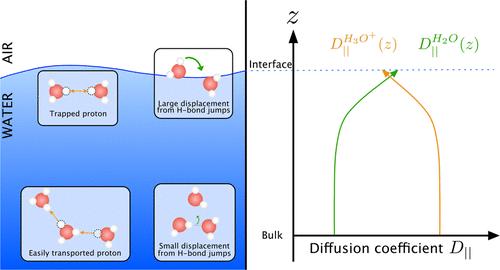
Excess proton diffusion at aqueous interfaces is crucial for applications including electrocatalysis, aerosol chemistry, and biological energy conversion. While interfaces have been proposed as pathways for channeling protons, proton diffusion at interfaces remains far less understood than in the bulk. Here we focus on the air–water interface and use density functional theory-based deep potential molecular dynamics simulations to reveal the contrasting interface’s impacts: excess proton diffusion slows down compared to the bulk, while water diffusion accelerates. This contrast stems from reduced hydrogen-bond coordination at the interface, which facilitates water diffusion and transient unstable proton rattling but impedes the stable proton hops central to Grotthuss diffusion. As a result, at the interface, excess protons and water molecules diffuse at comparable rates, in stark departure from bulk behavior. This mechanistic insight delineates distinct limiting regimes for bulk-enhanced interfacial proton diffusion, with important implications for interfacial chemistry.
期刊介绍:
The Journal of Physical Chemistry (JPC) Letters is devoted to reporting new and original experimental and theoretical basic research of interest to physical chemists, biophysical chemists, chemical physicists, physicists, material scientists, and engineers. An important criterion for acceptance is that the paper reports a significant scientific advance and/or physical insight such that rapid publication is essential. Two issues of JPC Letters are published each month.




 京公网安备 11010802042870号
京ICP备2023020795号-1
京公网安备 11010802042870号
京ICP备2023020795号-1

 分享
分享
 求助内容:
求助内容: 应助结果提醒方式:
 扫码关注我们
