Feng Jia , Yongqing Wang , Zhiqiang Chen , Jingxian Jin , Lei Zeng , Li Zhang , Huaijian Tang , Yanyan Wang , Pei Fan
{"title":"10-羟基乙酸-2-烯酸通过与toll样受体4相互作用减少血管平滑肌细胞炎症","authors":"Feng Jia , Yongqing Wang , Zhiqiang Chen , Jingxian Jin , Lei Zeng , Li Zhang , Huaijian Tang , Yanyan Wang , Pei Fan","doi":"10.1016/j.phymed.2025.156534","DOIUrl":null,"url":null,"abstract":"<div><h3>Background</h3><div>10-Hydroxydec-2-enoic acid (10-HDA), a unique and marker compound in royal jelly, has a wide range of bio-activities. However, its role in regulating inflammation of vascular smooth muscle cell (VSMC), which is essential to a set of vascular diseases, is still unknown.</div></div><div><h3>Purpose</h3><div>Our study aimed to investigate whether 10-HDA exerts effect on VSMC inflammation via interacting with toll-like receptor 4 (TLR4), a pivotal inflammatory initiator.</div></div><div><h3>Methods</h3><div>A package of proteins, which might participate in TLR4-mediated signaling, influenced by 10-HDA were analyzed in mouse VSMCs with Angiotensin Ⅱ(Ang Ⅱ) or lipopolysaccharide (LPS) stimulation. Accordingly, pro- or anti-inflammatory cytokines, reactive oxygen species (ROS), and anti-oxidants that are closely relevant to inflammatory process were determined. The possible mode for 10-HDA interacting with TLR4 was also characterized. Moreover, involvement of a key miRNA in 10-HDA regulating VSMC inflammation was identified.</div></div><div><h3>Results</h3><div>In the presence of Ang Ⅱ, 10-HDA inhibited the TLR4 expression in a dose-dependent manner. In such occasion, 10-HDA hindered the up-regulation of specificity protein 1 (SP1) and serine/threonine-protein phosphatase 6 catalytic subunit (PPP6C), the phosphorylation of extracellular signal-regulated kinase 1/2, TGF-β-activated kinase 1, and nuclear factor-κB p56, as well as the enhancement of myeloid differentiation primary response gene 88. Apart from SP1 and PPP6C, the level change of these proteins by 10-HDA was similar with LPS stimulation. The effect might be resulted from 10-HDA blocking TLR4 through multiple atomic interactions. 10-HDA mitigated the increase of pro-inflammatory cytokines tumor necrosis factor-alpha, interleukin-2 (IL-2), and IL-6, as well as increased the anti-inflammatory cytokine IL-10, in the Ang Ⅱ- or LPS-induced VSMCs. Correspondingly, the level of ROS was attenuated and the anti-oxidants such as glutathione and superoxide dismutase were fortified. The data indicated the anti-inflammatory potential of 10-HDA in VSMCs, which was associated with 10-HDA's capability of relieving oxidative stress. Additionally, the expression of miR-17–5p was saved by 10-HDA from Ang Ⅱ- or LPS-treated VSMCs, which might be relevant to SP1 and PPP6C targeting.</div></div><div><h3>Conclusion</h3><div>The present work of 10-HDA, for the first time, revealed its ability to alleviate VSMC inflammation by targeting TLR4 and therefore modulate the downstream inflammatory participants. Our data will cast light on the utilization of 10-HDA in VSMC inflammation-related vascular disorders.</div></div>","PeriodicalId":20212,"journal":{"name":"Phytomedicine","volume":"140 ","pages":"Article 156534"},"PeriodicalIF":8.3000,"publicationDate":"2025-05-01","publicationTypes":"Journal Article","fieldsOfStudy":null,"isOpenAccess":false,"openAccessPdf":"","citationCount":"0","resultStr":"{\"title\":\"10-Hydroxydec-2-enoic acid reduces vascular smooth muscle cell inflammation via interacting with Toll-like receptor 4\",\"authors\":\"Feng Jia , Yongqing Wang , Zhiqiang Chen , Jingxian Jin , Lei Zeng , Li Zhang , Huaijian Tang , Yanyan Wang , Pei Fan\",\"doi\":\"10.1016/j.phymed.2025.156534\",\"DOIUrl\":null,\"url\":null,\"abstract\":\"<div><h3>Background</h3><div>10-Hydroxydec-2-enoic acid (10-HDA), a unique and marker compound in royal jelly, has a wide range of bio-activities. However, its role in regulating inflammation of vascular smooth muscle cell (VSMC), which is essential to a set of vascular diseases, is still unknown.</div></div><div><h3>Purpose</h3><div>Our study aimed to investigate whether 10-HDA exerts effect on VSMC inflammation via interacting with toll-like receptor 4 (TLR4), a pivotal inflammatory initiator.</div></div><div><h3>Methods</h3><div>A package of proteins, which might participate in TLR4-mediated signaling, influenced by 10-HDA were analyzed in mouse VSMCs with Angiotensin Ⅱ(Ang Ⅱ) or lipopolysaccharide (LPS) stimulation. Accordingly, pro- or anti-inflammatory cytokines, reactive oxygen species (ROS), and anti-oxidants that are closely relevant to inflammatory process were determined. The possible mode for 10-HDA interacting with TLR4 was also characterized. Moreover, involvement of a key miRNA in 10-HDA regulating VSMC inflammation was identified.</div></div><div><h3>Results</h3><div>In the presence of Ang Ⅱ, 10-HDA inhibited the TLR4 expression in a dose-dependent manner. In such occasion, 10-HDA hindered the up-regulation of specificity protein 1 (SP1) and serine/threonine-protein phosphatase 6 catalytic subunit (PPP6C), the phosphorylation of extracellular signal-regulated kinase 1/2, TGF-β-activated kinase 1, and nuclear factor-κB p56, as well as the enhancement of myeloid differentiation primary response gene 88. Apart from SP1 and PPP6C, the level change of these proteins by 10-HDA was similar with LPS stimulation. The effect might be resulted from 10-HDA blocking TLR4 through multiple atomic interactions. 10-HDA mitigated the increase of pro-inflammatory cytokines tumor necrosis factor-alpha, interleukin-2 (IL-2), and IL-6, as well as increased the anti-inflammatory cytokine IL-10, in the Ang Ⅱ- or LPS-induced VSMCs. Correspondingly, the level of ROS was attenuated and the anti-oxidants such as glutathione and superoxide dismutase were fortified. The data indicated the anti-inflammatory potential of 10-HDA in VSMCs, which was associated with 10-HDA's capability of relieving oxidative stress. Additionally, the expression of miR-17–5p was saved by 10-HDA from Ang Ⅱ- or LPS-treated VSMCs, which might be relevant to SP1 and PPP6C targeting.</div></div><div><h3>Conclusion</h3><div>The present work of 10-HDA, for the first time, revealed its ability to alleviate VSMC inflammation by targeting TLR4 and therefore modulate the downstream inflammatory participants. Our data will cast light on the utilization of 10-HDA in VSMC inflammation-related vascular disorders.</div></div>\",\"PeriodicalId\":20212,\"journal\":{\"name\":\"Phytomedicine\",\"volume\":\"140 \",\"pages\":\"Article 156534\"},\"PeriodicalIF\":8.3000,\"publicationDate\":\"2025-05-01\",\"publicationTypes\":\"Journal Article\",\"fieldsOfStudy\":null,\"isOpenAccess\":false,\"openAccessPdf\":\"\",\"citationCount\":\"0\",\"resultStr\":null,\"platform\":\"Semanticscholar\",\"paperid\":null,\"PeriodicalName\":\"Phytomedicine\",\"FirstCategoryId\":\"3\",\"ListUrlMain\":\"https://www.sciencedirect.com/science/article/pii/S0944711325001758\",\"RegionNum\":1,\"RegionCategory\":\"医学\",\"ArticlePicture\":[],\"TitleCN\":null,\"AbstractTextCN\":null,\"PMCID\":null,\"EPubDate\":\"2025/3/6 0:00:00\",\"PubModel\":\"Epub\",\"JCR\":\"Q1\",\"JCRName\":\"CHEMISTRY, MEDICINAL\",\"Score\":null,\"Total\":0}","platform":"Semanticscholar","paperid":null,"PeriodicalName":"Phytomedicine","FirstCategoryId":"3","ListUrlMain":"https://www.sciencedirect.com/science/article/pii/S0944711325001758","RegionNum":1,"RegionCategory":"医学","ArticlePicture":[],"TitleCN":null,"AbstractTextCN":null,"PMCID":null,"EPubDate":"2025/3/6 0:00:00","PubModel":"Epub","JCR":"Q1","JCRName":"CHEMISTRY, MEDICINAL","Score":null,"Total":0}
10-Hydroxydec-2-enoic acid reduces vascular smooth muscle cell inflammation via interacting with Toll-like receptor 4
Background
10-Hydroxydec-2-enoic acid (10-HDA), a unique and marker compound in royal jelly, has a wide range of bio-activities. However, its role in regulating inflammation of vascular smooth muscle cell (VSMC), which is essential to a set of vascular diseases, is still unknown.
Purpose
Our study aimed to investigate whether 10-HDA exerts effect on VSMC inflammation via interacting with toll-like receptor 4 (TLR4), a pivotal inflammatory initiator.
Methods
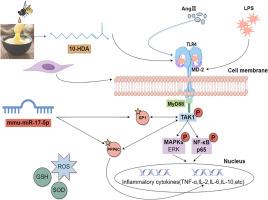
A package of proteins, which might participate in TLR4-mediated signaling, influenced by 10-HDA were analyzed in mouse VSMCs with Angiotensin Ⅱ(Ang Ⅱ) or lipopolysaccharide (LPS) stimulation. Accordingly, pro- or anti-inflammatory cytokines, reactive oxygen species (ROS), and anti-oxidants that are closely relevant to inflammatory process were determined. The possible mode for 10-HDA interacting with TLR4 was also characterized. Moreover, involvement of a key miRNA in 10-HDA regulating VSMC inflammation was identified.
Results
In the presence of Ang Ⅱ, 10-HDA inhibited the TLR4 expression in a dose-dependent manner. In such occasion, 10-HDA hindered the up-regulation of specificity protein 1 (SP1) and serine/threonine-protein phosphatase 6 catalytic subunit (PPP6C), the phosphorylation of extracellular signal-regulated kinase 1/2, TGF-β-activated kinase 1, and nuclear factor-κB p56, as well as the enhancement of myeloid differentiation primary response gene 88. Apart from SP1 and PPP6C, the level change of these proteins by 10-HDA was similar with LPS stimulation. The effect might be resulted from 10-HDA blocking TLR4 through multiple atomic interactions. 10-HDA mitigated the increase of pro-inflammatory cytokines tumor necrosis factor-alpha, interleukin-2 (IL-2), and IL-6, as well as increased the anti-inflammatory cytokine IL-10, in the Ang Ⅱ- or LPS-induced VSMCs. Correspondingly, the level of ROS was attenuated and the anti-oxidants such as glutathione and superoxide dismutase were fortified. The data indicated the anti-inflammatory potential of 10-HDA in VSMCs, which was associated with 10-HDA's capability of relieving oxidative stress. Additionally, the expression of miR-17–5p was saved by 10-HDA from Ang Ⅱ- or LPS-treated VSMCs, which might be relevant to SP1 and PPP6C targeting.
Conclusion
The present work of 10-HDA, for the first time, revealed its ability to alleviate VSMC inflammation by targeting TLR4 and therefore modulate the downstream inflammatory participants. Our data will cast light on the utilization of 10-HDA in VSMC inflammation-related vascular disorders.
期刊介绍:
Phytomedicine is a therapy-oriented journal that publishes innovative studies on the efficacy, safety, quality, and mechanisms of action of specified plant extracts, phytopharmaceuticals, and their isolated constituents. This includes clinical, pharmacological, pharmacokinetic, and toxicological studies of herbal medicinal products, preparations, and purified compounds with defined and consistent quality, ensuring reproducible pharmacological activity. Founded in 1994, Phytomedicine aims to focus and stimulate research in this field and establish internationally accepted scientific standards for pharmacological studies, proof of clinical efficacy, and safety of phytomedicines.





 京公网安备 11010802042870号
京ICP备2023020795号-1
京公网安备 11010802042870号
京ICP备2023020795号-1

 分享
分享
 求助内容:
求助内容: 应助结果提醒方式:
 扫码关注我们
