Marie Lallouet, Loic Olçomendy, Julien Gaitan, Killian Montiège, Marie Monchablon, Antoine Pirog, Dorian Chapeau, Emilie Puginier, Sylvie Renaud, Matthieu Raoux and Jochen Lang
{"title":"一种用于电生理在线监测的微流控双胰岛芯片装置。","authors":"Marie Lallouet, Loic Olçomendy, Julien Gaitan, Killian Montiège, Marie Monchablon, Antoine Pirog, Dorian Chapeau, Emilie Puginier, Sylvie Renaud, Matthieu Raoux and Jochen Lang","doi":"10.1039/D4LC00967C","DOIUrl":null,"url":null,"abstract":"<p >Pancreatic islets play a major role in glucose homeostasis as well as in diabetes, and islets-on-chip devices have been mainly developed using optical means for on-line monitoring. In contrast, no well-characterized electrophysiological platform for on-line analysis with unrivalled temporal resolution has been reported. Extracellular electrophysiology monitors two crucial parameters, islet β-cell activity and β-to-β-cell coupling, does not require chemical or genetic probes with inherent potential bias, is non-invasive and permits repetitive long-term monitoring. We have now developed and characterized a microfluidic islets-on-chip for combined electrophysiology (on-line) and hormone monitoring (off-line) with two chambers for concomitant monitoring. Fabrication of the device, based on commercial or easily manufacturable components, is within the reach of non-specialized laboratories. The chip permits convenient loading as well as long-term culture with comparable glucose kinetics and low shear stress in both chambers. An optimized flow rate did not alter islet β-cell electrical activity or coupling in response to glucose. Culturing for up to 8 days did not change islet survival as well as glucose-induced electrical or secretory kinetics of islet β-cells. The addition of a physiological amino acid mix, in the presence of elevated glucose, made a considerable change in the functional organisation of islet β-cell activity in terms of frequency and coupling, which explains the ensuing strong increase in insulin secretion. This device thus allows reliable long-term multiparametric on-line monitoring in two islet populations. The ease of fabrication, assembly and handling should permit widespread long-term on-line monitoring of islet activity in native micro-organs (<em>e.g.</em> controls/mutants), pseudo-islets or stem-cell-derived islet-like organoids.</p>","PeriodicalId":85,"journal":{"name":"Lab on a Chip","volume":" 7","pages":" 1831-1841"},"PeriodicalIF":6.3000,"publicationDate":"2025-02-25","publicationTypes":"Journal Article","fieldsOfStudy":null,"isOpenAccess":false,"openAccessPdf":"https://pubs.rsc.org/en/content/articlepdf/2025/lc/d4lc00967c?page=search","citationCount":"0","resultStr":"{\"title\":\"A microfluidic twin islets-on-chip device for on-line electrophysiological monitoring†\",\"authors\":\"Marie Lallouet, Loic Olçomendy, Julien Gaitan, Killian Montiège, Marie Monchablon, Antoine Pirog, Dorian Chapeau, Emilie Puginier, Sylvie Renaud, Matthieu Raoux and Jochen Lang\",\"doi\":\"10.1039/D4LC00967C\",\"DOIUrl\":null,\"url\":null,\"abstract\":\"<p >Pancreatic islets play a major role in glucose homeostasis as well as in diabetes, and islets-on-chip devices have been mainly developed using optical means for on-line monitoring. In contrast, no well-characterized electrophysiological platform for on-line analysis with unrivalled temporal resolution has been reported. Extracellular electrophysiology monitors two crucial parameters, islet β-cell activity and β-to-β-cell coupling, does not require chemical or genetic probes with inherent potential bias, is non-invasive and permits repetitive long-term monitoring. We have now developed and characterized a microfluidic islets-on-chip for combined electrophysiology (on-line) and hormone monitoring (off-line) with two chambers for concomitant monitoring. Fabrication of the device, based on commercial or easily manufacturable components, is within the reach of non-specialized laboratories. The chip permits convenient loading as well as long-term culture with comparable glucose kinetics and low shear stress in both chambers. An optimized flow rate did not alter islet β-cell electrical activity or coupling in response to glucose. Culturing for up to 8 days did not change islet survival as well as glucose-induced electrical or secretory kinetics of islet β-cells. The addition of a physiological amino acid mix, in the presence of elevated glucose, made a considerable change in the functional organisation of islet β-cell activity in terms of frequency and coupling, which explains the ensuing strong increase in insulin secretion. This device thus allows reliable long-term multiparametric on-line monitoring in two islet populations. The ease of fabrication, assembly and handling should permit widespread long-term on-line monitoring of islet activity in native micro-organs (<em>e.g.</em> controls/mutants), pseudo-islets or stem-cell-derived islet-like organoids.</p>\",\"PeriodicalId\":85,\"journal\":{\"name\":\"Lab on a Chip\",\"volume\":\" 7\",\"pages\":\" 1831-1841\"},\"PeriodicalIF\":6.3000,\"publicationDate\":\"2025-02-25\",\"publicationTypes\":\"Journal Article\",\"fieldsOfStudy\":null,\"isOpenAccess\":false,\"openAccessPdf\":\"https://pubs.rsc.org/en/content/articlepdf/2025/lc/d4lc00967c?page=search\",\"citationCount\":\"0\",\"resultStr\":null,\"platform\":\"Semanticscholar\",\"paperid\":null,\"PeriodicalName\":\"Lab on a Chip\",\"FirstCategoryId\":\"5\",\"ListUrlMain\":\"https://pubs.rsc.org/en/content/articlelanding/2025/lc/d4lc00967c\",\"RegionNum\":2,\"RegionCategory\":\"工程技术\",\"ArticlePicture\":[],\"TitleCN\":null,\"AbstractTextCN\":null,\"PMCID\":null,\"EPubDate\":\"\",\"PubModel\":\"\",\"JCR\":\"Q1\",\"JCRName\":\"BIOCHEMICAL RESEARCH METHODS\",\"Score\":null,\"Total\":0}","platform":"Semanticscholar","paperid":null,"PeriodicalName":"Lab on a Chip","FirstCategoryId":"5","ListUrlMain":"https://pubs.rsc.org/en/content/articlelanding/2025/lc/d4lc00967c","RegionNum":2,"RegionCategory":"工程技术","ArticlePicture":[],"TitleCN":null,"AbstractTextCN":null,"PMCID":null,"EPubDate":"","PubModel":"","JCR":"Q1","JCRName":"BIOCHEMICAL RESEARCH METHODS","Score":null,"Total":0}
A microfluidic twin islets-on-chip device for on-line electrophysiological monitoring†
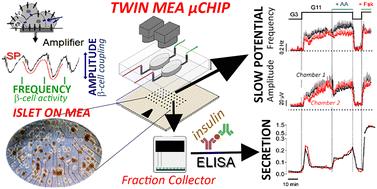
Pancreatic islets play a major role in glucose homeostasis as well as in diabetes, and islets-on-chip devices have been mainly developed using optical means for on-line monitoring. In contrast, no well-characterized electrophysiological platform for on-line analysis with unrivalled temporal resolution has been reported. Extracellular electrophysiology monitors two crucial parameters, islet β-cell activity and β-to-β-cell coupling, does not require chemical or genetic probes with inherent potential bias, is non-invasive and permits repetitive long-term monitoring. We have now developed and characterized a microfluidic islets-on-chip for combined electrophysiology (on-line) and hormone monitoring (off-line) with two chambers for concomitant monitoring. Fabrication of the device, based on commercial or easily manufacturable components, is within the reach of non-specialized laboratories. The chip permits convenient loading as well as long-term culture with comparable glucose kinetics and low shear stress in both chambers. An optimized flow rate did not alter islet β-cell electrical activity or coupling in response to glucose. Culturing for up to 8 days did not change islet survival as well as glucose-induced electrical or secretory kinetics of islet β-cells. The addition of a physiological amino acid mix, in the presence of elevated glucose, made a considerable change in the functional organisation of islet β-cell activity in terms of frequency and coupling, which explains the ensuing strong increase in insulin secretion. This device thus allows reliable long-term multiparametric on-line monitoring in two islet populations. The ease of fabrication, assembly and handling should permit widespread long-term on-line monitoring of islet activity in native micro-organs (e.g. controls/mutants), pseudo-islets or stem-cell-derived islet-like organoids.
期刊介绍:
Lab on a Chip is the premiere journal that publishes cutting-edge research in the field of miniaturization. By their very nature, microfluidic/nanofluidic/miniaturized systems are at the intersection of disciplines, spanning fundamental research to high-end application, which is reflected by the broad readership of the journal. Lab on a Chip publishes two types of papers on original research: full-length research papers and communications. Papers should demonstrate innovations, which can come from technical advancements or applications addressing pressing needs in globally important areas. The journal also publishes Comments, Reviews, and Perspectives.




 京公网安备 11010802042870号
京ICP备2023020795号-1
京公网安备 11010802042870号
京ICP备2023020795号-1

 分享
分享
 求助内容:
求助内容: 应助结果提醒方式:
 扫码关注我们
