{"title":"高效碳基钙钛矿太阳能电池的溶剂与组分工程协同效应。","authors":"Nannan Wang, Jiating Wang, Xinrui Gao, Yingjia Zhuansun, Decai Zhu, Qingbo Wei, Shengzhong (Frank) Liu","doi":"10.1002/smtd.202402039","DOIUrl":null,"url":null,"abstract":"<p>It is highly desired to get rid of the high-temperature annealing process in manufacturing perovskite solar cells (PSCs) to reduce production costs. Herein, perovskite films are designed by rapidly evaporating of a mixture solvent consisting of methylamine ethanol solution (MA-EtOH sol) and acetonitrile (ACN) (MA-EtOH-ACN) by dopping different amounts of formamidinium iodide (FAI) into the CH<sub>3</sub>NH<sub>2</sub>PbI<sub>3</sub> (MAPbI<sub>3</sub>) precursor solution; as a result, the high-temperature annealing step is effectively eliminated while the perovskite solar cell efficiency remains unchanged. The in situ UV–vis absorption for monitoring the perovskite crystallization process shows that FAI retards the crystallization rate, leading to a dense and smooth film. It is also found that the synergistic effect of solvent and composition engineering reduces defect density, boosts absorption strength, and enhances film stability. Consequently, high-performance ITO/SnO<sub>2</sub>/FA<sub>0.05</sub>MA<sub>0.95</sub>PbI<sub>3</sub>/carbon device is obtained with efficiency as high as 18.74%, with an excellent short circuit current of 25.04 mA cm<sup>−2</sup>, an open circuit voltage of 1.16 V, and a fill factor of 64.53%. The carbon-based perovskite solar cells also exhibit outstanding stability. This strategy offers a reference to producing efficient and stable perovskite cells by the straightforward ink method.</p>","PeriodicalId":229,"journal":{"name":"Small Methods","volume":"9 7","pages":""},"PeriodicalIF":9.1000,"publicationDate":"2025-03-04","publicationTypes":"Journal Article","fieldsOfStudy":null,"isOpenAccess":false,"openAccessPdf":"","citationCount":"0","resultStr":"{\"title\":\"Synergistic Effect of Solvent and Component Engineering for High-Efficiency Carbon-Based Perovskite Solar Cells\",\"authors\":\"Nannan Wang, Jiating Wang, Xinrui Gao, Yingjia Zhuansun, Decai Zhu, Qingbo Wei, Shengzhong (Frank) Liu\",\"doi\":\"10.1002/smtd.202402039\",\"DOIUrl\":null,\"url\":null,\"abstract\":\"<p>It is highly desired to get rid of the high-temperature annealing process in manufacturing perovskite solar cells (PSCs) to reduce production costs. Herein, perovskite films are designed by rapidly evaporating of a mixture solvent consisting of methylamine ethanol solution (MA-EtOH sol) and acetonitrile (ACN) (MA-EtOH-ACN) by dopping different amounts of formamidinium iodide (FAI) into the CH<sub>3</sub>NH<sub>2</sub>PbI<sub>3</sub> (MAPbI<sub>3</sub>) precursor solution; as a result, the high-temperature annealing step is effectively eliminated while the perovskite solar cell efficiency remains unchanged. The in situ UV–vis absorption for monitoring the perovskite crystallization process shows that FAI retards the crystallization rate, leading to a dense and smooth film. It is also found that the synergistic effect of solvent and composition engineering reduces defect density, boosts absorption strength, and enhances film stability. Consequently, high-performance ITO/SnO<sub>2</sub>/FA<sub>0.05</sub>MA<sub>0.95</sub>PbI<sub>3</sub>/carbon device is obtained with efficiency as high as 18.74%, with an excellent short circuit current of 25.04 mA cm<sup>−2</sup>, an open circuit voltage of 1.16 V, and a fill factor of 64.53%. The carbon-based perovskite solar cells also exhibit outstanding stability. This strategy offers a reference to producing efficient and stable perovskite cells by the straightforward ink method.</p>\",\"PeriodicalId\":229,\"journal\":{\"name\":\"Small Methods\",\"volume\":\"9 7\",\"pages\":\"\"},\"PeriodicalIF\":9.1000,\"publicationDate\":\"2025-03-04\",\"publicationTypes\":\"Journal Article\",\"fieldsOfStudy\":null,\"isOpenAccess\":false,\"openAccessPdf\":\"\",\"citationCount\":\"0\",\"resultStr\":null,\"platform\":\"Semanticscholar\",\"paperid\":null,\"PeriodicalName\":\"Small Methods\",\"FirstCategoryId\":\"88\",\"ListUrlMain\":\"https://onlinelibrary.wiley.com/doi/10.1002/smtd.202402039\",\"RegionNum\":2,\"RegionCategory\":\"材料科学\",\"ArticlePicture\":[],\"TitleCN\":null,\"AbstractTextCN\":null,\"PMCID\":null,\"EPubDate\":\"\",\"PubModel\":\"\",\"JCR\":\"Q1\",\"JCRName\":\"CHEMISTRY, PHYSICAL\",\"Score\":null,\"Total\":0}","platform":"Semanticscholar","paperid":null,"PeriodicalName":"Small Methods","FirstCategoryId":"88","ListUrlMain":"https://onlinelibrary.wiley.com/doi/10.1002/smtd.202402039","RegionNum":2,"RegionCategory":"材料科学","ArticlePicture":[],"TitleCN":null,"AbstractTextCN":null,"PMCID":null,"EPubDate":"","PubModel":"","JCR":"Q1","JCRName":"CHEMISTRY, PHYSICAL","Score":null,"Total":0}
引用次数: 0
摘要
在钙钛矿太阳能电池(PSCs)的制造过程中,人们迫切希望摆脱高温退火工艺,以降低生产成本。本文通过在CH3NH2PbI3 (MAPbI3)前驱体溶液中掺入不同量的碘化甲脒(FAI),使甲胺乙醇溶液(MA-EtOH sol)和乙腈(MA-EtOH-ACN)组成的混合溶剂快速蒸发,设计钙钛矿薄膜;因此,在保持钙钛矿太阳能电池效率不变的情况下,有效地消除了高温退火步骤。用于监测钙钛矿结晶过程的原位紫外-可见吸收表明,FAI延缓了钙钛矿的结晶速率,导致了致密光滑的薄膜。溶剂和组分工程的协同作用降低了缺陷密度,提高了吸收强度,增强了膜的稳定性。该器件效率高达18.74%,短路电流为25.04 mA cm-2,开路电压为1.16 V,填充系数为64.53%。碳基钙钛矿太阳能电池也表现出出色的稳定性。该策略为直接墨水法生产高效稳定的钙钛矿电池提供了参考。
Synergistic Effect of Solvent and Component Engineering for High-Efficiency Carbon-Based Perovskite Solar Cells
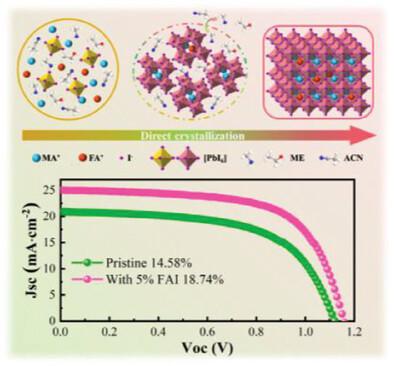
It is highly desired to get rid of the high-temperature annealing process in manufacturing perovskite solar cells (PSCs) to reduce production costs. Herein, perovskite films are designed by rapidly evaporating of a mixture solvent consisting of methylamine ethanol solution (MA-EtOH sol) and acetonitrile (ACN) (MA-EtOH-ACN) by dopping different amounts of formamidinium iodide (FAI) into the CH3NH2PbI3 (MAPbI3) precursor solution; as a result, the high-temperature annealing step is effectively eliminated while the perovskite solar cell efficiency remains unchanged. The in situ UV–vis absorption for monitoring the perovskite crystallization process shows that FAI retards the crystallization rate, leading to a dense and smooth film. It is also found that the synergistic effect of solvent and composition engineering reduces defect density, boosts absorption strength, and enhances film stability. Consequently, high-performance ITO/SnO2/FA0.05MA0.95PbI3/carbon device is obtained with efficiency as high as 18.74%, with an excellent short circuit current of 25.04 mA cm−2, an open circuit voltage of 1.16 V, and a fill factor of 64.53%. The carbon-based perovskite solar cells also exhibit outstanding stability. This strategy offers a reference to producing efficient and stable perovskite cells by the straightforward ink method.
Small MethodsMaterials Science-General Materials Science
CiteScore
17.40
自引率
1.60%
发文量
347
期刊介绍:
Small Methods is a multidisciplinary journal that publishes groundbreaking research on methods relevant to nano- and microscale research. It welcomes contributions from the fields of materials science, biomedical science, chemistry, and physics, showcasing the latest advancements in experimental techniques.
With a notable 2022 Impact Factor of 12.4 (Journal Citation Reports, Clarivate Analytics, 2023), Small Methods is recognized for its significant impact on the scientific community.
The online ISSN for Small Methods is 2366-9608.





 京公网安备 11010802042870号
京ICP备2023020795号-1
京公网安备 11010802042870号
京ICP备2023020795号-1

 分享
分享
 求助内容:
求助内容: 应助结果提醒方式:
 扫码关注我们
