{"title":"类型为2的可能扭结链的拓扑描述符的期望值。","authors":"Ruxian Chen, Asima Razzaque, Maham Khalil, Salma Kanwal, Saima Noor, Robina Nazir","doi":"10.3389/fchem.2024.1517892","DOIUrl":null,"url":null,"abstract":"<p><p>In this paper, we investigate square-hexagonal chains, a class of systems where the inner dual of a structure with a square-hexagon shape forms a path graph. The specific configuration of square and hexagonal polygons, and how they are concatenated, leads to different types of square-hexagonal chains. A square containing a vertex of degree 2 is classified as having a kink, and the resulting kink is referred to as a type <math> <mrow> <mmultiscripts><mrow><mo>⊤</mo></mrow> <none></none> <none></none> <mprescripts></mprescripts> <mrow><mn>2</mn></mrow> <none></none></mmultiscripts> </mrow> </math> kink. This kink is further subdivided into three types: <math> <mrow> <mmultiscripts><mrow><mo>⊤</mo></mrow> <mrow><mn>1</mn></mrow> <none></none> <mprescripts></mprescripts> <mrow><mn>2</mn></mrow> <none></none></mmultiscripts> </mrow> </math> , <sub>2</sub> <math><mrow><mo>⊤</mo> <mn>2</mn></mrow> </math> , and <sub>2</sub> <math><mrow><mo>⊤</mo> <mn>3</mn></mrow> </math> . We focus on the kink chain of type <sub>2</sub> <math><mrow><mo>⊤</mo> <mn>2</mn></mrow> </math> and compute various topological descriptors for this configuration. By deriving analytical expressions, we determine the maximizing and minimizing values of these descriptors. Additionally, we provide a comprehensive analysis of the expected values for these descriptors and offer a comparison of their behaviors through analytical, numerical, and graphical methods. These results offer insights into the structural properties and behavior of square-hexagonal chains, particularly in relation to the optimization of topological descriptors.</p>","PeriodicalId":12421,"journal":{"name":"Frontiers in Chemistry","volume":"12 ","pages":"1517892"},"PeriodicalIF":5.3000,"publicationDate":"2025-02-18","publicationTypes":"Journal Article","fieldsOfStudy":null,"isOpenAccess":false,"openAccessPdf":"https://www.ncbi.nlm.nih.gov/pmc/articles/PMC11876113/pdf/","citationCount":"0","resultStr":"{\"title\":\"<ArticleTitle xmlns:ns0=\\\"http://www.w3.org/1998/Math/MathML\\\">Expected values of topological descriptors for possible kink chains of type <sub>2</sub> <ns0:math> <ns0:mrow> <ns0:msub><ns0:mrow><ns0:mo>⊤</ns0:mo></ns0:mrow> <ns0:mrow><ns0:mn>2</ns0:mn></ns0:mrow> </ns0:msub> </ns0:mrow></ns0:math>.\",\"authors\":\"Ruxian Chen, Asima Razzaque, Maham Khalil, Salma Kanwal, Saima Noor, Robina Nazir\",\"doi\":\"10.3389/fchem.2024.1517892\",\"DOIUrl\":null,\"url\":null,\"abstract\":\"<p><p>In this paper, we investigate square-hexagonal chains, a class of systems where the inner dual of a structure with a square-hexagon shape forms a path graph. The specific configuration of square and hexagonal polygons, and how they are concatenated, leads to different types of square-hexagonal chains. A square containing a vertex of degree 2 is classified as having a kink, and the resulting kink is referred to as a type <math> <mrow> <mmultiscripts><mrow><mo>⊤</mo></mrow> <none></none> <none></none> <mprescripts></mprescripts> <mrow><mn>2</mn></mrow> <none></none></mmultiscripts> </mrow> </math> kink. This kink is further subdivided into three types: <math> <mrow> <mmultiscripts><mrow><mo>⊤</mo></mrow> <mrow><mn>1</mn></mrow> <none></none> <mprescripts></mprescripts> <mrow><mn>2</mn></mrow> <none></none></mmultiscripts> </mrow> </math> , <sub>2</sub> <math><mrow><mo>⊤</mo> <mn>2</mn></mrow> </math> , and <sub>2</sub> <math><mrow><mo>⊤</mo> <mn>3</mn></mrow> </math> . We focus on the kink chain of type <sub>2</sub> <math><mrow><mo>⊤</mo> <mn>2</mn></mrow> </math> and compute various topological descriptors for this configuration. By deriving analytical expressions, we determine the maximizing and minimizing values of these descriptors. Additionally, we provide a comprehensive analysis of the expected values for these descriptors and offer a comparison of their behaviors through analytical, numerical, and graphical methods. These results offer insights into the structural properties and behavior of square-hexagonal chains, particularly in relation to the optimization of topological descriptors.</p>\",\"PeriodicalId\":12421,\"journal\":{\"name\":\"Frontiers in Chemistry\",\"volume\":\"12 \",\"pages\":\"1517892\"},\"PeriodicalIF\":5.3000,\"publicationDate\":\"2025-02-18\",\"publicationTypes\":\"Journal Article\",\"fieldsOfStudy\":null,\"isOpenAccess\":false,\"openAccessPdf\":\"https://www.ncbi.nlm.nih.gov/pmc/articles/PMC11876113/pdf/\",\"citationCount\":\"0\",\"resultStr\":null,\"platform\":\"Semanticscholar\",\"paperid\":null,\"PeriodicalName\":\"Frontiers in Chemistry\",\"FirstCategoryId\":\"92\",\"ListUrlMain\":\"https://doi.org/10.3389/fchem.2024.1517892\",\"RegionNum\":3,\"RegionCategory\":\"化学\",\"ArticlePicture\":[],\"TitleCN\":null,\"AbstractTextCN\":null,\"PMCID\":null,\"EPubDate\":\"2024/1/1 0:00:00\",\"PubModel\":\"eCollection\",\"JCR\":\"Q2\",\"JCRName\":\"CHEMISTRY, MULTIDISCIPLINARY\",\"Score\":null,\"Total\":0}","platform":"Semanticscholar","paperid":null,"PeriodicalName":"Frontiers in Chemistry","FirstCategoryId":"92","ListUrlMain":"https://doi.org/10.3389/fchem.2024.1517892","RegionNum":3,"RegionCategory":"化学","ArticlePicture":[],"TitleCN":null,"AbstractTextCN":null,"PMCID":null,"EPubDate":"2024/1/1 0:00:00","PubModel":"eCollection","JCR":"Q2","JCRName":"CHEMISTRY, MULTIDISCIPLINARY","Score":null,"Total":0}
Expected values of topological descriptors for possible kink chains of type 2⊤2.
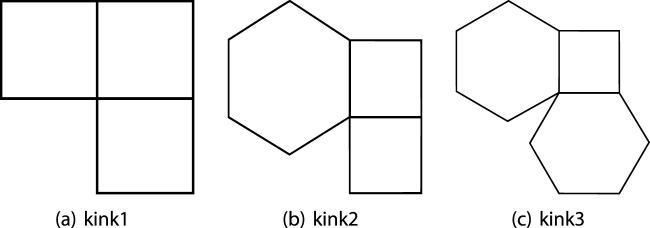
In this paper, we investigate square-hexagonal chains, a class of systems where the inner dual of a structure with a square-hexagon shape forms a path graph. The specific configuration of square and hexagonal polygons, and how they are concatenated, leads to different types of square-hexagonal chains. A square containing a vertex of degree 2 is classified as having a kink, and the resulting kink is referred to as a type kink. This kink is further subdivided into three types: , 2 , and 2 . We focus on the kink chain of type 2 and compute various topological descriptors for this configuration. By deriving analytical expressions, we determine the maximizing and minimizing values of these descriptors. Additionally, we provide a comprehensive analysis of the expected values for these descriptors and offer a comparison of their behaviors through analytical, numerical, and graphical methods. These results offer insights into the structural properties and behavior of square-hexagonal chains, particularly in relation to the optimization of topological descriptors.
期刊介绍:
Frontiers in Chemistry is a high visiblity and quality journal, publishing rigorously peer-reviewed research across the chemical sciences. Field Chief Editor Steve Suib at the University of Connecticut is supported by an outstanding Editorial Board of international researchers. This multidisciplinary open-access journal is at the forefront of disseminating and communicating scientific knowledge and impactful discoveries to academics, industry leaders and the public worldwide.
Chemistry is a branch of science that is linked to all other main fields of research. The omnipresence of Chemistry is apparent in our everyday lives from the electronic devices that we all use to communicate, to foods we eat, to our health and well-being, to the different forms of energy that we use. While there are many subtopics and specialties of Chemistry, the fundamental link in all these areas is how atoms, ions, and molecules come together and come apart in what some have come to call the “dance of life”.
All specialty sections of Frontiers in Chemistry are open-access with the goal of publishing outstanding research publications, review articles, commentaries, and ideas about various aspects of Chemistry. The past forms of publication often have specific subdisciplines, most commonly of analytical, inorganic, organic and physical chemistries, but these days those lines and boxes are quite blurry and the silos of those disciplines appear to be eroding. Chemistry is important to both fundamental and applied areas of research and manufacturing, and indeed the outlines of academic versus industrial research are also often artificial. Collaborative research across all specialty areas of Chemistry is highly encouraged and supported as we move forward. These are exciting times and the field of Chemistry is an important and significant contributor to our collective knowledge.






 京公网安备 11010802042870号
京ICP备2023020795号-1
京公网安备 11010802042870号
京ICP备2023020795号-1

 分享
分享
 求助内容:
求助内容: 应助结果提醒方式:
 扫码关注我们
