M Patera, A Zampogna, L Pietrosanti, F Asci, M Falletti, G Pinola, E Bianchini, G Di Lazzaro, V Rosati, P Grillo, F Giannini, F Fattapposta, G Costantini, A Pisani, G Saggio, Antonio Suppa
{"title":"帕金森病的异常手臂摆动运动:发病、进展和对左旋多巴的反应","authors":"M Patera, A Zampogna, L Pietrosanti, F Asci, M Falletti, G Pinola, E Bianchini, G Di Lazzaro, V Rosati, P Grillo, F Giannini, F Fattapposta, G Costantini, A Pisani, G Saggio, Antonio Suppa","doi":"10.1186/s12984-025-01589-w","DOIUrl":null,"url":null,"abstract":"<p><strong>Background: </strong>Reduced arm swing movements during gait are an early motor manifestation of Parkinson's disease (PD). The clinical evolution, response to L-Dopa and pathophysiological underpinning of abnormal arm swing movements in PD remain largely unclear. By using a network of wearable sensors, this study objectively assesses arm swing movements during gait in PD patients across different disease stages and therapeutic conditions.</p><p><strong>Methods: </strong>Twenty healthy subjects (HS) and 40 PD patients, including 20 early-stage and 20 mid-advanced subjects, underwent a 6-m Timed Up and Go test while monitored through a network of wearable inertial sensors. Arm swing movements were objectively evaluated in both hemibodies and different upper limb joints (shoulder and elbow), using specific time-domain (range of motion and velocity) and frequency-domain measures (harmonics and total harmonic distortion). To assess the effects of L-Dopa, patients under chronic dopaminergic therapy were randomly examined when OFF and ON therapy. Finally, clinical-behavioral correlations were investigated, primarily focusing on the relationship between arm swing movements and cardinal L-Dopa-responsive motor signs, including bradykinesia and rigidity.</p><p><strong>Results: </strong>Compared to HS, the whole group of PD patients showed reduced range of motion and velocity, alongside increased asymmetry of arm swing movements during gait. Additionally, a distinct increase in total harmonic distortion was found in patients. The kinematic changes were prominent in the early stage of the disease and progressively worsened owing to the involvement of the less affected hemibody. The time- and frequency-domain abnormalities were comparable in the two joints (i.e., shoulder and elbow). In the subgroup of patients under chronic dopaminergic treatment, L-Dopa restored patterns of arm swing movements. Finally, the kinematic alterations in arm swing movements during gait correlated with the clinical severity of bradykinesia and rigidity.</p><p><strong>Conclusions: </strong>Arm swing movements during gait in PD are characterized by narrow, slow, and irregular patterns. As the disease progresses, arm swing movements deteriorate also in the less affected hemibody, without any joint specificity. The positive response to L-Dopa along with the significant correlation between kinematics and bradykinesia/rigidity scores points to the involvement of dopaminergic pathways in the pathophysiology of abnormal arm swing movements in PD.</p>","PeriodicalId":16384,"journal":{"name":"Journal of NeuroEngineering and Rehabilitation","volume":"22 1","pages":"47"},"PeriodicalIF":6.0000,"publicationDate":"2025-03-04","publicationTypes":"Journal Article","fieldsOfStudy":null,"isOpenAccess":false,"openAccessPdf":"https://www.ncbi.nlm.nih.gov/pmc/articles/PMC11877831/pdf/","citationCount":"0","resultStr":"{\"title\":\"Abnormal arm swing movements in Parkinson's disease: onset, progression and response to L-Dopa.\",\"authors\":\"M Patera, A Zampogna, L Pietrosanti, F Asci, M Falletti, G Pinola, E Bianchini, G Di Lazzaro, V Rosati, P Grillo, F Giannini, F Fattapposta, G Costantini, A Pisani, G Saggio, Antonio Suppa\",\"doi\":\"10.1186/s12984-025-01589-w\",\"DOIUrl\":null,\"url\":null,\"abstract\":\"<p><strong>Background: </strong>Reduced arm swing movements during gait are an early motor manifestation of Parkinson's disease (PD). The clinical evolution, response to L-Dopa and pathophysiological underpinning of abnormal arm swing movements in PD remain largely unclear. By using a network of wearable sensors, this study objectively assesses arm swing movements during gait in PD patients across different disease stages and therapeutic conditions.</p><p><strong>Methods: </strong>Twenty healthy subjects (HS) and 40 PD patients, including 20 early-stage and 20 mid-advanced subjects, underwent a 6-m Timed Up and Go test while monitored through a network of wearable inertial sensors. Arm swing movements were objectively evaluated in both hemibodies and different upper limb joints (shoulder and elbow), using specific time-domain (range of motion and velocity) and frequency-domain measures (harmonics and total harmonic distortion). To assess the effects of L-Dopa, patients under chronic dopaminergic therapy were randomly examined when OFF and ON therapy. Finally, clinical-behavioral correlations were investigated, primarily focusing on the relationship between arm swing movements and cardinal L-Dopa-responsive motor signs, including bradykinesia and rigidity.</p><p><strong>Results: </strong>Compared to HS, the whole group of PD patients showed reduced range of motion and velocity, alongside increased asymmetry of arm swing movements during gait. Additionally, a distinct increase in total harmonic distortion was found in patients. The kinematic changes were prominent in the early stage of the disease and progressively worsened owing to the involvement of the less affected hemibody. The time- and frequency-domain abnormalities were comparable in the two joints (i.e., shoulder and elbow). In the subgroup of patients under chronic dopaminergic treatment, L-Dopa restored patterns of arm swing movements. Finally, the kinematic alterations in arm swing movements during gait correlated with the clinical severity of bradykinesia and rigidity.</p><p><strong>Conclusions: </strong>Arm swing movements during gait in PD are characterized by narrow, slow, and irregular patterns. As the disease progresses, arm swing movements deteriorate also in the less affected hemibody, without any joint specificity. The positive response to L-Dopa along with the significant correlation between kinematics and bradykinesia/rigidity scores points to the involvement of dopaminergic pathways in the pathophysiology of abnormal arm swing movements in PD.</p>\",\"PeriodicalId\":16384,\"journal\":{\"name\":\"Journal of NeuroEngineering and Rehabilitation\",\"volume\":\"22 1\",\"pages\":\"47\"},\"PeriodicalIF\":6.0000,\"publicationDate\":\"2025-03-04\",\"publicationTypes\":\"Journal Article\",\"fieldsOfStudy\":null,\"isOpenAccess\":false,\"openAccessPdf\":\"https://www.ncbi.nlm.nih.gov/pmc/articles/PMC11877831/pdf/\",\"citationCount\":\"0\",\"resultStr\":null,\"platform\":\"Semanticscholar\",\"paperid\":null,\"PeriodicalName\":\"Journal of NeuroEngineering and Rehabilitation\",\"FirstCategoryId\":\"5\",\"ListUrlMain\":\"https://doi.org/10.1186/s12984-025-01589-w\",\"RegionNum\":2,\"RegionCategory\":\"医学\",\"ArticlePicture\":[],\"TitleCN\":null,\"AbstractTextCN\":null,\"PMCID\":null,\"EPubDate\":\"\",\"PubModel\":\"\",\"JCR\":\"Q1\",\"JCRName\":\"ENGINEERING, BIOMEDICAL\",\"Score\":null,\"Total\":0}","platform":"Semanticscholar","paperid":null,"PeriodicalName":"Journal of NeuroEngineering and Rehabilitation","FirstCategoryId":"5","ListUrlMain":"https://doi.org/10.1186/s12984-025-01589-w","RegionNum":2,"RegionCategory":"医学","ArticlePicture":[],"TitleCN":null,"AbstractTextCN":null,"PMCID":null,"EPubDate":"","PubModel":"","JCR":"Q1","JCRName":"ENGINEERING, BIOMEDICAL","Score":null,"Total":0}
引用次数: 0
摘要
背景:步态时手臂摆动减少是帕金森病(PD)的早期运动表现。PD患者的临床演变、对左旋多巴的反应以及异常摆臂运动的病理生理基础仍不清楚。通过使用可穿戴传感器网络,本研究客观地评估了不同疾病阶段和治疗条件下PD患者步态中的手臂摆动运动。方法:20名健康受试者(HS)和40名PD患者(包括20名早期和20名中晚期患者)在可穿戴惯性传感器网络监测下进行6 m的Timed Up and Go测试。使用特定的时域(运动范围和速度)和频域测量(谐波和总谐波失真),客观地评估半体和不同上肢关节(肩部和肘部)的手臂摆动运动。为了评估左旋多巴的作用,对慢性多巴胺能治疗的患者在关闭和打开治疗时进行随机检查。最后,研究了临床-行为相关性,主要关注手臂摆动运动与左旋多巴反应性运动体征(包括运动迟缓和僵硬)之间的关系。结果:与HS相比,整个PD组患者的运动范围和速度都有所减少,同时步态中手臂摆动运动的不对称性增加。此外,在患者中发现总谐波失真明显增加。运动学变化在疾病的早期阶段是突出的,并且由于受影响较小的半身的参与而逐渐恶化。两个关节(即肩关节和肘关节)的时域和频域异常具有可比性。在慢性多巴胺能治疗的患者亚组中,左旋多巴恢复了手臂摆动运动的模式。最后,步态中手臂摆动运动的运动学改变与运动迟缓和僵硬的临床严重程度相关。结论:PD患者步态中的手臂摆动运动具有狭窄、缓慢和不规则的特点。随着疾病的进展,受影响较轻的身体的手臂摆动运动也会恶化,没有任何关节特异性。左旋多巴的阳性反应以及运动学和运动迟缓/僵硬评分之间的显著相关性表明多巴胺能通路参与PD异常手臂摆动运动的病理生理。
Abnormal arm swing movements in Parkinson's disease: onset, progression and response to L-Dopa.
Background: Reduced arm swing movements during gait are an early motor manifestation of Parkinson's disease (PD). The clinical evolution, response to L-Dopa and pathophysiological underpinning of abnormal arm swing movements in PD remain largely unclear. By using a network of wearable sensors, this study objectively assesses arm swing movements during gait in PD patients across different disease stages and therapeutic conditions.
Methods: Twenty healthy subjects (HS) and 40 PD patients, including 20 early-stage and 20 mid-advanced subjects, underwent a 6-m Timed Up and Go test while monitored through a network of wearable inertial sensors. Arm swing movements were objectively evaluated in both hemibodies and different upper limb joints (shoulder and elbow), using specific time-domain (range of motion and velocity) and frequency-domain measures (harmonics and total harmonic distortion). To assess the effects of L-Dopa, patients under chronic dopaminergic therapy were randomly examined when OFF and ON therapy. Finally, clinical-behavioral correlations were investigated, primarily focusing on the relationship between arm swing movements and cardinal L-Dopa-responsive motor signs, including bradykinesia and rigidity.
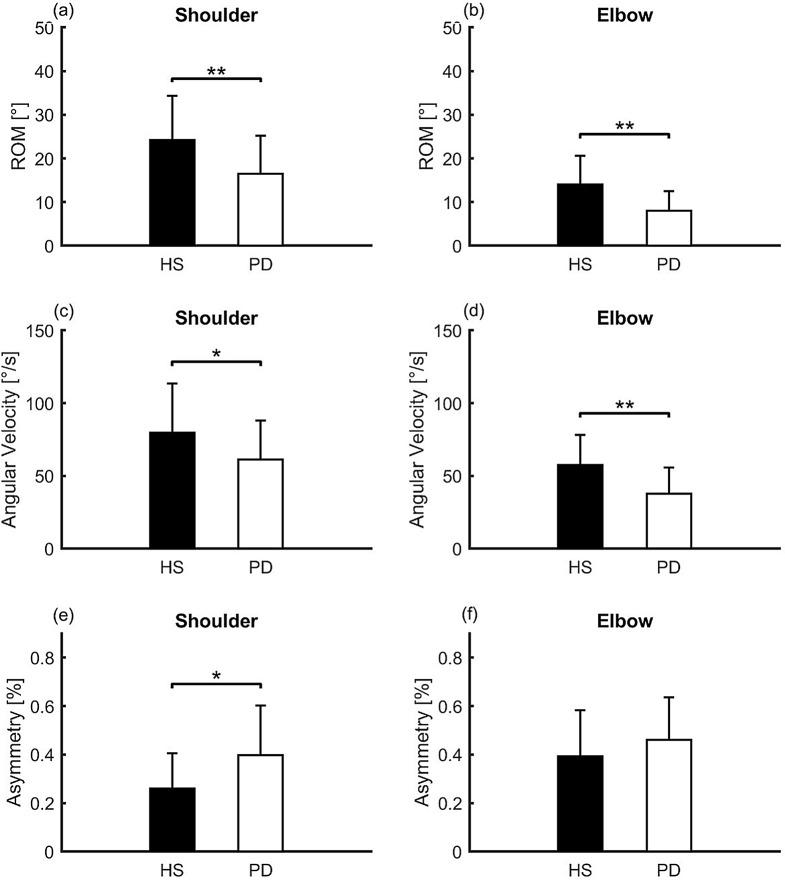
Results: Compared to HS, the whole group of PD patients showed reduced range of motion and velocity, alongside increased asymmetry of arm swing movements during gait. Additionally, a distinct increase in total harmonic distortion was found in patients. The kinematic changes were prominent in the early stage of the disease and progressively worsened owing to the involvement of the less affected hemibody. The time- and frequency-domain abnormalities were comparable in the two joints (i.e., shoulder and elbow). In the subgroup of patients under chronic dopaminergic treatment, L-Dopa restored patterns of arm swing movements. Finally, the kinematic alterations in arm swing movements during gait correlated with the clinical severity of bradykinesia and rigidity.
Conclusions: Arm swing movements during gait in PD are characterized by narrow, slow, and irregular patterns. As the disease progresses, arm swing movements deteriorate also in the less affected hemibody, without any joint specificity. The positive response to L-Dopa along with the significant correlation between kinematics and bradykinesia/rigidity scores points to the involvement of dopaminergic pathways in the pathophysiology of abnormal arm swing movements in PD.
期刊介绍:
Journal of NeuroEngineering and Rehabilitation considers manuscripts on all aspects of research that result from cross-fertilization of the fields of neuroscience, biomedical engineering, and physical medicine & rehabilitation.






 京公网安备 11010802042870号
京ICP备2023020795号-1
京公网安备 11010802042870号
京ICP备2023020795号-1

 分享
分享
 求助内容:
求助内容: 应助结果提醒方式:
 扫码关注我们
