Alexander J. Garvin, Alexander J. Lanz, George E. Ronson, Matthew J.W. Mackintosh, Katarzyna Starowicz, Alexandra K. Walker, Yara Aghabi, Hannah MacKay, Ruth M. Densham, Jai S. Bhachoo, Aneika C. Leney, Joanna R. Morris
{"title":"SUMO4促进DNA双链断裂修复所需的SUMO解偶联","authors":"Alexander J. Garvin, Alexander J. Lanz, George E. Ronson, Matthew J.W. Mackintosh, Katarzyna Starowicz, Alexandra K. Walker, Yara Aghabi, Hannah MacKay, Ruth M. Densham, Jai S. Bhachoo, Aneika C. Leney, Joanna R. Morris","doi":"10.1016/j.molcel.2025.02.004","DOIUrl":null,"url":null,"abstract":"The amplitudes of small-modifier protein signaling through ubiquitin and the small ubiquitin-like modifiers, SUMO1–3, are critical to the correct phasing of DNA repair protein accumulation, activity, and clearance and for the completion of mammalian DNA double-strand-break (DSB) repair. However, how SUMO-conjugate signaling in the response is delineated is poorly understood. At the same time, the role of the non-conjugated SUMO protein, SUMO4, has remained enigmatic. Here, we reveal that human SUMO4 is required to prevent excessive DNA-damage-induced SUMOylation and deleterious over-accumulation of RAP80. Mechanistically we show that SUMO4 acts independently of its conjugation and potentiates SENP1 catalytic activity. These data identify SUMO4 as a SUMO deconjugation component and show that SUMO4:SENP1 are critical regulators of DNA-damage-induced SUMO signaling.","PeriodicalId":18950,"journal":{"name":"Molecular Cell","volume":"11 1","pages":""},"PeriodicalIF":16.0000,"publicationDate":"2025-03-06","publicationTypes":"Journal Article","fieldsOfStudy":null,"isOpenAccess":false,"openAccessPdf":"","citationCount":"0","resultStr":"{\"title\":\"SUMO4 promotes SUMO deconjugation required for DNA double-strand-break repair\",\"authors\":\"Alexander J. Garvin, Alexander J. Lanz, George E. Ronson, Matthew J.W. Mackintosh, Katarzyna Starowicz, Alexandra K. Walker, Yara Aghabi, Hannah MacKay, Ruth M. Densham, Jai S. Bhachoo, Aneika C. Leney, Joanna R. Morris\",\"doi\":\"10.1016/j.molcel.2025.02.004\",\"DOIUrl\":null,\"url\":null,\"abstract\":\"The amplitudes of small-modifier protein signaling through ubiquitin and the small ubiquitin-like modifiers, SUMO1–3, are critical to the correct phasing of DNA repair protein accumulation, activity, and clearance and for the completion of mammalian DNA double-strand-break (DSB) repair. However, how SUMO-conjugate signaling in the response is delineated is poorly understood. At the same time, the role of the non-conjugated SUMO protein, SUMO4, has remained enigmatic. Here, we reveal that human SUMO4 is required to prevent excessive DNA-damage-induced SUMOylation and deleterious over-accumulation of RAP80. Mechanistically we show that SUMO4 acts independently of its conjugation and potentiates SENP1 catalytic activity. These data identify SUMO4 as a SUMO deconjugation component and show that SUMO4:SENP1 are critical regulators of DNA-damage-induced SUMO signaling.\",\"PeriodicalId\":18950,\"journal\":{\"name\":\"Molecular Cell\",\"volume\":\"11 1\",\"pages\":\"\"},\"PeriodicalIF\":16.0000,\"publicationDate\":\"2025-03-06\",\"publicationTypes\":\"Journal Article\",\"fieldsOfStudy\":null,\"isOpenAccess\":false,\"openAccessPdf\":\"\",\"citationCount\":\"0\",\"resultStr\":null,\"platform\":\"Semanticscholar\",\"paperid\":null,\"PeriodicalName\":\"Molecular Cell\",\"FirstCategoryId\":\"99\",\"ListUrlMain\":\"https://doi.org/10.1016/j.molcel.2025.02.004\",\"RegionNum\":1,\"RegionCategory\":\"生物学\",\"ArticlePicture\":[],\"TitleCN\":null,\"AbstractTextCN\":null,\"PMCID\":null,\"EPubDate\":\"\",\"PubModel\":\"\",\"JCR\":\"Q1\",\"JCRName\":\"BIOCHEMISTRY & MOLECULAR BIOLOGY\",\"Score\":null,\"Total\":0}","platform":"Semanticscholar","paperid":null,"PeriodicalName":"Molecular Cell","FirstCategoryId":"99","ListUrlMain":"https://doi.org/10.1016/j.molcel.2025.02.004","RegionNum":1,"RegionCategory":"生物学","ArticlePicture":[],"TitleCN":null,"AbstractTextCN":null,"PMCID":null,"EPubDate":"","PubModel":"","JCR":"Q1","JCRName":"BIOCHEMISTRY & MOLECULAR BIOLOGY","Score":null,"Total":0}
SUMO4 promotes SUMO deconjugation required for DNA double-strand-break repair
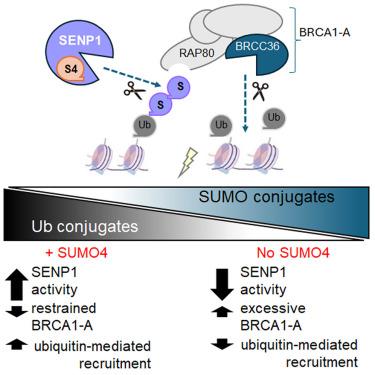
The amplitudes of small-modifier protein signaling through ubiquitin and the small ubiquitin-like modifiers, SUMO1–3, are critical to the correct phasing of DNA repair protein accumulation, activity, and clearance and for the completion of mammalian DNA double-strand-break (DSB) repair. However, how SUMO-conjugate signaling in the response is delineated is poorly understood. At the same time, the role of the non-conjugated SUMO protein, SUMO4, has remained enigmatic. Here, we reveal that human SUMO4 is required to prevent excessive DNA-damage-induced SUMOylation and deleterious over-accumulation of RAP80. Mechanistically we show that SUMO4 acts independently of its conjugation and potentiates SENP1 catalytic activity. These data identify SUMO4 as a SUMO deconjugation component and show that SUMO4:SENP1 are critical regulators of DNA-damage-induced SUMO signaling.
期刊介绍:
Molecular Cell is a companion to Cell, the leading journal of biology and the highest-impact journal in the world. Launched in December 1997 and published monthly. Molecular Cell is dedicated to publishing cutting-edge research in molecular biology, focusing on fundamental cellular processes. The journal encompasses a wide range of topics, including DNA replication, recombination, and repair; Chromatin biology and genome organization; Transcription; RNA processing and decay; Non-coding RNA function; Translation; Protein folding, modification, and quality control; Signal transduction pathways; Cell cycle and checkpoints; Cell death; Autophagy; Metabolism.




 京公网安备 11010802042870号
京ICP备2023020795号-1
京公网安备 11010802042870号
京ICP备2023020795号-1

 分享
分享
 求助内容:
求助内容: 应助结果提醒方式:
 扫码关注我们
