Chengyu Liu, Titus de Haas, Francesco Buda, Sylvestre Bonnet
{"title":"钴卟啉催化剂的吸电子效应促进了中性水溶液中均匀光催化析氢","authors":"Chengyu Liu, Titus de Haas, Francesco Buda, Sylvestre Bonnet","doi":"10.1021/acscatal.5c00788","DOIUrl":null,"url":null,"abstract":"Molecular catalysts offer an ideal platform for conducting mechanistic studies of the hydrogen evolution reaction (HER) due to their electronic tunability. This study explores a series of anionic M═Co(III)- and M═Zn(II)-porphyrin complexes with electron-donating ([M(OMeP)]<sup><i>n</i>−</sup>, [M(MeP)]<sup><i>n</i>−</sup>) and electron-withdrawing ([M(F8P)]<sup><i>n</i>−</sup>, [M(F16P)]<sup><i>n</i>−</sup>) substituents. The activity of these complexes for the HER was analyzed in homogeneous photocatalytic conditions using [Ru(bpy)<sub>3</sub>]<sup>2+</sup> as a photosensitizer under blue light (450 nm) irradiation. The substituent-induced electronic effects were found to tightly control the activity and mechanism of the photocatalytic HER. As expected, the electron-rich [Co(OMeP)]<sup>3–</sup> catalyst showed higher activity in acidic media (pH 4.1) with a maximum TOF of 7.2 ± 0.4 h<sup>–1</sup> and TON of 175 ± 5 after 39.5 h. DFT calculations were performed to investigate the HER mechanism. H<sub>2</sub> formation was found to initiate following proton-coupled reduction of a Co<sup>III</sup>–H hydride intermediate in such conditions. More surprisingly, however, the electron-poor [Co(F16P)]<sup>3–</sup> catalyst was more active at neutral pH (7.0), achieving a maximum TOF of 6.7 ± 0.3 h<sup>–1</sup> and TON of 70 ± 3 after 39.5 h. Instead of forming the Co<sup>III</sup>–H hydride, an additional ligand-based reduction led to a ligand-protonated intermediate. This work demonstrates that electron-poor HER catalysts can outperform electron-rich catalysts near neutral pH conditions.","PeriodicalId":9,"journal":{"name":"ACS Catalysis ","volume":"38 1","pages":""},"PeriodicalIF":13.1000,"publicationDate":"2025-03-05","publicationTypes":"Journal Article","fieldsOfStudy":null,"isOpenAccess":false,"openAccessPdf":"","citationCount":"0","resultStr":"{\"title\":\"Electron-Withdrawing Effects in Cobalt Porphyrin Catalysts Boost Homogeneous Photocatalytic Hydrogen Evolution in Neutral Aqueous Solutions\",\"authors\":\"Chengyu Liu, Titus de Haas, Francesco Buda, Sylvestre Bonnet\",\"doi\":\"10.1021/acscatal.5c00788\",\"DOIUrl\":null,\"url\":null,\"abstract\":\"Molecular catalysts offer an ideal platform for conducting mechanistic studies of the hydrogen evolution reaction (HER) due to their electronic tunability. This study explores a series of anionic M═Co(III)- and M═Zn(II)-porphyrin complexes with electron-donating ([M(OMeP)]<sup><i>n</i>−</sup>, [M(MeP)]<sup><i>n</i>−</sup>) and electron-withdrawing ([M(F8P)]<sup><i>n</i>−</sup>, [M(F16P)]<sup><i>n</i>−</sup>) substituents. The activity of these complexes for the HER was analyzed in homogeneous photocatalytic conditions using [Ru(bpy)<sub>3</sub>]<sup>2+</sup> as a photosensitizer under blue light (450 nm) irradiation. The substituent-induced electronic effects were found to tightly control the activity and mechanism of the photocatalytic HER. As expected, the electron-rich [Co(OMeP)]<sup>3–</sup> catalyst showed higher activity in acidic media (pH 4.1) with a maximum TOF of 7.2 ± 0.4 h<sup>–1</sup> and TON of 175 ± 5 after 39.5 h. DFT calculations were performed to investigate the HER mechanism. H<sub>2</sub> formation was found to initiate following proton-coupled reduction of a Co<sup>III</sup>–H hydride intermediate in such conditions. More surprisingly, however, the electron-poor [Co(F16P)]<sup>3–</sup> catalyst was more active at neutral pH (7.0), achieving a maximum TOF of 6.7 ± 0.3 h<sup>–1</sup> and TON of 70 ± 3 after 39.5 h. Instead of forming the Co<sup>III</sup>–H hydride, an additional ligand-based reduction led to a ligand-protonated intermediate. This work demonstrates that electron-poor HER catalysts can outperform electron-rich catalysts near neutral pH conditions.\",\"PeriodicalId\":9,\"journal\":{\"name\":\"ACS Catalysis \",\"volume\":\"38 1\",\"pages\":\"\"},\"PeriodicalIF\":13.1000,\"publicationDate\":\"2025-03-05\",\"publicationTypes\":\"Journal Article\",\"fieldsOfStudy\":null,\"isOpenAccess\":false,\"openAccessPdf\":\"\",\"citationCount\":\"0\",\"resultStr\":null,\"platform\":\"Semanticscholar\",\"paperid\":null,\"PeriodicalName\":\"ACS Catalysis \",\"FirstCategoryId\":\"92\",\"ListUrlMain\":\"https://doi.org/10.1021/acscatal.5c00788\",\"RegionNum\":1,\"RegionCategory\":\"化学\",\"ArticlePicture\":[],\"TitleCN\":null,\"AbstractTextCN\":null,\"PMCID\":null,\"EPubDate\":\"\",\"PubModel\":\"\",\"JCR\":\"Q1\",\"JCRName\":\"CHEMISTRY, PHYSICAL\",\"Score\":null,\"Total\":0}","platform":"Semanticscholar","paperid":null,"PeriodicalName":"ACS Catalysis ","FirstCategoryId":"92","ListUrlMain":"https://doi.org/10.1021/acscatal.5c00788","RegionNum":1,"RegionCategory":"化学","ArticlePicture":[],"TitleCN":null,"AbstractTextCN":null,"PMCID":null,"EPubDate":"","PubModel":"","JCR":"Q1","JCRName":"CHEMISTRY, PHYSICAL","Score":null,"Total":0}
引用次数: 0
摘要
分子催化剂由于其电子可调性为析氢反应机理研究提供了理想的平台。本研究探索了一系列具有供电子([M(OMeP)]n−,[M(MeP)]n−)和吸电子([M(F8P)]n−,[M(F16P)]n−)取代基的阴离子M = Co(III)-和M = Zn(II)-卟啉配合物。在蓝光(450 nm)照射下,以[Ru(bpy)3]2+为光敏剂,在均相光催化条件下分析了这些配合物对HER的活性。取代基诱导的电子效应严格控制了光催化HER的活性和机理。正如预期的那样,富电子[Co(OMeP)]3 -催化剂在酸性介质(pH 4.1)中表现出更高的活性,39.5 h后最大TOF为7.2±0.4 h - 1, TON为175±5。通过DFT计算来研究HER机理。发现在这种条件下,CoIII-H氢化物中间体的质子偶联还原会引发H2的形成。然而,更令人惊讶的是,电子差的[Co(F16P)]3 -催化剂在中性pH(7.0)下更活跃,39.5 h后TOF达到6.7±0.3 h - 1, TON达到70±3。而不是形成CoIII-H氢化物,额外的配体基还原导致配体质子化中间体。这项工作表明,在中性pH条件下,贫电子HER催化剂的性能优于富电子催化剂。
Electron-Withdrawing Effects in Cobalt Porphyrin Catalysts Boost Homogeneous Photocatalytic Hydrogen Evolution in Neutral Aqueous Solutions
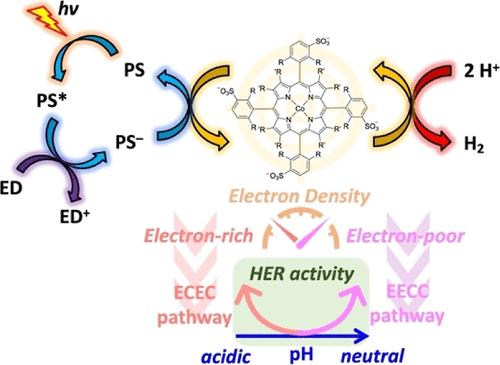
Molecular catalysts offer an ideal platform for conducting mechanistic studies of the hydrogen evolution reaction (HER) due to their electronic tunability. This study explores a series of anionic M═Co(III)- and M═Zn(II)-porphyrin complexes with electron-donating ([M(OMeP)]n−, [M(MeP)]n−) and electron-withdrawing ([M(F8P)]n−, [M(F16P)]n−) substituents. The activity of these complexes for the HER was analyzed in homogeneous photocatalytic conditions using [Ru(bpy)3]2+ as a photosensitizer under blue light (450 nm) irradiation. The substituent-induced electronic effects were found to tightly control the activity and mechanism of the photocatalytic HER. As expected, the electron-rich [Co(OMeP)]3– catalyst showed higher activity in acidic media (pH 4.1) with a maximum TOF of 7.2 ± 0.4 h–1 and TON of 175 ± 5 after 39.5 h. DFT calculations were performed to investigate the HER mechanism. H2 formation was found to initiate following proton-coupled reduction of a CoIII–H hydride intermediate in such conditions. More surprisingly, however, the electron-poor [Co(F16P)]3– catalyst was more active at neutral pH (7.0), achieving a maximum TOF of 6.7 ± 0.3 h–1 and TON of 70 ± 3 after 39.5 h. Instead of forming the CoIII–H hydride, an additional ligand-based reduction led to a ligand-protonated intermediate. This work demonstrates that electron-poor HER catalysts can outperform electron-rich catalysts near neutral pH conditions.
期刊介绍:
ACS Catalysis is an esteemed journal that publishes original research in the fields of heterogeneous catalysis, molecular catalysis, and biocatalysis. It offers broad coverage across diverse areas such as life sciences, organometallics and synthesis, photochemistry and electrochemistry, drug discovery and synthesis, materials science, environmental protection, polymer discovery and synthesis, and energy and fuels.
The scope of the journal is to showcase innovative work in various aspects of catalysis. This includes new reactions and novel synthetic approaches utilizing known catalysts, the discovery or modification of new catalysts, elucidation of catalytic mechanisms through cutting-edge investigations, practical enhancements of existing processes, as well as conceptual advances in the field. Contributions to ACS Catalysis can encompass both experimental and theoretical research focused on catalytic molecules, macromolecules, and materials that exhibit catalytic turnover.




 京公网安备 11010802042870号
京ICP备2023020795号-1
京公网安备 11010802042870号
京ICP备2023020795号-1

 分享
分享
 求助内容:
求助内容: 应助结果提醒方式:
 扫码关注我们
