Xiaorui Du, Chongshuai Gao, Jiaxin Huang, Yanbin Cui, Shijun Liu, Chenguang Wang
{"title":"Pt/TiO2催化剂上糠醛高效还原胺化制备伯胺:纳米簇邻近效应的表现","authors":"Xiaorui Du, Chongshuai Gao, Jiaxin Huang, Yanbin Cui, Shijun Liu, Chenguang Wang","doi":"10.1021/acscatal.4c07187","DOIUrl":null,"url":null,"abstract":"Controlling both the hydrogenation performance and the activation of Schiff base intermediate in catalysts is crucial for attaining high slectivity toward primary amine in the reduction amination of furfural. However, it remains pending for Pt-based catalysts, on which the reduction amination reactions rarely generate primary amines so far. In this work, we developed a Pt/TiO<sub>2</sub> nanocluster (NC) catalyst with a size distribution independent of the reduction temperature and loading amount. The reductive amination performance was investigated by regulating the surface electronic state and the distance between Pt NCs, and the results, attractively, revealed that the catalyst with a lower loading amount exhibited a higher furfurylamine (FAM) yield. Further studies unraveled that the catalyst with a larger Pt NC proximity had more abundant effective adsorption sites for the key intermediate Schiff base, i.e., the surface Ti<sup>4+</sup> sites adjacent to the Pt NC, promoting the transformation of the Schiff base. Meanwhile, reducing the surface density of Pt NCs helped control the intensity of hydrogen spillover, thereby inhibiting the occurrence of overhydrogenation reactions. Optimal activity for primary amine generation from furfural reductive amination was achieved with a Pt NC catalyst reduced at 500 °C and with a loading amount of only 0.1 wt %, resulting in a FAM yield exceeding 93% and a production rate of 297.9 g<sub>FAM</sub> g<sub>Pt</sub> h<sup>–1</sup>. The reaction mechanism, involving the competitive relationship between NH<sub>3</sub> and H<sub>2</sub>, was elucidated through kinetic studies and theoretical calculations. This work provides insights for the designation of catalysts with controllable hydrogenation activity and adsorption selectivity and contributes to the understanding of the mechanism of the reductive amination reaction.","PeriodicalId":9,"journal":{"name":"ACS Catalysis ","volume":"13 1","pages":""},"PeriodicalIF":13.6000,"publicationDate":"2025-03-05","publicationTypes":"Journal Article","fieldsOfStudy":null,"isOpenAccess":false,"openAccessPdf":"","citationCount":"0","resultStr":"{\"title\":\"Efficient Reductive Amination of Furfural to a Primary Amine on a Pt/TiO2 Catalyst: A Manifestation of the Nanocluster Proximity Effect\",\"authors\":\"Xiaorui Du, Chongshuai Gao, Jiaxin Huang, Yanbin Cui, Shijun Liu, Chenguang Wang\",\"doi\":\"10.1021/acscatal.4c07187\",\"DOIUrl\":null,\"url\":null,\"abstract\":\"Controlling both the hydrogenation performance and the activation of Schiff base intermediate in catalysts is crucial for attaining high slectivity toward primary amine in the reduction amination of furfural. However, it remains pending for Pt-based catalysts, on which the reduction amination reactions rarely generate primary amines so far. In this work, we developed a Pt/TiO<sub>2</sub> nanocluster (NC) catalyst with a size distribution independent of the reduction temperature and loading amount. The reductive amination performance was investigated by regulating the surface electronic state and the distance between Pt NCs, and the results, attractively, revealed that the catalyst with a lower loading amount exhibited a higher furfurylamine (FAM) yield. Further studies unraveled that the catalyst with a larger Pt NC proximity had more abundant effective adsorption sites for the key intermediate Schiff base, i.e., the surface Ti<sup>4+</sup> sites adjacent to the Pt NC, promoting the transformation of the Schiff base. Meanwhile, reducing the surface density of Pt NCs helped control the intensity of hydrogen spillover, thereby inhibiting the occurrence of overhydrogenation reactions. Optimal activity for primary amine generation from furfural reductive amination was achieved with a Pt NC catalyst reduced at 500 °C and with a loading amount of only 0.1 wt %, resulting in a FAM yield exceeding 93% and a production rate of 297.9 g<sub>FAM</sub> g<sub>Pt</sub> h<sup>–1</sup>. The reaction mechanism, involving the competitive relationship between NH<sub>3</sub> and H<sub>2</sub>, was elucidated through kinetic studies and theoretical calculations. This work provides insights for the designation of catalysts with controllable hydrogenation activity and adsorption selectivity and contributes to the understanding of the mechanism of the reductive amination reaction.\",\"PeriodicalId\":9,\"journal\":{\"name\":\"ACS Catalysis \",\"volume\":\"13 1\",\"pages\":\"\"},\"PeriodicalIF\":13.6000,\"publicationDate\":\"2025-03-05\",\"publicationTypes\":\"Journal Article\",\"fieldsOfStudy\":null,\"isOpenAccess\":false,\"openAccessPdf\":\"\",\"citationCount\":\"0\",\"resultStr\":null,\"platform\":\"Semanticscholar\",\"paperid\":null,\"PeriodicalName\":\"ACS Catalysis \",\"FirstCategoryId\":\"92\",\"ListUrlMain\":\"https://doi.org/10.1021/acscatal.4c07187\",\"RegionNum\":1,\"RegionCategory\":\"化学\",\"ArticlePicture\":[],\"TitleCN\":null,\"AbstractTextCN\":null,\"PMCID\":null,\"EPubDate\":\"\",\"PubModel\":\"\",\"JCR\":\"Q1\",\"JCRName\":\"CHEMISTRY, PHYSICAL\",\"Score\":null,\"Total\":0}","platform":"Semanticscholar","paperid":null,"PeriodicalName":"ACS Catalysis ","FirstCategoryId":"92","ListUrlMain":"https://doi.org/10.1021/acscatal.4c07187","RegionNum":1,"RegionCategory":"化学","ArticlePicture":[],"TitleCN":null,"AbstractTextCN":null,"PMCID":null,"EPubDate":"","PubModel":"","JCR":"Q1","JCRName":"CHEMISTRY, PHYSICAL","Score":null,"Total":0}
Efficient Reductive Amination of Furfural to a Primary Amine on a Pt/TiO2 Catalyst: A Manifestation of the Nanocluster Proximity Effect
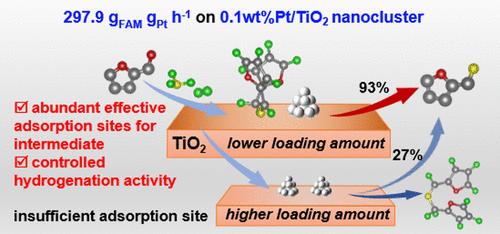
Controlling both the hydrogenation performance and the activation of Schiff base intermediate in catalysts is crucial for attaining high slectivity toward primary amine in the reduction amination of furfural. However, it remains pending for Pt-based catalysts, on which the reduction amination reactions rarely generate primary amines so far. In this work, we developed a Pt/TiO2 nanocluster (NC) catalyst with a size distribution independent of the reduction temperature and loading amount. The reductive amination performance was investigated by regulating the surface electronic state and the distance between Pt NCs, and the results, attractively, revealed that the catalyst with a lower loading amount exhibited a higher furfurylamine (FAM) yield. Further studies unraveled that the catalyst with a larger Pt NC proximity had more abundant effective adsorption sites for the key intermediate Schiff base, i.e., the surface Ti4+ sites adjacent to the Pt NC, promoting the transformation of the Schiff base. Meanwhile, reducing the surface density of Pt NCs helped control the intensity of hydrogen spillover, thereby inhibiting the occurrence of overhydrogenation reactions. Optimal activity for primary amine generation from furfural reductive amination was achieved with a Pt NC catalyst reduced at 500 °C and with a loading amount of only 0.1 wt %, resulting in a FAM yield exceeding 93% and a production rate of 297.9 gFAM gPt h–1. The reaction mechanism, involving the competitive relationship between NH3 and H2, was elucidated through kinetic studies and theoretical calculations. This work provides insights for the designation of catalysts with controllable hydrogenation activity and adsorption selectivity and contributes to the understanding of the mechanism of the reductive amination reaction.
期刊介绍:
ACS Catalysis is an esteemed journal that publishes original research in the fields of heterogeneous catalysis, molecular catalysis, and biocatalysis. It offers broad coverage across diverse areas such as life sciences, organometallics and synthesis, photochemistry and electrochemistry, drug discovery and synthesis, materials science, environmental protection, polymer discovery and synthesis, and energy and fuels.
The scope of the journal is to showcase innovative work in various aspects of catalysis. This includes new reactions and novel synthetic approaches utilizing known catalysts, the discovery or modification of new catalysts, elucidation of catalytic mechanisms through cutting-edge investigations, practical enhancements of existing processes, as well as conceptual advances in the field. Contributions to ACS Catalysis can encompass both experimental and theoretical research focused on catalytic molecules, macromolecules, and materials that exhibit catalytic turnover.




 京公网安备 11010802042870号
京ICP备2023020795号-1
京公网安备 11010802042870号
京ICP备2023020795号-1

 分享
分享
 求助内容:
求助内容: 应助结果提醒方式:
 扫码关注我们
