Andrey D. Trofimov, Andrey V. Emelyanov, Anna N. Matsukatova, Alexander A. Nesmelov, Sergey A. Zavyalov, Timofey D. Patsaev, Pavel A. Forsh, Gang Liu, Vladimir V. Rylkov and Vyacheslav A. Demin
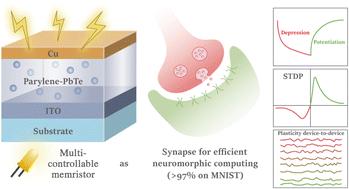
{"title":"神经形态计算用聚苯二烯- pbte纳米复合记忆电阻器的光敏电阻开关","authors":"Andrey D. Trofimov, Andrey V. Emelyanov, Anna N. Matsukatova, Alexander A. Nesmelov, Sergey A. Zavyalov, Timofey D. Patsaev, Pavel A. Forsh, Gang Liu, Vladimir V. Rylkov and Vyacheslav A. Demin","doi":"10.1039/D5NR00456J","DOIUrl":null,"url":null,"abstract":"<p >Resistive switching (RS) memory devices with incorporated capabilities of <em>in situ</em> data sensing, storing and processing are promising for artificial intelligence applications. In this respect, controlling resistance not only by electrical but also optical stimulations provides attractive opportunities for the development of novel neuromorphic sensing and computing systems. Here, we demonstrate the RS of Cu/parylene–PbTe/ITO memristive devices and the dependence of RS on optical excitation for efficient neuromorphic computing with high classification accuracy. The main memristive characteristics (multilevel resistive states, RS voltages, endurance, retention, RS time, RS energy, <em>etc</em>.) are evaluated with account of temporal and spatial variations. Additionally, the devices demonstrate a range of synaptic plasticity behaviors, such as spike-timing (amplitude, width)-dependent plasticity, long-term potentiation and depression. A qualitative model that describes photosensitive RS and takes into account the influence of photogenerated charge carriers on conductive filament growth is proposed based on the experimental results. This work presents an appealing approach towards the development of photosensitive memristive devices for upcoming neuromorphic sensing and computing systems.</p>","PeriodicalId":92,"journal":{"name":"Nanoscale","volume":" 14","pages":" 8484-8495"},"PeriodicalIF":5.1000,"publicationDate":"2025-03-06","publicationTypes":"Journal Article","fieldsOfStudy":null,"isOpenAccess":false,"openAccessPdf":"","citationCount":"0","resultStr":"{\"title\":\"Photosensitive resistive switching in parylene–PbTe nanocomposite memristors for neuromorphic computing†\",\"authors\":\"Andrey D. Trofimov, Andrey V. Emelyanov, Anna N. Matsukatova, Alexander A. Nesmelov, Sergey A. Zavyalov, Timofey D. Patsaev, Pavel A. Forsh, Gang Liu, Vladimir V. Rylkov and Vyacheslav A. Demin\",\"doi\":\"10.1039/D5NR00456J\",\"DOIUrl\":null,\"url\":null,\"abstract\":\"<p >Resistive switching (RS) memory devices with incorporated capabilities of <em>in situ</em> data sensing, storing and processing are promising for artificial intelligence applications. In this respect, controlling resistance not only by electrical but also optical stimulations provides attractive opportunities for the development of novel neuromorphic sensing and computing systems. Here, we demonstrate the RS of Cu/parylene–PbTe/ITO memristive devices and the dependence of RS on optical excitation for efficient neuromorphic computing with high classification accuracy. The main memristive characteristics (multilevel resistive states, RS voltages, endurance, retention, RS time, RS energy, <em>etc</em>.) are evaluated with account of temporal and spatial variations. Additionally, the devices demonstrate a range of synaptic plasticity behaviors, such as spike-timing (amplitude, width)-dependent plasticity, long-term potentiation and depression. A qualitative model that describes photosensitive RS and takes into account the influence of photogenerated charge carriers on conductive filament growth is proposed based on the experimental results. This work presents an appealing approach towards the development of photosensitive memristive devices for upcoming neuromorphic sensing and computing systems.</p>\",\"PeriodicalId\":92,\"journal\":{\"name\":\"Nanoscale\",\"volume\":\" 14\",\"pages\":\" 8484-8495\"},\"PeriodicalIF\":5.1000,\"publicationDate\":\"2025-03-06\",\"publicationTypes\":\"Journal Article\",\"fieldsOfStudy\":null,\"isOpenAccess\":false,\"openAccessPdf\":\"\",\"citationCount\":\"0\",\"resultStr\":null,\"platform\":\"Semanticscholar\",\"paperid\":null,\"PeriodicalName\":\"Nanoscale\",\"FirstCategoryId\":\"88\",\"ListUrlMain\":\"https://pubs.rsc.org/en/content/articlelanding/2025/nr/d5nr00456j\",\"RegionNum\":3,\"RegionCategory\":\"材料科学\",\"ArticlePicture\":[],\"TitleCN\":null,\"AbstractTextCN\":null,\"PMCID\":null,\"EPubDate\":\"\",\"PubModel\":\"\",\"JCR\":\"Q1\",\"JCRName\":\"CHEMISTRY, MULTIDISCIPLINARY\",\"Score\":null,\"Total\":0}","platform":"Semanticscholar","paperid":null,"PeriodicalName":"Nanoscale","FirstCategoryId":"88","ListUrlMain":"https://pubs.rsc.org/en/content/articlelanding/2025/nr/d5nr00456j","RegionNum":3,"RegionCategory":"材料科学","ArticlePicture":[],"TitleCN":null,"AbstractTextCN":null,"PMCID":null,"EPubDate":"","PubModel":"","JCR":"Q1","JCRName":"CHEMISTRY, MULTIDISCIPLINARY","Score":null,"Total":0}
Photosensitive resistive switching in parylene–PbTe nanocomposite memristors for neuromorphic computing†
Resistive switching (RS) memory devices with incorporated capabilities of in situ data sensing, storing and processing are promising for artificial intelligence applications. In this respect, controlling resistance not only by electrical but also optical stimulations provides attractive opportunities for the development of novel neuromorphic sensing and computing systems. Here, we demonstrate the RS of Cu/parylene–PbTe/ITO memristive devices and the dependence of RS on optical excitation for efficient neuromorphic computing with high classification accuracy. The main memristive characteristics (multilevel resistive states, RS voltages, endurance, retention, RS time, RS energy, etc.) are evaluated with account of temporal and spatial variations. Additionally, the devices demonstrate a range of synaptic plasticity behaviors, such as spike-timing (amplitude, width)-dependent plasticity, long-term potentiation and depression. A qualitative model that describes photosensitive RS and takes into account the influence of photogenerated charge carriers on conductive filament growth is proposed based on the experimental results. This work presents an appealing approach towards the development of photosensitive memristive devices for upcoming neuromorphic sensing and computing systems.
期刊介绍:
Nanoscale is a high-impact international journal, publishing high-quality research across nanoscience and nanotechnology. Nanoscale publishes a full mix of research articles on experimental and theoretical work, including reviews, communications, and full papers.Highly interdisciplinary, this journal appeals to scientists, researchers and professionals interested in nanoscience and nanotechnology, quantum materials and quantum technology, including the areas of physics, chemistry, biology, medicine, materials, energy/environment, information technology, detection science, healthcare and drug discovery, and electronics.




 京公网安备 11010802042870号
京ICP备2023020795号-1
京公网安备 11010802042870号
京ICP备2023020795号-1

 分享
分享
 求助内容:
求助内容: 应助结果提醒方式:
 扫码关注我们
