Suvi-Tuuli Varjamo, Christopher Edwards, Yaoqiang Zhou, Ruihuan Fang, Seyed Hossein Hosseini Shokouh, Zhipei Sun
{"title":"TMD异质结构的光学修饰","authors":"Suvi-Tuuli Varjamo, Christopher Edwards, Yaoqiang Zhou, Ruihuan Fang, Seyed Hossein Hosseini Shokouh, Zhipei Sun","doi":"10.1021/acs.nanolett.4c06512","DOIUrl":null,"url":null,"abstract":"Optical modification is a fast, cost-effective, and scalable approach to tailoring the physical properties of two-dimensional (2D) materials for various applications. However, most previous efforts have focused on modifying individual 2D materials, which fails to utilize the method to its fullest potential. In this paper, heterostructures composed of hBN-capped molybdenum ditelluride (MoTe<sub>2</sub>) and molybdenum disulfide (MoS<sub>2</sub>) are optically modified with a continuous wave laser. The process simultaneously thins MoS<sub>2</sub> and induces clustering of tellurium atoms from the ablated MoTe<sub>2</sub>. These structural changes result in significant enhancements of the physical properties, including a 43-fold increase in MoS<sub>2</sub> photoluminescence and the transformation of the heterojunction into an anti-ambipolar transistor. These findings highlight a previously unutilized pathway to tune the heterostructure properties for applications in novel electronics and optoelectronics.","PeriodicalId":53,"journal":{"name":"Nano Letters","volume":"53 1","pages":""},"PeriodicalIF":9.1000,"publicationDate":"2025-03-05","publicationTypes":"Journal Article","fieldsOfStudy":null,"isOpenAccess":false,"openAccessPdf":"","citationCount":"0","resultStr":"{\"title\":\"Optical Modification of TMD Heterostructures\",\"authors\":\"Suvi-Tuuli Varjamo, Christopher Edwards, Yaoqiang Zhou, Ruihuan Fang, Seyed Hossein Hosseini Shokouh, Zhipei Sun\",\"doi\":\"10.1021/acs.nanolett.4c06512\",\"DOIUrl\":null,\"url\":null,\"abstract\":\"Optical modification is a fast, cost-effective, and scalable approach to tailoring the physical properties of two-dimensional (2D) materials for various applications. However, most previous efforts have focused on modifying individual 2D materials, which fails to utilize the method to its fullest potential. In this paper, heterostructures composed of hBN-capped molybdenum ditelluride (MoTe<sub>2</sub>) and molybdenum disulfide (MoS<sub>2</sub>) are optically modified with a continuous wave laser. The process simultaneously thins MoS<sub>2</sub> and induces clustering of tellurium atoms from the ablated MoTe<sub>2</sub>. These structural changes result in significant enhancements of the physical properties, including a 43-fold increase in MoS<sub>2</sub> photoluminescence and the transformation of the heterojunction into an anti-ambipolar transistor. These findings highlight a previously unutilized pathway to tune the heterostructure properties for applications in novel electronics and optoelectronics.\",\"PeriodicalId\":53,\"journal\":{\"name\":\"Nano Letters\",\"volume\":\"53 1\",\"pages\":\"\"},\"PeriodicalIF\":9.1000,\"publicationDate\":\"2025-03-05\",\"publicationTypes\":\"Journal Article\",\"fieldsOfStudy\":null,\"isOpenAccess\":false,\"openAccessPdf\":\"\",\"citationCount\":\"0\",\"resultStr\":null,\"platform\":\"Semanticscholar\",\"paperid\":null,\"PeriodicalName\":\"Nano Letters\",\"FirstCategoryId\":\"88\",\"ListUrlMain\":\"https://doi.org/10.1021/acs.nanolett.4c06512\",\"RegionNum\":1,\"RegionCategory\":\"材料科学\",\"ArticlePicture\":[],\"TitleCN\":null,\"AbstractTextCN\":null,\"PMCID\":null,\"EPubDate\":\"\",\"PubModel\":\"\",\"JCR\":\"Q1\",\"JCRName\":\"CHEMISTRY, MULTIDISCIPLINARY\",\"Score\":null,\"Total\":0}","platform":"Semanticscholar","paperid":null,"PeriodicalName":"Nano Letters","FirstCategoryId":"88","ListUrlMain":"https://doi.org/10.1021/acs.nanolett.4c06512","RegionNum":1,"RegionCategory":"材料科学","ArticlePicture":[],"TitleCN":null,"AbstractTextCN":null,"PMCID":null,"EPubDate":"","PubModel":"","JCR":"Q1","JCRName":"CHEMISTRY, MULTIDISCIPLINARY","Score":null,"Total":0}
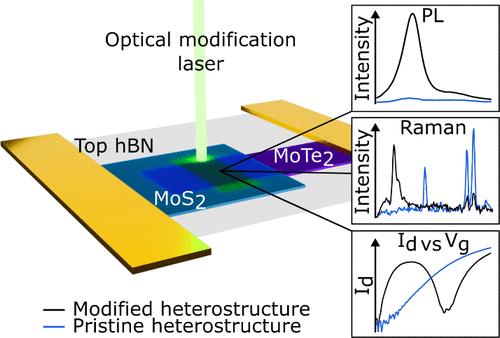
Optical modification is a fast, cost-effective, and scalable approach to tailoring the physical properties of two-dimensional (2D) materials for various applications. However, most previous efforts have focused on modifying individual 2D materials, which fails to utilize the method to its fullest potential. In this paper, heterostructures composed of hBN-capped molybdenum ditelluride (MoTe2) and molybdenum disulfide (MoS2) are optically modified with a continuous wave laser. The process simultaneously thins MoS2 and induces clustering of tellurium atoms from the ablated MoTe2. These structural changes result in significant enhancements of the physical properties, including a 43-fold increase in MoS2 photoluminescence and the transformation of the heterojunction into an anti-ambipolar transistor. These findings highlight a previously unutilized pathway to tune the heterostructure properties for applications in novel electronics and optoelectronics.
期刊介绍:
Nano Letters serves as a dynamic platform for promptly disseminating original results in fundamental, applied, and emerging research across all facets of nanoscience and nanotechnology. A pivotal criterion for inclusion within Nano Letters is the convergence of at least two different areas or disciplines, ensuring a rich interdisciplinary scope. The journal is dedicated to fostering exploration in diverse areas, including:
- Experimental and theoretical findings on physical, chemical, and biological phenomena at the nanoscale
- Synthesis, characterization, and processing of organic, inorganic, polymer, and hybrid nanomaterials through physical, chemical, and biological methodologies
- Modeling and simulation of synthetic, assembly, and interaction processes
- Realization of integrated nanostructures and nano-engineered devices exhibiting advanced performance
- Applications of nanoscale materials in living and environmental systems
Nano Letters is committed to advancing and showcasing groundbreaking research that intersects various domains, fostering innovation and collaboration in the ever-evolving field of nanoscience and nanotechnology.




 京公网安备 11010802042870号
京ICP备2023020795号-1
京公网安备 11010802042870号
京ICP备2023020795号-1

 分享
分享
 求助内容:
求助内容: 应助结果提醒方式:
 扫码关注我们
