{"title":"激发态的催化作用:使先天过渡金属光化学发挥作用","authors":"Fabio Juliá","doi":"10.1021/acscatal.4c07962","DOIUrl":null,"url":null,"abstract":"Transition metal catalysis is an indispensable tool for organic synthesis that has been harnessed, modulated, and perfected for many decades by careful selection of metal centers and ligands, giving rise to synthetic methods with unparalleled efficiency and chemoselectivity. Recent developments have demonstrated how light irradiation can also be recruited as a powerful tool to dramatically alter the outcome of catalytic reactions, providing access to innovative pathways with remarkable synthetic potential. In this context, the adoption of photochemical conditions as a mainstream strategy to drive organic reactions has unveiled exciting opportunities to exploit the rich excited-state framework of transition metals for catalytic applications. This Perspective examines advances in the application of transition metal complexes as standalone photocatalysts, exploiting the innate reactivity of their excited states beyond their common use as photoredox catalysts. An account of relevant examples is dissected to provide a discussion on the electronic reorganization, the orbitals involved, and the associated reactivity of different types of excited states. This analysis aims to provide practitioners with fundamental principles and guiding strategies to understand, design, and apply light-activation strategies to homogeneous transition metal catalysis for organic synthesis.","PeriodicalId":9,"journal":{"name":"ACS Catalysis ","volume":"58 1","pages":""},"PeriodicalIF":13.6000,"publicationDate":"2025-03-05","publicationTypes":"Journal Article","fieldsOfStudy":null,"isOpenAccess":false,"openAccessPdf":"","citationCount":"0","resultStr":"{\"title\":\"Catalysis in the Excited State: Bringing Innate Transition Metal Photochemistry into Play\",\"authors\":\"Fabio Juliá\",\"doi\":\"10.1021/acscatal.4c07962\",\"DOIUrl\":null,\"url\":null,\"abstract\":\"Transition metal catalysis is an indispensable tool for organic synthesis that has been harnessed, modulated, and perfected for many decades by careful selection of metal centers and ligands, giving rise to synthetic methods with unparalleled efficiency and chemoselectivity. Recent developments have demonstrated how light irradiation can also be recruited as a powerful tool to dramatically alter the outcome of catalytic reactions, providing access to innovative pathways with remarkable synthetic potential. In this context, the adoption of photochemical conditions as a mainstream strategy to drive organic reactions has unveiled exciting opportunities to exploit the rich excited-state framework of transition metals for catalytic applications. This Perspective examines advances in the application of transition metal complexes as standalone photocatalysts, exploiting the innate reactivity of their excited states beyond their common use as photoredox catalysts. An account of relevant examples is dissected to provide a discussion on the electronic reorganization, the orbitals involved, and the associated reactivity of different types of excited states. This analysis aims to provide practitioners with fundamental principles and guiding strategies to understand, design, and apply light-activation strategies to homogeneous transition metal catalysis for organic synthesis.\",\"PeriodicalId\":9,\"journal\":{\"name\":\"ACS Catalysis \",\"volume\":\"58 1\",\"pages\":\"\"},\"PeriodicalIF\":13.6000,\"publicationDate\":\"2025-03-05\",\"publicationTypes\":\"Journal Article\",\"fieldsOfStudy\":null,\"isOpenAccess\":false,\"openAccessPdf\":\"\",\"citationCount\":\"0\",\"resultStr\":null,\"platform\":\"Semanticscholar\",\"paperid\":null,\"PeriodicalName\":\"ACS Catalysis \",\"FirstCategoryId\":\"92\",\"ListUrlMain\":\"https://doi.org/10.1021/acscatal.4c07962\",\"RegionNum\":1,\"RegionCategory\":\"化学\",\"ArticlePicture\":[],\"TitleCN\":null,\"AbstractTextCN\":null,\"PMCID\":null,\"EPubDate\":\"\",\"PubModel\":\"\",\"JCR\":\"Q1\",\"JCRName\":\"CHEMISTRY, PHYSICAL\",\"Score\":null,\"Total\":0}","platform":"Semanticscholar","paperid":null,"PeriodicalName":"ACS Catalysis ","FirstCategoryId":"92","ListUrlMain":"https://doi.org/10.1021/acscatal.4c07962","RegionNum":1,"RegionCategory":"化学","ArticlePicture":[],"TitleCN":null,"AbstractTextCN":null,"PMCID":null,"EPubDate":"","PubModel":"","JCR":"Q1","JCRName":"CHEMISTRY, PHYSICAL","Score":null,"Total":0}
Catalysis in the Excited State: Bringing Innate Transition Metal Photochemistry into Play
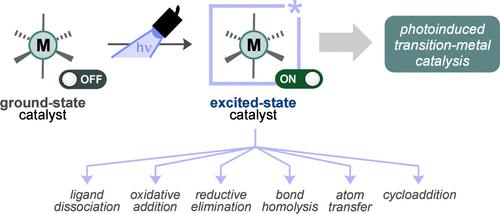
Transition metal catalysis is an indispensable tool for organic synthesis that has been harnessed, modulated, and perfected for many decades by careful selection of metal centers and ligands, giving rise to synthetic methods with unparalleled efficiency and chemoselectivity. Recent developments have demonstrated how light irradiation can also be recruited as a powerful tool to dramatically alter the outcome of catalytic reactions, providing access to innovative pathways with remarkable synthetic potential. In this context, the adoption of photochemical conditions as a mainstream strategy to drive organic reactions has unveiled exciting opportunities to exploit the rich excited-state framework of transition metals for catalytic applications. This Perspective examines advances in the application of transition metal complexes as standalone photocatalysts, exploiting the innate reactivity of their excited states beyond their common use as photoredox catalysts. An account of relevant examples is dissected to provide a discussion on the electronic reorganization, the orbitals involved, and the associated reactivity of different types of excited states. This analysis aims to provide practitioners with fundamental principles and guiding strategies to understand, design, and apply light-activation strategies to homogeneous transition metal catalysis for organic synthesis.
期刊介绍:
ACS Catalysis is an esteemed journal that publishes original research in the fields of heterogeneous catalysis, molecular catalysis, and biocatalysis. It offers broad coverage across diverse areas such as life sciences, organometallics and synthesis, photochemistry and electrochemistry, drug discovery and synthesis, materials science, environmental protection, polymer discovery and synthesis, and energy and fuels.
The scope of the journal is to showcase innovative work in various aspects of catalysis. This includes new reactions and novel synthetic approaches utilizing known catalysts, the discovery or modification of new catalysts, elucidation of catalytic mechanisms through cutting-edge investigations, practical enhancements of existing processes, as well as conceptual advances in the field. Contributions to ACS Catalysis can encompass both experimental and theoretical research focused on catalytic molecules, macromolecules, and materials that exhibit catalytic turnover.




 京公网安备 11010802042870号
京ICP备2023020795号-1
京公网安备 11010802042870号
京ICP备2023020795号-1

 分享
分享
 求助内容:
求助内容: 应助结果提醒方式:
 扫码关注我们
