Wenjun Gong, Yating Pang, Chenyu Wang, Wenming Wang and Hongfei Wang
{"title":"[Fe2(µ-SL)2(NO)4]复合物及其蛋白质加合物的光诱导NO释放:来自结构、细胞毒性和光动力学研究的见解","authors":"Wenjun Gong, Yating Pang, Chenyu Wang, Wenming Wang and Hongfei Wang","doi":"10.1039/D5QI00255A","DOIUrl":null,"url":null,"abstract":"<p >The dinitrosyl iron complex (DNIC) is a ubiquitous functional brick often used as a vehicle for the NO radical and chelatable iron pool, with a key role in chemical and biomedical applications. In this work, four DNICs modified with different thiolate bridging ligands (–SL) were synthesized. These complexes were characterized by <small><sup>1</sup></small>H-NMR, electrospray ionization mass spectrometry, and X-ray crystal diffraction. Photoinduced NO release from the complexes in solution was further explored by time-resolved infrared and electron paramagnetic resonance (EPR) spectroscopy. The cluster complexes showed relatively lower cytotoxicity against the normal human liver cell line HL-7702 and higher cytotoxicity against human cervical cancer cells, with a selectivity index of 2.4–4.8. The cluster complexes with different L groups had different rates of NO release and protein binding constants. Moreover, NO released upon photoirradiation entered living cells, which were successfully imaged using an NO-selective fluorescent probe. The ferritin complex adducts further enhanced the cytotoxicity and cellular fluorescence intensity of NO, and the crystal structure revealed the coordination of the Fe(SL)<small><sub>2</sub></small> unit with Cys102 of ferritin. This study provides insight into the photodynamic mechanism of nitrosyl iron–sulfur clusters to understand their physiological activity.</p>","PeriodicalId":79,"journal":{"name":"Inorganic Chemistry Frontiers","volume":" 9","pages":" 3490-3504"},"PeriodicalIF":6.4000,"publicationDate":"2025-03-06","publicationTypes":"Journal Article","fieldsOfStudy":null,"isOpenAccess":false,"openAccessPdf":"","citationCount":"0","resultStr":"{\"title\":\"Photoinduced NO release of [Fe2(μ-SL)2(NO)4] complexes and their protein adducts: insights from structure, cytotoxicity, and photodynamic studies†\",\"authors\":\"Wenjun Gong, Yating Pang, Chenyu Wang, Wenming Wang and Hongfei Wang\",\"doi\":\"10.1039/D5QI00255A\",\"DOIUrl\":null,\"url\":null,\"abstract\":\"<p >The dinitrosyl iron complex (DNIC) is a ubiquitous functional brick often used as a vehicle for the NO radical and chelatable iron pool, with a key role in chemical and biomedical applications. In this work, four DNICs modified with different thiolate bridging ligands (–SL) were synthesized. These complexes were characterized by <small><sup>1</sup></small>H-NMR, electrospray ionization mass spectrometry, and X-ray crystal diffraction. Photoinduced NO release from the complexes in solution was further explored by time-resolved infrared and electron paramagnetic resonance (EPR) spectroscopy. The cluster complexes showed relatively lower cytotoxicity against the normal human liver cell line HL-7702 and higher cytotoxicity against human cervical cancer cells, with a selectivity index of 2.4–4.8. The cluster complexes with different L groups had different rates of NO release and protein binding constants. Moreover, NO released upon photoirradiation entered living cells, which were successfully imaged using an NO-selective fluorescent probe. The ferritin complex adducts further enhanced the cytotoxicity and cellular fluorescence intensity of NO, and the crystal structure revealed the coordination of the Fe(SL)<small><sub>2</sub></small> unit with Cys102 of ferritin. This study provides insight into the photodynamic mechanism of nitrosyl iron–sulfur clusters to understand their physiological activity.</p>\",\"PeriodicalId\":79,\"journal\":{\"name\":\"Inorganic Chemistry Frontiers\",\"volume\":\" 9\",\"pages\":\" 3490-3504\"},\"PeriodicalIF\":6.4000,\"publicationDate\":\"2025-03-06\",\"publicationTypes\":\"Journal Article\",\"fieldsOfStudy\":null,\"isOpenAccess\":false,\"openAccessPdf\":\"\",\"citationCount\":\"0\",\"resultStr\":null,\"platform\":\"Semanticscholar\",\"paperid\":null,\"PeriodicalName\":\"Inorganic Chemistry Frontiers\",\"FirstCategoryId\":\"92\",\"ListUrlMain\":\"https://pubs.rsc.org/en/content/articlelanding/2025/qi/d5qi00255a\",\"RegionNum\":1,\"RegionCategory\":\"化学\",\"ArticlePicture\":[],\"TitleCN\":null,\"AbstractTextCN\":null,\"PMCID\":null,\"EPubDate\":\"\",\"PubModel\":\"\",\"JCR\":\"Q1\",\"JCRName\":\"CHEMISTRY, INORGANIC & NUCLEAR\",\"Score\":null,\"Total\":0}","platform":"Semanticscholar","paperid":null,"PeriodicalName":"Inorganic Chemistry Frontiers","FirstCategoryId":"92","ListUrlMain":"https://pubs.rsc.org/en/content/articlelanding/2025/qi/d5qi00255a","RegionNum":1,"RegionCategory":"化学","ArticlePicture":[],"TitleCN":null,"AbstractTextCN":null,"PMCID":null,"EPubDate":"","PubModel":"","JCR":"Q1","JCRName":"CHEMISTRY, INORGANIC & NUCLEAR","Score":null,"Total":0}
Photoinduced NO release of [Fe2(μ-SL)2(NO)4] complexes and their protein adducts: insights from structure, cytotoxicity, and photodynamic studies†
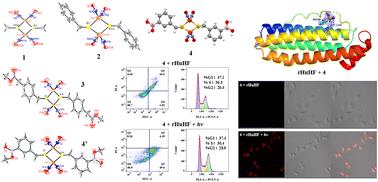
The dinitrosyl iron complex (DNIC) is a ubiquitous functional brick often used as a vehicle for the NO radical and chelatable iron pool, with a key role in chemical and biomedical applications. In this work, four DNICs modified with different thiolate bridging ligands (–SL) were synthesized. These complexes were characterized by 1H-NMR, electrospray ionization mass spectrometry, and X-ray crystal diffraction. Photoinduced NO release from the complexes in solution was further explored by time-resolved infrared and electron paramagnetic resonance (EPR) spectroscopy. The cluster complexes showed relatively lower cytotoxicity against the normal human liver cell line HL-7702 and higher cytotoxicity against human cervical cancer cells, with a selectivity index of 2.4–4.8. The cluster complexes with different L groups had different rates of NO release and protein binding constants. Moreover, NO released upon photoirradiation entered living cells, which were successfully imaged using an NO-selective fluorescent probe. The ferritin complex adducts further enhanced the cytotoxicity and cellular fluorescence intensity of NO, and the crystal structure revealed the coordination of the Fe(SL)2 unit with Cys102 of ferritin. This study provides insight into the photodynamic mechanism of nitrosyl iron–sulfur clusters to understand their physiological activity.




 京公网安备 11010802042870号
京ICP备2023020795号-1
京公网安备 11010802042870号
京ICP备2023020795号-1

 分享
分享
 求助内容:
求助内容: 应助结果提醒方式:
 扫码关注我们
